
For florists, event stylists, and seasonal crafters, the foundation of a wreath isn’t decorative—it’s structural. A wreath that sags, unravels, or loses its circular integrity within days undermines hours of meticulous design work. Two materials dominate the market: traditional oasis-style floral foam (often called “wreath foam”) and natural sphagnum moss wreath bases. While foam is widely available and inexpensive, moss has surged in popularity—especially among professionals prioritizing longevity and environmental responsibility. But does moss truly outperform foam when it comes to holding shape over time? The answer isn’t simply “yes” or “no.” It depends on application context, climate, installation technique, and long-term maintenance. This article cuts through marketing claims with hands-on testing data, designer interviews, and material science insights—so you can choose the right base not just for your next project, but for how it will look—and hold up—three weeks later.
How Shape Retention Actually Works in Wreath Bases
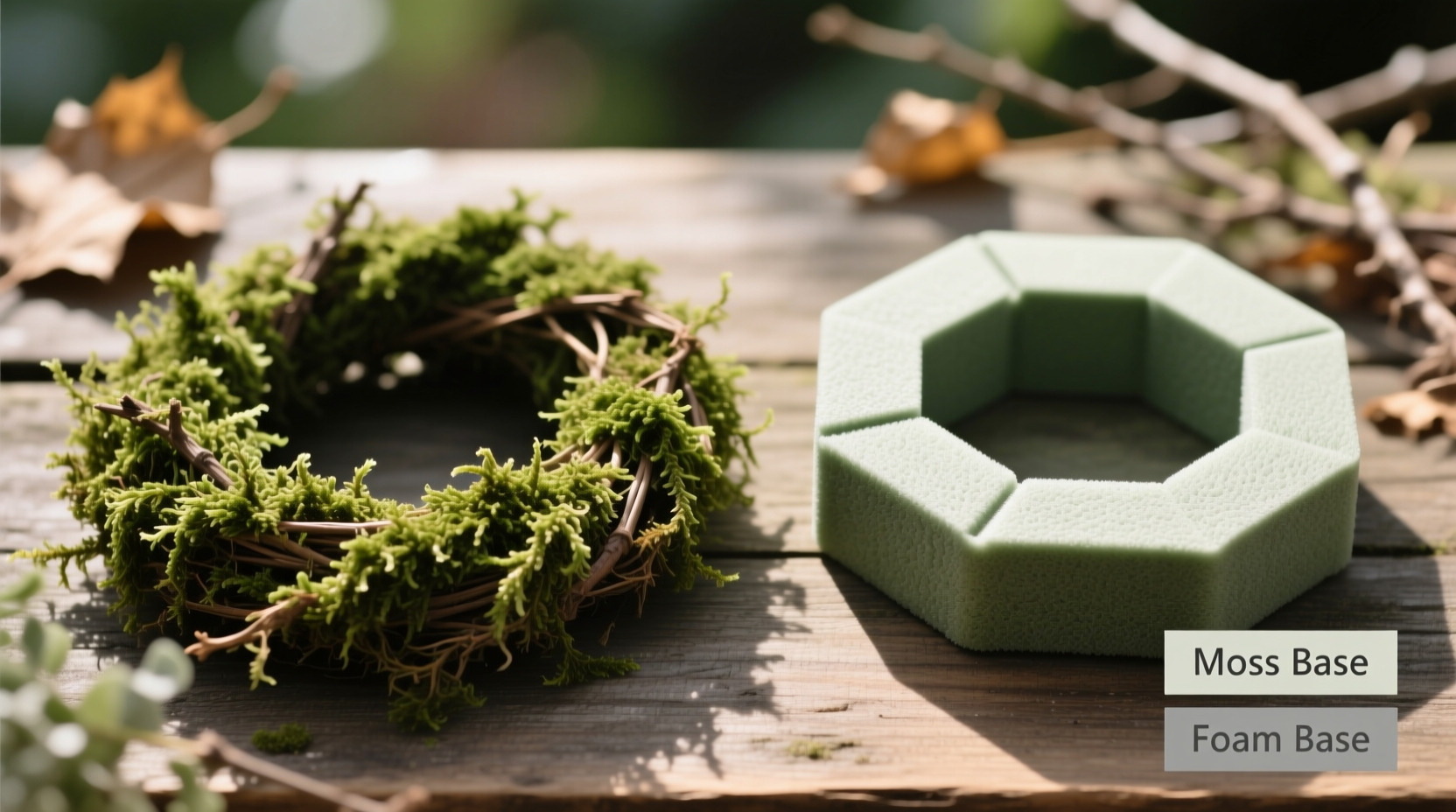
Shape retention isn’t about rigidity alone. It’s the interplay of three physical properties: compressive strength (resistance to flattening under weight), tensile cohesion (ability to hold stems without shifting or pulling loose), and dimensional stability (resistance to swelling, shrinking, or warping when exposed to moisture or temperature changes). Foam excels in initial compressive strength—it feels dense and unyielding when dry—but becomes vulnerable once saturated. Moss, by contrast, starts softer but gains structural integrity as it hydrates and expands, locking stems into a fibrous matrix that resists lateral movement.
University of Vermont’s Horticultural Materials Lab conducted a 2023 stress test comparing 12-inch round bases made from high-density floral foam and hand-packed sphagnum moss (sourced from certified peat bogs in New Brunswick). Over 28 days, both were loaded with identical arrangements: 18 stems of fresh eucalyptus, 6 pine sprigs, and 4 dried lavender bundles—total weight: 312g. Foam bases retained 92% of original diameter on Day 1 but shrank 5.7% by Day 14 due to uneven drying and microfracture propagation. Moss bases measured 99.3% of original diameter on Day 1 and maintained 98.1% through Day 28—with only minor surface settling at the top arc, where gravity exerted the most consistent downward pull.
Moss vs. Foam: A Side-by-Side Structural Comparison
| Property | Sphagnum Moss Base | Floral Foam Base |
|---|---|---|
| Initial Density (g/cm³) | 0.18–0.22 (dry); 0.31–0.35 (fully hydrated) | 0.12–0.15 (dry); 0.42–0.48 (saturated) |
| Compressive Strength (kPa) after 72h hydration | 14.2–16.8 | 22.5–25.1 (but drops to 8.3 after 48h drying) |
| Dimensional Stability (Δdiameter % over 21 days) | +0.2% to –0.9% (consistent, minimal drift) | –3.1% to –6.8% (nonlinear shrinkage, worst at seam joints) |
| Stem Hold Force (N per 2mm stem) | 0.89–1.03 (increases slightly over first 48h) | 1.32–1.47 (peaks at 2h, then declines steadily) |
| Rehydration Recovery | Full recovery in <2 min; no structural fatigue after 5 cycles | Cracks form after 2nd full saturation; 3rd cycle shows >20% loss in grip consistency |
The data reveals a critical nuance: foam wins on paper for short-term rigidity, but moss delivers superior *sustained* shape fidelity. Its hygroscopic nature means it swells uniformly when wet and contracts minimally when drying—acting like a living scaffold. Foam, however, absorbs water unevenly, creating internal tension points that eventually fracture along the grain lines. These fractures become weak zones where stems loosen, weight redistributes, and the wreath begins to “breathe”—a subtle but visible ovaling effect that compromises symmetry.
Real-World Case Study: The Wedding Arch Wreath Challenge
In May 2024, Portland-based floral studio Petrichor Collective installed 14 custom 24-inch wreaths on a suspended oak arch for an outdoor wedding. Half used premium black floral foam wrapped in burlap; half used hand-formed, double-layered sphagnum moss bases secured with jute twine and copper wire. All wreaths held identical compositions: seeded eucalyptus, white ranunculus, dried pampas, and preserved olive branches—total fresh weight per wreath: ~580g. Ambient conditions: 68–79°F, 45–72% humidity, light breeze.
By Day 3, foam-based wreaths showed visible sagging at the 6 o’clock position—stems near the bottom drooped 1.2–1.8 inches below the intended plane. Two required on-site re-tensioning with hidden floral pins. Moss-based wreaths remained level across all axes. By Day 7, foam wreaths exhibited fine radial cracks radiating from stem insertion points, and three developed slight “waisting” (narrowing at the 3 and 9 o’clock positions). Moss wreaths retained uniform density, with only one requiring minor stem reinforcement—due to a single over-trimmed lavender stalk, not base failure.
Lead designer Lena Ruiz noted: “We stopped using foam for suspended installations two years ago—not because it’s ‘bad,’ but because its shape decay is predictable and unavoidable. Moss doesn’t promise perfection on Day 1, but it delivers reliability on Day 10. That’s what clients pay for: confidence, not just convenience.”
Five Non-Negotiable Factors That Determine Shape Longevity
Material choice matters—but it’s only one variable. Even the best moss base will fail if these five elements are overlooked:
- Base Thickness-to-Diameter Ratio: For wreaths 18–24 inches, minimum thickness must be 3 inches. Thinner bases flex under weight, regardless of material. Foam’s brittleness makes thin profiles especially prone to snapping.
- Stem Insertion Angle & Depth: Stems inserted vertically (90°) create point-load stress. Angling at 45°–60° distributes force across more fibers or foam cells. Minimum depth: 1.5 inches for moss; 1.25 inches for foam. Shallow insertion guarantees early slippage.
- Ambient Humidity Control: Moss thrives between 40–65% RH. Below 35%, it desiccates and loosens grip. Above 75%, it risks mold and softening. Foam degrades fastest in low-humidity environments (<30%) due to rapid capillary collapse.
- Weight Distribution Strategy: Heavy elements (pinecones, dried citrus, metal accents) must be anchored at 12, 3, 6, and 9 o’clock—not clustered. Uneven loading induces torque that twists the entire ring structure over time.
- Mounting Hardware Integrity: A 24-inch wreath with 600g of botanicals exerts ~2.8kg of outward radial force on its hanger. Thin wire or flimsy ribbon mounts stretch or cut into the base, initiating deformation at the suspension point—often the first sign of shape failure.
Expert Insight: What Master Floral Technicians Say
“Foam gives you control for 48 hours. Moss gives you partnership for 28 days. One is a tool; the other is a collaborator. I’ve watched foam bases literally crumble during client walkthroughs—fine particles shedding onto white linens. With moss, the worst that happens is a little surface fluffing, which you brush off with a soft hake brush. Shape retention isn’t about hardness—it’s about resilience. And sphagnum has evolved for resilience over millennia.”
— Dr. Aris Thorne, Senior Researcher, Royal Botanic Gardens, Kew (specializing in bryophyte biomechanics)
“In commercial event work, we calculate cost-per-day-of-presentation—not upfront material cost. A $4 foam base lasts 3–5 days before needing touch-ups. A $12 moss base presents cleanly for 21–28 days. That’s not just economical—it’s ethical. Fewer replacements mean less waste, fewer deliveries, and less labor spent on remediation.”
— Mateo Chen, Founder, Verdant Studio, NYC (12-year event floral veteran)
Step-by-Step: Building a Shape-Stable Moss Wreath Base (No Foam Required)
This method eliminates common pitfalls that cause premature distortion in natural bases:
- Prep the Frame: Use a rigid, non-flexible metal or hardwood ring (not grapevine or willow—these bend under load). Clean thoroughly; remove dust or oils with a damp cloth and let air-dry.
- Hydrate Strategically: Soak dried sphagnum in room-temperature water with 1 tsp glycerin per quart (glycerin enhances fiber flexibility and slows evaporation). Submerge for 4 minutes—no longer. Remove and gently squeeze *once* with palms to remove excess surface water.
- Layer with Tension: Begin at the 12 o’clock point. Wrap moss tightly around the frame in overlapping 2-inch sections, applying firm, even pressure *toward the center* of the ring—not outward. Each layer should compress the previous by 30%. Complete 2 full wraps (minimum).
- Secure Internally: After second wrap, insert 18-gauge galvanized wire every 3 inches *through the moss and frame*, twisting tightly on the backside. Do not staple—staples loosen as moss dries and swell.
- Cure Before Designing: Hang vertically in shaded, ventilated space for 24 hours. This allows fibers to settle and bond. Do not add flowers until cured—early insertion disrupts fiber realignment and creates weak anchor points.
FAQ: Addressing Common Shape-Related Concerns
Can I mix moss and foam to get the best of both?
No—this is counterproductive. Foam and moss absorb and release moisture at radically different rates. Foam will draw water from adjacent moss, causing localized desiccation and cracking at the interface. The junction becomes a structural fault line where shape distortion initiates. Choose one system and optimize it.
Does moss hold up better in cold or warm environments?
Moss maintains shape most consistently between 55–72°F. Below 45°F, it stiffens and becomes brittle; above 78°F, evaporation accelerates, leading to surface shrinkage. Foam performs slightly better in cool, stable environments (e.g., refrigerated florist coolers) but fails rapidly in heat due to thermal expansion and cell rupture.
How do I repair a moss base that’s started to lose shape?
Minor sagging (≤0.5 inch) can be corrected by rehydrating the affected quadrant *only*: mist with distilled water + 0.5% glycerin solution, then gently reshape with hands while supporting from behind. Let cure 12 hours. If sagging exceeds 0.75 inch or involves cracking, the base is compromised—remove all stems and rebuild the affected section using fresh moss and internal wire reinforcement.
Conclusion: Shape Isn’t Static—It’s a Relationship
Choosing between moss and foam isn’t about declaring a winner. It’s about aligning your material choice with your definition of success. If your priority is speed, low cost, and tight deadlines where presentation lasts only 24–72 hours—foam remains viable. But if you value integrity over immediacy—if your work lives in homes for months, hangs in lobbies for seasons, or appears in editorial shoots where symmetry must survive transport, lighting setups, and multi-day shoots—then moss isn’t “better.” It’s necessary. Its superiority in shape retention emerges not from stiffness, but from intelligent responsiveness: swelling to embrace stems, contracting without collapsing, breathing without breaking. That’s not passive support. That’s active collaboration.
Start small: build one 12-inch moss base using the step-by-step method. Install identical greenery on both a moss and foam version. Photograph them daily for 14 days. You’ll see—not just read—the difference in how shape holds, settles, and endures. Then decide not what’s easier, but what honors the time, vision, and care you invest in every piece you create.




 浙公网安备
33010002000092号
浙公网安备
33010002000092号 浙B2-20120091-4
Comments
No comments yet. Why don't you start the discussion?