
In a world that glorifies busyness, multitasking has become a badge of honor. People boast about juggling emails during meetings, texting while driving, or answering Slack messages while writing reports. But beneath the surface of this perceived efficiency lies a troubling truth: multitasking often does more harm than good. Cognitive science consistently shows that switching between tasks depletes mental energy, increases error rates, and extends completion time. Far from boosting productivity, chronic multitasking can erode focus, deepen stress, and diminish the quality of work.
The myth of multitasking is deeply embedded in workplace culture. Managers expect quick responses. Employees pride themselves on handling multiple demands at once. Yet research from neuroscience and psychology reveals that the human brain isn’t wired for true simultaneous task execution. Instead, it toggles rapidly between activities—a process known as “task-switching”—which comes with significant cognitive costs. Understanding these dynamics is essential for anyone seeking real productivity, clarity, and sustainable performance.
The Myth of Multitasking: What Science Says
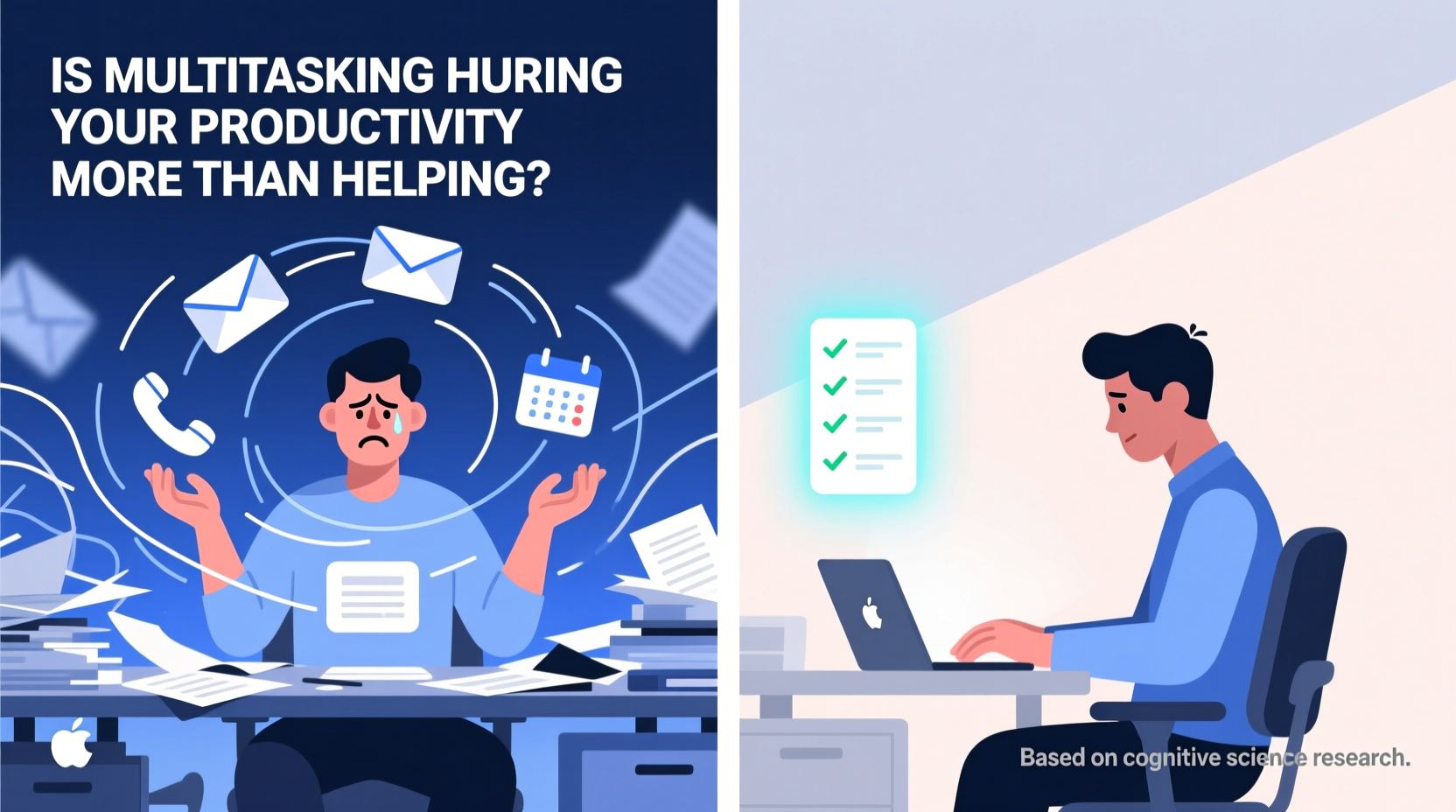
True multitasking—performing two cognitively demanding tasks at the exact same time—is nearly impossible for the human brain. When you attempt to read an article while listening to a podcast, your brain doesn’t process both streams fully. Instead, it shifts attention back and forth, creating gaps in comprehension. This constant shifting incurs what researchers call a \"switching cost\"—a delay and drop in performance each time attention moves from one task to another.
A landmark study by the American Psychological Association found that task-switching can waste up to 40% of productive time. Even simple interruptions, like checking a notification, require an average of 23 minutes to fully re-engage with the original task, according to research from the University of California, Irvine. The illusion of productivity masks a deeper inefficiency: the more you switch, the less you accomplish with precision and depth.
“Every time you shift your attention, there’s a neurochemical cost. Your brain burns glucose faster, leading to mental fatigue.” — Dr. Earl Miller, Cognitive Neuroscientist, MIT
This cognitive taxation explains why people feel drained after a day filled with meetings, messages, and fragmented work—even if they haven’t completed much. The brain treats task-switching like a series of micro-interruptions, each triggering a small stress response. Over time, this leads to decision fatigue, reduced creativity, and increased susceptibility to errors.
The Hidden Costs of Constant Task-Switching
Beyond lost time, multitasking undermines several critical aspects of high-performance work:
- Reduced accuracy: Studies show that people make significantly more mistakes when interrupted or required to switch tasks frequently.
- Impaired memory: Divided attention weakens encoding into long-term memory, making learning and retention harder.
- Lower creativity: Innovation requires deep thought and uninterrupted reflection—conditions that multitasking actively disrupts.
- Increased stress: Juggling tasks elevates cortisol levels, contributing to anxiety and burnout over time.
One telling experiment conducted at Stanford University compared heavy multitaskers with light multitaskers across various cognitive tasks. Surprisingly, the heavy multitaskers performed worse—not because they were less intelligent, but because their brains struggled to filter irrelevant information and maintain focus. They were more easily distracted, less organized, and slower to switch between tasks effectively.
When Multitasking Feels Necessary—And When It Isn’t
Not all multitasking is equally harmful. The key distinction lies in the nature of the tasks involved. Combining a low-cognitive-load activity with a high-focus task can sometimes work—like walking while brainstorming, or listening to instrumental music while writing. These pairings don’t overload the same neural pathways.
However, combining two high-demand tasks—such as drafting a proposal while participating in a Zoom call—leads to poor outcomes in both. You’ll likely miss key points in the meeting and produce subpar writing. The brain cannot allocate full resources to either task simultaneously.
The danger arises when people normalize unproductive multitasking habits under pressure. For example, responding to emails during a strategy session might seem efficient, but it fractures attention and reduces engagement. Leaders who appear “busy” are often merely reactive, not effective.
| Type of Multitasking | Feasibility | Example |
|---|---|---|
| High + High Cognitive Load | Low – Not Recommended | Writing report + attending virtual meeting |
| High + Low Cognitive Load | Moderate – Use with Caution | Reading research paper + pacing slowly |
| Low + Low Cognitive Load | High – Generally Safe | Folding laundry + listening to a familiar podcast |
Strategies to Replace Multitasking with Focused Work
Replacing multitasking with intentional focus isn't just possible—it's necessary for meaningful productivity. Here’s how to build systems that support deep work and reduce cognitive clutter:
1. Time-Block Your Day
Allocate specific chunks of time for different types of work. Group similar tasks together (e.g., email processing, creative writing, administrative duties) and assign them to designated slots. This minimizes context switching and builds momentum within each category.
2. Use the “Single-Tab Rule”
Limit yourself to one browser tab or application at a time when working on a primary task. Close unrelated tabs, mute messaging apps, and silence phone alerts. This creates a cleaner cognitive environment and reduces temptation to switch.
3. Apply the Two-Minute Rule for Interruptions
If an urgent thought or task pops up (e.g., “I need to reply to that message”), ask: Can it wait two minutes? If yes, jot it down on a notepad and return to it later. This preserves your current focus without losing the idea.
4. Schedule Buffer Zones Between Tasks
Instead of packing your calendar back-to-back, leave 5–10 minute gaps between activities. These transitions allow your brain to reset, reflect, and prepare for the next task—reducing carryover stress and improving clarity.
5. Practice Monotasking Exercises
Train your brain to focus by setting short intervals (15–25 minutes) where you do only one thing: write, read, code, or plan. Gradually increase the duration as your concentration improves. Tools like the Pomodoro Technique can help structure this training.
“We’ve confused motion with progress. Doing five things poorly isn’t better than doing one well.” — Cal Newport, Author of *Deep Work*
Real-World Example: A Manager’s Productivity Transformation
Sarah, a marketing director at a mid-sized tech firm, prided herself on being responsive and always “on.” She routinely checked Slack during team calls, answered emails while preparing presentations, and attended three overlapping meetings per day. Despite working 10-hour days, she felt constantly behind and noticed declining morale in her team.
After reading about cognitive load theory, Sarah decided to experiment. For one week, she implemented strict focus blocks: no meetings before 10 a.m., email processed only twice daily (11 a.m. and 4 p.m.), and a rule of single-tasking during creative work. She also began ending meetings five minutes early to debrief and prioritize next steps.
The results surprised her. In seven days, she completed two campaign drafts ahead of schedule, reduced follow-up questions from her team by 60%, and reported feeling calmer and more in control. Her team noticed the change too—meetings became more focused, decisions clearer, and communication more intentional. Sarah realized her previous “busyness” had been a barrier to real leadership.
Action Checklist: Building a Focus-First Workflow
Adopting a focused approach requires consistent practice. Use this checklist to transition away from counterproductive multitasking:
- ✅ Audit your last workday: How many times did you switch tasks unnecessarily?
- ✅ Identify your top three high-focus tasks and schedule dedicated time for them.
- ✅ Disable non-urgent notifications on all devices during deep work periods.
- ✅ Set up a physical or digital “distraction list” to capture intrusive thoughts.
- ✅ Commit to closing all unrelated apps and tabs when starting a priority task.
- ✅ Review your weekly calendar: Are there at least three 90-minute focus blocks scheduled?
- ✅ Reflect daily: Did I complete my most important task without interruption?
FAQ: Common Questions About Multitasking and Productivity
Isn’t multitasking necessary in fast-paced jobs?
While rapid response is sometimes required, constant multitasking reduces overall effectiveness. High-performing professionals in fast environments use structured workflows—like triaging messages in batches or delegating urgent items—to maintain control without sacrificing focus on critical tasks.
Can some people truly multitask well?
Research on “supertaskers”—individuals who perform well under multitasking conditions—shows they represent less than 2.5% of the population. For the vast majority, multitasking impairs performance. Assuming you’re an exception without evidence is risky and often self-deceptive.
What should I do when others expect me to respond instantly?
Set clear boundaries. Use auto-replies (“I’m focusing until 12 p.m.—will respond promptly after”), status indicators (“Do Not Disturb until 11 a.m.”), or agreed-upon response windows. Most reasonable colleagues respect transparency when it leads to better outcomes.
Conclusion: Reclaim Your Attention, Reclaim Your Productivity
Multitasking isn’t a skill to master—it’s a habit to break. The pursuit of constant responsiveness comes at a steep price: diminished focus, higher stress, and lower-quality output. By understanding the science of attention and designing workflows that honor cognitive limits, you can achieve more with less effort and greater satisfaction.
Productivity isn’t measured by how many things you touch, but by how well you complete what matters. Start small: protect one hour of focused time tomorrow. Eliminate distractions. See what happens when you do just one thing at a time. Chances are, you’ll finish faster, think clearer, and feel more in control. That’s not multitasking—it’s mastery.




 浙公网安备
33010002000092号
浙公网安备
33010002000092号 浙B2-20120091-4
Comments
No comments yet. Why don't you start the discussion?