
In an era where being “busy” is worn like a badge of honor, the ability to juggle multiple tasks at once is often celebrated. From answering emails during meetings to scrolling through messages while drafting reports, we’ve normalized constant task-switching as a sign of competence. But beneath this illusion of efficiency lies a troubling truth: multitasking isn’t making us more productive—it’s eroding our focus, increasing errors, and draining mental energy. The science is clear, and the evidence is mounting. What we call multitasking is actually cognitive overload in disguise.
The Myth of Multitasking
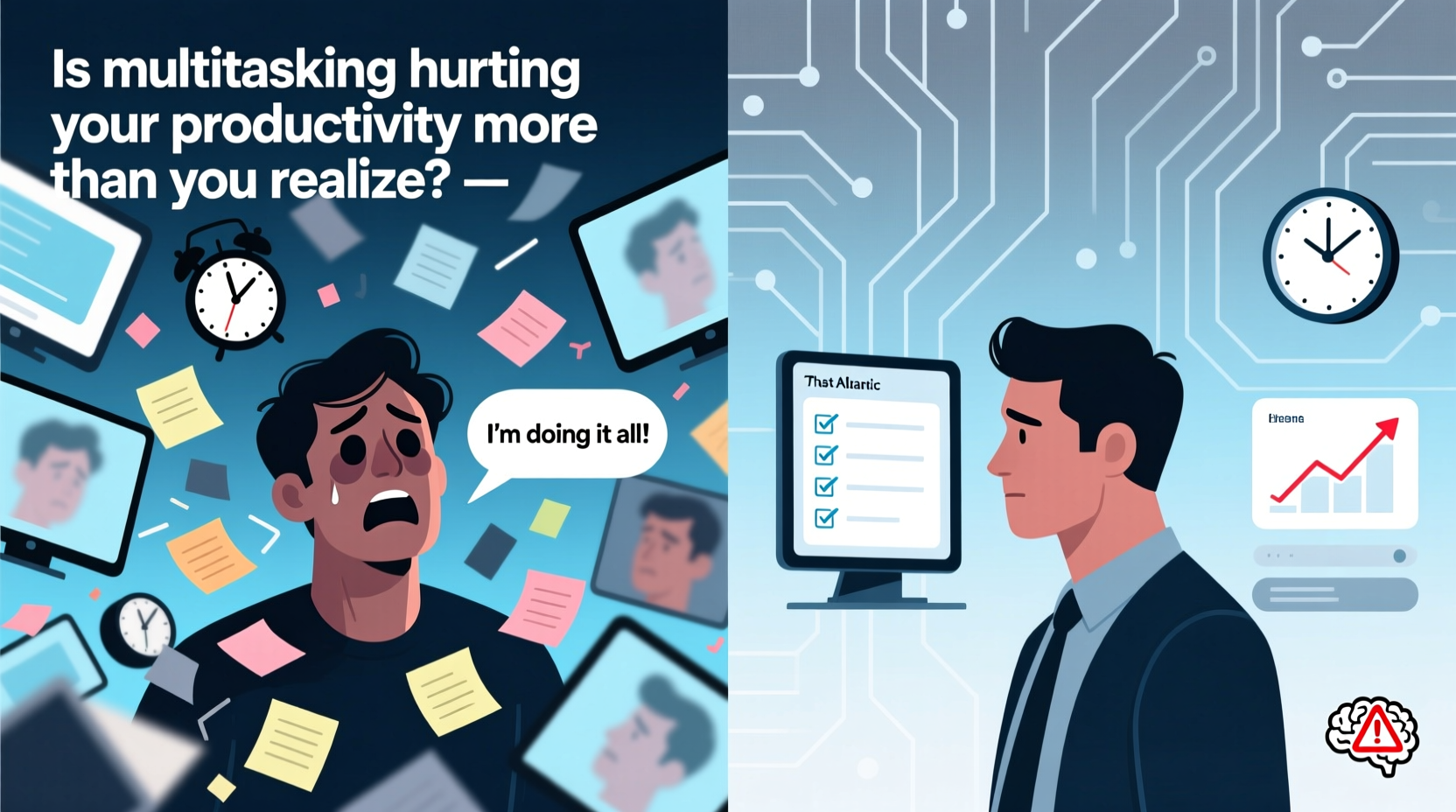
True multitasking—performing two cognitively demanding tasks simultaneously—is biologically impossible for the human brain. Unlike computers, which can process multiple threads in parallel, the brain operates sequentially. When we believe we’re multitasking, we’re actually rapidly switching attention between tasks, a process known as \"task-switching.\"
Each switch incurs a cognitive cost. Neuroscientists refer to this as “switching penalty,” where the brain must disengage from one activity, reconfigure neural networks, and engage with the next. These transitions may take only fractions of a second, but they accumulate throughout the day, leading to significant losses in time, accuracy, and mental clarity.
“Every time you switch tasks, there’s a metabolic cost in the brain. It’s like revving a car engine repeatedly—you burn fuel without going anywhere.” — Dr. Earl Miller, Cognitive Neuroscientist, MIT
Research from the American Psychological Association shows that task-switching can reduce productivity by as much as 40%. In some cases, IQ scores temporarily dropped more than when participants were sleep-deprived or under the influence of marijuana. This isn’t just inefficiency; it’s self-sabotage disguised as hustle.
The Hidden Costs of Constant Distraction
We live in a world engineered for distraction. Notifications, open office layouts, and always-on communication tools pull our attention in countless directions. Each interruption forces the brain to reorient, and studies show it takes an average of 23 minutes to fully regain deep focus after a single disruption.
Chronic partial attention leads to:
- Increased errors: Mistakes in data entry, missed details in reports, and overlooked steps in processes become more common.
- Mental fatigue: The brain consumes more glucose during task-switching, accelerating burnout.
- Reduced creativity: Deep thinking and insight emerge during uninterrupted focus, not in fragmented bursts.
- Poor memory retention: Information processed under divided attention is less likely to be encoded into long-term memory.
Single-Tasking: The Counterintuitive Path to Peak Performance
The most productive people aren’t those who do many things at once—they’re the ones who do one thing well. Single-tasking, or monotasking, involves dedicating full attention to a single activity until completion or a natural pause. This approach aligns with how the brain functions optimally: in focused, sustained bursts.
Cal Newport, author of *Deep Work*, argues that the ability to concentrate without distraction is becoming a rare and valuable skill in the knowledge economy. Those who cultivate it consistently outperform their distracted peers in both output quality and speed.
To transition from multitasking to single-tasking:
- Identify your most important task (MIT) each morning.
- Block 60–90 minute intervals on your calendar for uninterrupted work.
- Use physical or digital cues (e.g., closed door, “do not disturb” mode) to signal focus time.
- Start small—even 25-minute focused sprints using the Pomodoro technique can build mental stamina.
A Real Example: The Software Developer Who Doubled Output
Jamal, a senior developer at a mid-sized tech firm, was consistently missing deadlines despite working late hours. His calendar was packed with back-to-back meetings, code reviews, and Slack pings. After tracking his work patterns for a week, he realized he was switching tasks an average of 78 times per day.
He decided to experiment. For two weeks, he blocked three 90-minute focus sessions daily, silenced all notifications, and delegated non-urgent communication to designated response windows. The result? He completed a feature in four days that previously would have taken ten. His bug rate dropped by 60%, and his team reported improved collaboration because he was more present during actual meetings.
“I wasn’t working harder,” Jamal said. “I was just finally working undistracted.”
Do’s and Don’ts of Managing Attention
| Do | Don’t |
|---|---|
| Plan your day in advance with prioritized tasks | React to every incoming message immediately |
| Group similar tasks (batching) | Switch between unrelated high-focus tasks |
| Use time blocking for deep work | Leave your schedule entirely open-ended |
| Take intentional breaks to recharge | Work through lunch or skip breaks entirely |
| Review your progress at day’s end | End the day without reflecting or planning ahead |
A Step-by-Step Guide to Reclaiming Your Focus
If you're ready to break free from the multitasking trap, follow this five-day plan to reset your workflow:
- Day 1: Audit Your Attention
Track every task and interruption for one full workday. Note how often you switch tasks and what triggers the switches (email, chat, phone, etc.). - Day 2: Prioritize Ruthlessly
Identify your top three priorities for the week. Rank them by impact, not urgency. Schedule dedicated time blocks for the most important one. - Day 3: Design a Distraction-Free Zone
Choose one 60-minute window to work without interruptions. Turn off notifications, close unnecessary tabs, and inform colleagues if needed. Use this time for deep work only. - Day 4: Implement Task Batching
Group low-cognitive-load tasks (e.g., email, admin, scheduling) into two fixed slots per day. Avoid scattering them throughout your schedule. - Day 5: Reflect and Adjust
At the end of the week, review what worked. Did you complete more meaningful work? Were you less fatigued? Refine your approach based on real results.
Expert Insight: The Neuroscience Behind Focus
Dr. Adam Gazzaley, neurologist and co-author of *The Distracted Mind*, explains that our brains are equipped with powerful goal-management systems—but they’re easily overwhelmed by interference.
“We have limited cognitive control resources. When we try to do too much at once, we impair our ability to filter irrelevant information, maintain goals in mind, and manage our emotions. This isn’t a personal failing—it’s a neurological reality.” — Dr. Adam Gazzaley, University of California, San Francisco
Gazzaley’s research shows that even the anticipation of a notification can reduce cognitive capacity. The brain enters a state of “preemptive attention,” constantly scanning for the next input, which undermines sustained concentration.
Building a Sustainable Focus Routine
Sustained attention is a muscle—it weakens with overuse and strengthens with training. Just as athletes don’t run marathons on day one, mental focus requires gradual conditioning.
Beginners should aim for 25–30 minutes of uninterrupted work, followed by a 5-minute break. Over time, extend these intervals to 50–90 minutes. Pair focus blocks with movement, hydration, and brief mindfulness exercises to enhance recovery and resilience.
Environment plays a crucial role. Consider:
- Using noise-canceling headphones with white noise or instrumental music.
- Decluttering your workspace to minimize visual distractions.
- Setting up separate browser profiles or devices for work vs. leisure.
FAQ
Isn’t some multitasking necessary, like taking notes during a meeting?
Yes, but note-taking during meetings is a practiced skill involving automatic motor functions (writing) paired with listening. True multitasking issues arise when both tasks require active decision-making, such as analyzing data while on a call. If possible, assign note-taking to someone else or record the meeting to review later.
What about people who seem naturally good at multitasking?
Studies on so-called “supertaskers” reveal they make up less than 2% of the population. Most people who believe they’re good at multitasking are actually poor at self-assessment. They complete more tasks but with lower accuracy and higher stress levels.
Can technology help me avoid multitasking?
Certain tools can support focus. Apps like Freedom, Focus@Will, or Cold Turkey block distracting websites. Calendar blocking and task managers (e.g., Todoist, Notion) help structure single-task workflows. But technology alone won’t fix the habit—intentional behavior change is required.
Checklist: Transitioning Away from Multitasking
- ☑ Audit your daily task-switching frequency
- ☑ Identify your top 1–3 priority tasks each day
- ☑ Schedule at least one 60-minute focus block daily
- ☑ Turn off non-essential notifications during deep work
- ☑ Batch low-priority tasks into designated time slots
- ☑ Reflect weekly on focus quality and output
- ☑ Gradually increase focus session duration over time
Conclusion
Multitasking isn’t a superpower—it’s a productivity myth that’s costing you time, accuracy, and mental well-being. By recognizing the cognitive toll of constant switching and embracing the disciplined practice of single-tasking, you unlock a more effective, sustainable way to work. The goal isn’t to do more at once, but to do what matters most with full presence and precision.




 浙公网安备
33010002000092号
浙公网安备
33010002000092号 浙B2-20120091-4
Comments
No comments yet. Why don't you start the discussion?