
In an age where being “busy” is worn like a badge of honor, many people pride themselves on juggling multiple tasks at once. From answering emails during meetings to scrolling social media while drafting reports, multitasking has become the default mode of modern work and life. But beneath the surface of this constant activity lies a troubling truth: what feels efficient may actually be eroding our productivity, focus, and even long-term cognitive health.
Neuroscience and behavioral research increasingly show that the human brain isn’t designed for true multitasking. Instead of accomplishing more, we often end up doing more poorly—switching rapidly between tasks, accumulating mental fatigue, and missing critical details. The cost? Lower-quality output, increased stress, and longer completion times. The real danger is that these effects are subtle, making them easy to overlook until burnout or mistakes become unavoidable.
The Myth of Multitasking
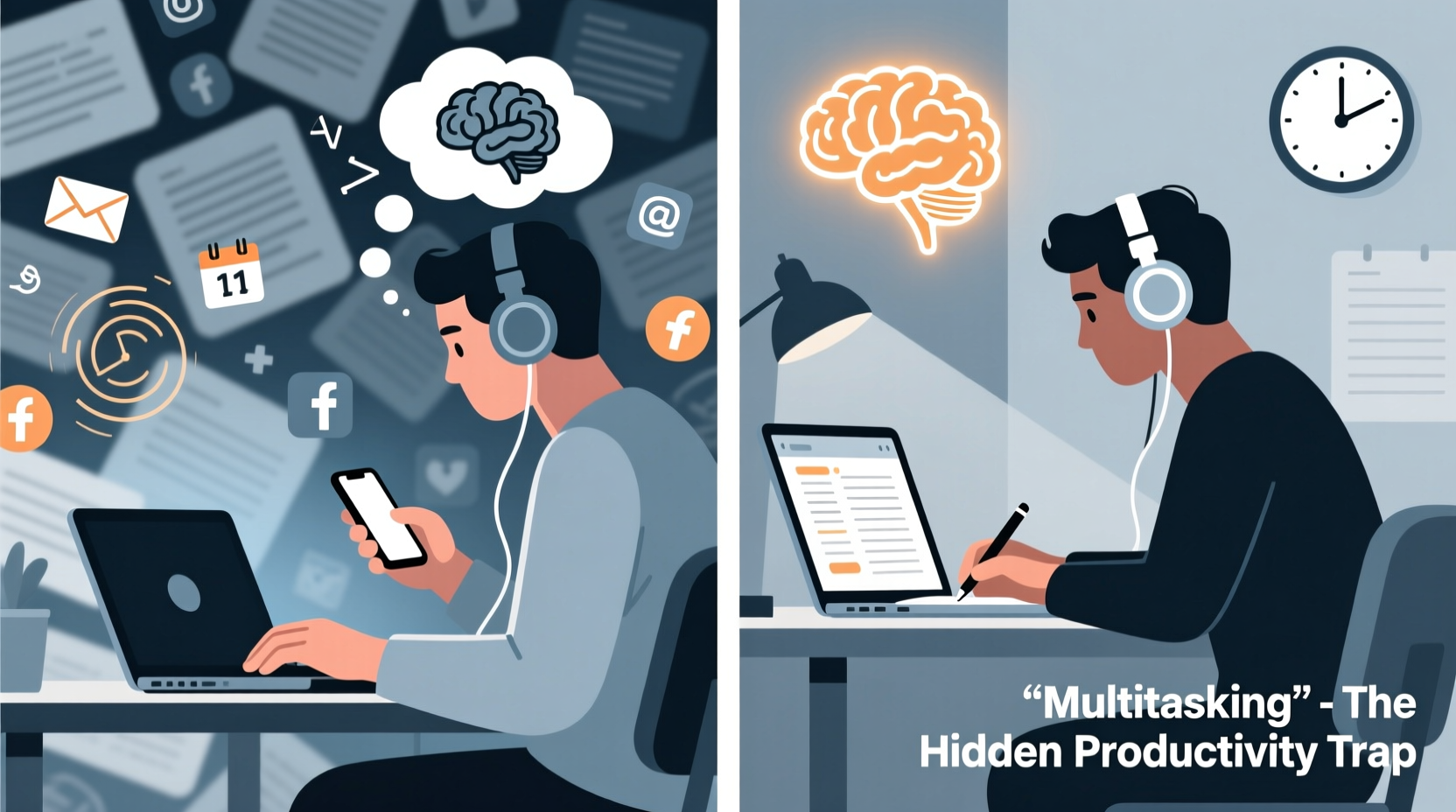
True multitasking—performing two cognitively demanding tasks simultaneously—is nearly impossible for the human brain. What most people call multitasking is actually task-switching: rapidly shifting attention from one activity to another. Each switch incurs a cognitive cost known as a \"switching penalty,\" which slows down processing and increases error rates.
A landmark study by researchers at the University of Michigan found that when participants switched between tasks, their overall performance dropped significantly. Even simple switches—like alternating between solving math problems and classifying words—led to a 40% increase in time needed to complete both tasks. This delay occurs because the brain must reorient itself each time it shifts focus, reloading context, goals, and rules.
“We’re fooling ourselves when we think we’re getting more done by doing several things at once. The brain can only deeply engage with one complex task at a time.” — Dr. David Strayer, Cognitive Neuroscientist, University of Utah
Worse still, frequent task-switching depletes working memory and executive function—the very mental resources required for planning, decision-making, and self-control. Over time, chronic multitaskers report higher levels of stress, lower job satisfaction, and diminished ability to concentrate even during single-task activities.
How Multitasking Undermines Productivity
At first glance, handling multiple inputs might seem like a way to maximize efficiency. In reality, it fragments attention, disrupts flow states, and increases the likelihood of errors. Consider the following impacts:
- Reduced concentration: Constant interruptions break deep focus, making it harder to enter or sustain a state of flow—the optimal mental zone for high-performance work.
- Increased errors: A study published in the Journal of Experimental Psychology showed that participants who responded to emails while writing reports made twice as many mistakes as those who worked uninterrupted.
- Longer completion times: Interruptions add hidden delays. It can take over 20 minutes to fully regain focus after a single distraction, according to research from Gloria Mark at the University of California, Irvine.
- Mental fatigue: Juggling tasks exhausts cognitive energy faster than sustained attention, leading to decision fatigue and reduced willpower later in the day.
The Hidden Cost: Cognitive Overload and Mental Health
Beyond lost time and errors, chronic multitasking contributes to cognitive overload—a condition where the brain receives more information than it can process effectively. Symptoms include forgetfulness, irritability, poor judgment, and difficulty prioritizing.
Over time, this pattern rewires neural pathways. A 2009 study by Stanford University revealed that heavy multitaskers were worse at filtering out irrelevant information, organizing thoughts, and switching between tasks efficiently—ironically, they performed worse precisely on the skills they believed they had mastered.
“They’re suckers for irrelevancy,” said Clifford Nass, the study’s lead researcher. “Everything distracts them.”
This constant state of partial attention also affects emotional regulation. People who frequently multitask report higher anxiety levels and lower mindfulness. They’re more likely to feel overwhelmed, rushed, and disconnected from meaningful work.
Mini Case Study: The Overwhelmed Project Manager
Sarah, a project manager at a mid-sized tech firm, prided herself on her ability to handle five projects at once. She routinely joined Zoom calls while responding to Slack messages, drafted status updates during team meetings, and checked emails between every task. On paper, she was always “on.”
But over six months, her error rate climbed. She missed key deadlines, duplicated work, and received feedback about disengagement in meetings. Her stress levels spiked, and she began waking up exhausted despite eight hours of sleep.
After a coaching session, Sarah implemented a single change: she blocked 90-minute focus sessions in her calendar, silenced all notifications, and committed to one task per block. Within three weeks, her output improved, her team noticed better communication, and her stress levels dropped. She wasn’t doing more—she was doing less, but better.
What Works Better: The Power of Single-Tasking
The antidote to multitasking isn’t slower work—it’s smarter work. High performers across industries—from elite athletes to top-tier software engineers—rely on deep focus and deliberate practice, not frantic busyness.
Single-tasking, or monotasking, means giving full attention to one activity until completion or a natural pause. This approach aligns with how the brain functions best: absorbing information, making connections, and producing quality results without interference.
Organizations like Basecamp and Asana have built cultures around focused work, limiting meetings, encouraging asynchronous communication, and protecting employees’ time for deep work. Their results speak for themselves: higher innovation rates, fewer bugs, and stronger employee retention.
Step-by-Step Guide to Reducing Multitasking
- Track your distractions: For one workday, log every interruption—notifications, internal thoughts, colleague requests. Note how often you switch tasks.
- Identify focus-critical tasks: List the 2–3 activities that require your highest cognitive effort (e.g., writing, coding, strategic planning).
- Schedule focus blocks: Block 60–90 minute windows in your calendar for these tasks. Treat them like important meetings.
- Create a distraction-free environment: Silence phone, close email tabs, use apps like Focus Mode or Freedom to block distracting sites.
- Use a “parking lot” list: When unrelated ideas or tasks pop up, jot them down to address later—don’t act on them immediately.
- Review and reflect: At the end of each week, assess how many focus blocks you completed and how your output quality changed.
Do’s and Don’ts of Managing Attention
| Do | Don’t |
|---|---|
| Group similar tasks (e.g., reply to all emails in one batch) | Check email continuously throughout the day |
| Use physical cues (e.g., headphones) to signal “do not disturb” | Assume availability equals necessity—just because you can respond doesn’t mean you should |
| Start the day with your most important task (MIT) | Begin with low-value tasks like inbox sorting or social media |
| Take intentional breaks every 60–90 minutes | Work through lunch or skip breaks to “save time” |
| Communicate boundaries (“I’m heads-down until 11—can we chat then?”) | Apologize for being unavailable during focus time |
Expert Strategies for Building Focus
Improving attention isn’t just about willpower—it’s about designing systems that support deep work. Here are evidence-backed strategies used by high performers:
- The Pomodoro Technique: Work in 25-minute intervals followed by 5-minute breaks. After four cycles, take a longer 15–30 minute break. This rhythm prevents fatigue and maintains alertness.
- Timeboxing: Assign fixed time slots for specific tasks, including email, meetings, and administrative work. This prevents tasks from expanding to fill available time.
- Attention anchors: Use a visual or physical cue—like a specific lamp or notebook—to signal the start of focused work. Over time, this conditions the brain to enter focus mode faster.
- Digital minimalism: As advocated by Cal Newport, this philosophy encourages using technology intentionally, removing apps and tools that don’t add clear value.
“The key to productivity is not doing more, but focusing on what truly matters. Clarity beats busyness every time.” — Cal Newport, Author of *Deep Work*
FAQ
Isn’t some multitasking necessary, like taking notes during a meeting?
Yes—some forms of multitasking are manageable when one task is automatic (e.g., walking) or highly practiced (e.g., typing). However, combining two complex cognitive tasks—like listening critically and composing original thoughts—impairs both. For meetings, consider recording them and taking detailed notes afterward, or assign note-taking to one person so others can focus on discussion.
Can training improve multitasking ability?
Research suggests limited gains. While some people switch tasks slightly faster, no amount of training allows the brain to truly process two complex streams of information simultaneously. Any improvement is marginal compared to the benefits of single-tasking.
What if my job requires constant responsiveness?
Even in fast-paced roles, you can set boundaries. Try batching responses: check messages every 30 or 60 minutes instead of reacting instantly. Inform colleagues of your response rhythm so expectations are managed. Most urgent issues aren’t as urgent as they seem.
Conclusion: Reclaim Your Focus, Reclaim Your Productivity
Multitasking isn’t a skill to master—it’s a habit to unlearn. The belief that we can do more by doing everything at once is a myth perpetuated by a culture obsessed with speed and visibility. The reality is that real progress happens in moments of undivided attention, thoughtful reflection, and sustained effort.
By recognizing the hidden costs of task-switching and embracing single-tasking, you’re not slowing down—you’re working smarter. You’ll produce higher-quality work, make fewer mistakes, and preserve your mental energy for what truly matters.




 浙公网安备
33010002000092号
浙公网安备
33010002000092号 浙B2-20120091-4
Comments
No comments yet. Why don't you start the discussion?