
Niacinamide has earned its reputation as a skincare powerhouse. Known for its ability to regulate oil production, reduce inflammation, strengthen the skin barrier, and fade hyperpigmentation, it's a staple in serums, moisturizers, and toners across drugstore and luxury lines alike. But despite its generally gentle nature, some users report unexpected breakouts after introducing niacinamide into their routines. This raises an urgent question: Is niacinamide actually causing acne, or is what you're experiencing just purging?
Understanding the distinction between purging and breakouts is essential—not only for managing expectations but also for making informed decisions about whether to continue using a product or remove it from your regimen.
What Is Skin Purging?
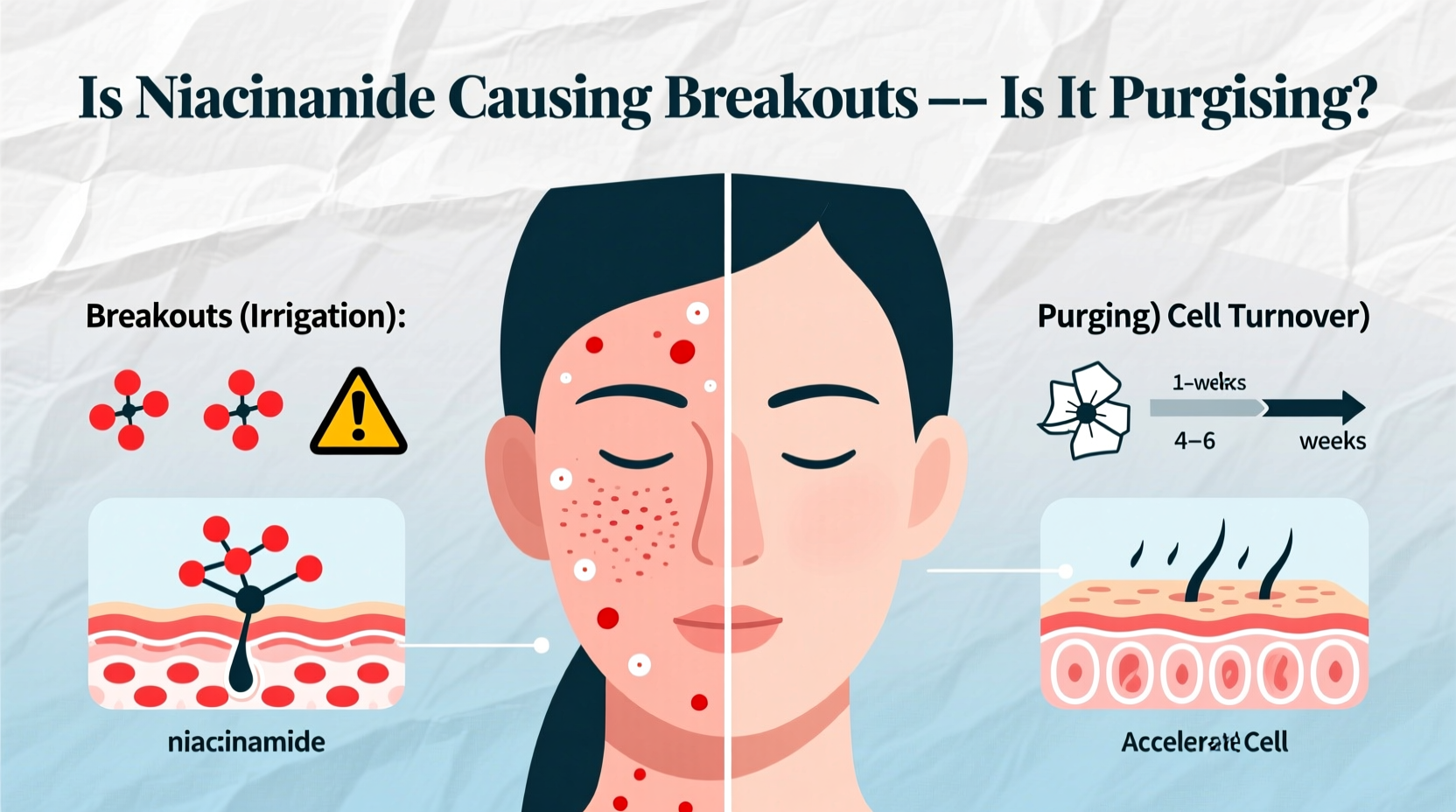
Skin purging occurs when an active ingredient accelerates cellular turnover, bringing underlying clogs and microcomedones (invisible acne formations) to the surface faster than they would naturally emerge. Unlike traditional breakouts caused by irritation or clogged pores from comedogenic ingredients, purging is a temporary reaction that indicates the product is working on a deeper level.
Purging typically happens with ingredients that exfoliate or increase cell renewal, such as retinoids, AHAs/BHAs, vitamin C (in certain forms), and yes—niacinamide, though less commonly associated with purging than other actives.
“Purging isn’t a sign the product is wrong for your skin—it’s often a sign it’s doing exactly what it should.” — Dr. Lindsey Zubritsky, Board-Certified Dermatologist
The key is timing and pattern. Purging usually begins within one to two weeks of starting a new product and resolves within four to six weeks. It tends to appear in areas where you already experience frequent breakouts and presents as small, red bumps, whiteheads, or pustules that heal quickly once the purge cycle ends.
Why Might Niacinamide Cause Purging?
While niacinamide isn't a direct exfoliant like glycolic acid or salicylic acid, it supports skin health in ways that can indirectly speed up cell turnover. By improving barrier function and reducing inflammation, niacinamide helps normalize the skin’s natural shedding process. For individuals with congested pores or sluggish turnover, this adjustment can temporarily bring hidden blemishes forward.
In addition, many niacinamide-containing products include supporting ingredients—such as hyaluronic acid, zinc, or even low-dose exfoliants—that may contribute to increased activity beneath the surface. The formulation matters as much as the star ingredient.
Signs Your Skin Is Purging vs. Reacting
Distinguishing between purging and a true adverse reaction requires close observation. Here’s how to tell them apart:
| Factor | Purging | Breakout/Reaction |
|---|---|---|
| Timing | Starts within 1–3 weeks of use | Can occur immediately or after prolonged use |
| Location | Areas where you normally get acne | New areas, especially around cheeks, jawline, or chin |
| Type of Lesions | Small pimples, whiteheads, blackheads | Cystic, inflamed, painful bumps; sometimes accompanied by itching or burning |
| Duration | Resolves in 4–6 weeks | Persists or worsens beyond 6 weeks |
| Improvement Over Time | Skin clears and improves after initial phase | No improvement—or worsening—even after stopping product |
If your \"breakouts\" are appearing in zones where you don’t typically experience congestion—like the cheeks or hairline—and are accompanied by redness, stinging, or flaking, it’s more likely an allergic reaction, sensitivity, or irritation rather than purging.
When Niacinamide Actually Causes Breakouts
Despite being well-tolerated by most skin types, including oily, acne-prone, and sensitive skin, niacinamide isn’t universally safe for everyone. In rare cases, it can cause true breakouts due to several factors:
- Formulation issues: Some niacinamide serums contain high levels of alcohol, fragrance, or emulsifiers that can irritate or clog pores. These additives—not niacinamide itself—are often the culprits.
- Concentration too high: While 5% is considered optimal and effective, some products contain 10% or higher. At elevated concentrations, niacinamide may disrupt pH balance or overwhelm sensitive skin.
- pH imbalance: Niacinamide works best at a slightly acidic pH (around 5.5–6.5). If combined improperly with very low-pH ingredients (like L-ascorbic acid), it can convert into nicotinic acid, which causes flushing, redness, and irritation in some people.
- Individual intolerance: Though uncommon, some individuals have a genuine sensitivity to niacinamide, leading to persistent congestion or inflammatory responses.
“I’ve seen patients develop milia-like eruptions or closed comedones specifically linked to heavy, occlusive niacinamide creams. It’s not always the molecule—it’s how it’s delivered.” — Dr. Aisha Rahman, Clinical Dermatologist
Real Example: A Case of Misdiagnosed Reaction
Sophie, 28, started using a popular 10% niacinamide serum to target post-acne marks. Within ten days, she noticed clusters of tiny bumps along her forehead and jawline—areas she rarely broke out in before. Assuming it was purging, she continued use for five weeks. Instead of clearing, the bumps became denser and slightly itchy.
After consulting a dermatologist, Sophie learned that her serum contained pentylene glycol and dimethicone, both of which were clogging her pores. She switched to a minimalist 5% formula without silicones or fragrance. Her skin calmed within two weeks, and over the next month, her texture improved significantly. The original breakout wasn’t purging—it was a comedogenic reaction masked as one.
How to Safely Introduce Niacinamide Into Your Routine
To avoid confusion and protect your skin barrier, follow a structured approach when adding niacinamide:
- Choose the right concentration: Start with 5%. Higher percentages don’t necessarily mean better results and increase risk of irritation.
- Read the full ingredient list: Avoid formulas with drying alcohols (e.g., denatured alcohol, SD alcohol 40), synthetic fragrances, or heavy silicones if you’re prone to congestion.
- Introduce slowly: Apply every other night for the first week, then nightly if tolerated.
- Layer correctly: Use after water-based toners and before heavier moisturizers. Avoid mixing with direct vitamin C (L-ascorbic acid) unless formulated together.
- Monitor for 6 weeks: Give your skin time to adjust. True purging should resolve within this window.
Checklist: Is It Time to Stop Using Niacinamide?
Use this checklist to determine whether to discontinue use:
- ❌ Breakouts appear in new areas not typical for your acne pattern
- ❌ Bumps are painful, cystic, or deeply inflamed
- ❌ You experience persistent redness, burning, or tightness
- ❌ No improvement after 6–8 weeks of consistent use
- ❌ Reaction recurs upon reintroduction after a break
If three or more apply, it’s likely not purging—and discontinuation is advisable.
FAQ: Common Questions About Niacinamide and Breakouts
Can niacinamide make acne worse before it gets better?
Yes, but only in cases of purging, which is temporary and limited to existing acne-prone zones. This usually lasts no longer than six weeks. If acne continues to worsen beyond that point, it’s likely not purging but a negative reaction to the product formulation.
Does 10% niacinamide cause more breakouts than 5%?
Not inherently—but higher concentrations increase the chance of irritation, especially in sensitive or reactive skin types. Most clinical studies show that 5% is equally effective for brightening, oil control, and pore refinement, with fewer side effects.
Can I use niacinamide if I have fungal acne?
Caution is advised. While niacinamide itself is not comedogenic, many carrier ingredients in niacinamide serums—such as certain oils and esters—can feed Malassezia yeast. Look for products labeled “non-comedogenic” and “fragrance-free,” and avoid those with coconut-derived ingredients or fatty alcohols like lauryl alcohol.
Final Thoughts: Know Your Skin, Trust the Process
Niacinamide remains one of the most versatile and research-backed ingredients in modern skincare. Its benefits span across skin types and concerns—from reducing redness in rosacea to minimizing enlarged pores in oily complexions. However, like any active ingredient, it must be used wisely.
The appearance of breakouts shortly after starting niacinamide doesn’t automatically mean you should quit. Evaluate the timeline, location, and type of lesions. Give your skin a fair trial period while monitoring for signs of true irritation. Often, what feels like a setback is actually a short-term purge paving the way for clearer skin.
But equally important: don’t ignore persistent negative reactions. Your skin communicates through changes. Listen closely. Adjust thoughtfully. And remember—effective skincare isn’t about enduring discomfort; it’s about building a routine that supports long-term health and resilience.




 浙公网安备
33010002000092号
浙公网安备
33010002000092号 浙B2-20120091-4
Comments
No comments yet. Why don't you start the discussion?