
The evolution of display technology has reached a pivotal moment. As we step into 2025, OLED gaming monitors are no longer niche luxuries—they’re mainstream contenders. With major brands like LG, ASUS, Samsung, and Dell offering high-refresh OLED panels, gamers are faced with a critical decision: Is upgrading to OLED worth it over the mature, reliable LED (LCD/IPS) alternatives? The answer isn’t binary. While OLED delivers unmatched contrast and response times, it comes with trade-offs in brightness, longevity, and price. This analysis breaks down the real-world implications of choosing OLED versus LED for gaming in 2025, based on technological advancements, user experiences, and long-term value.
Understanding the Core Differences
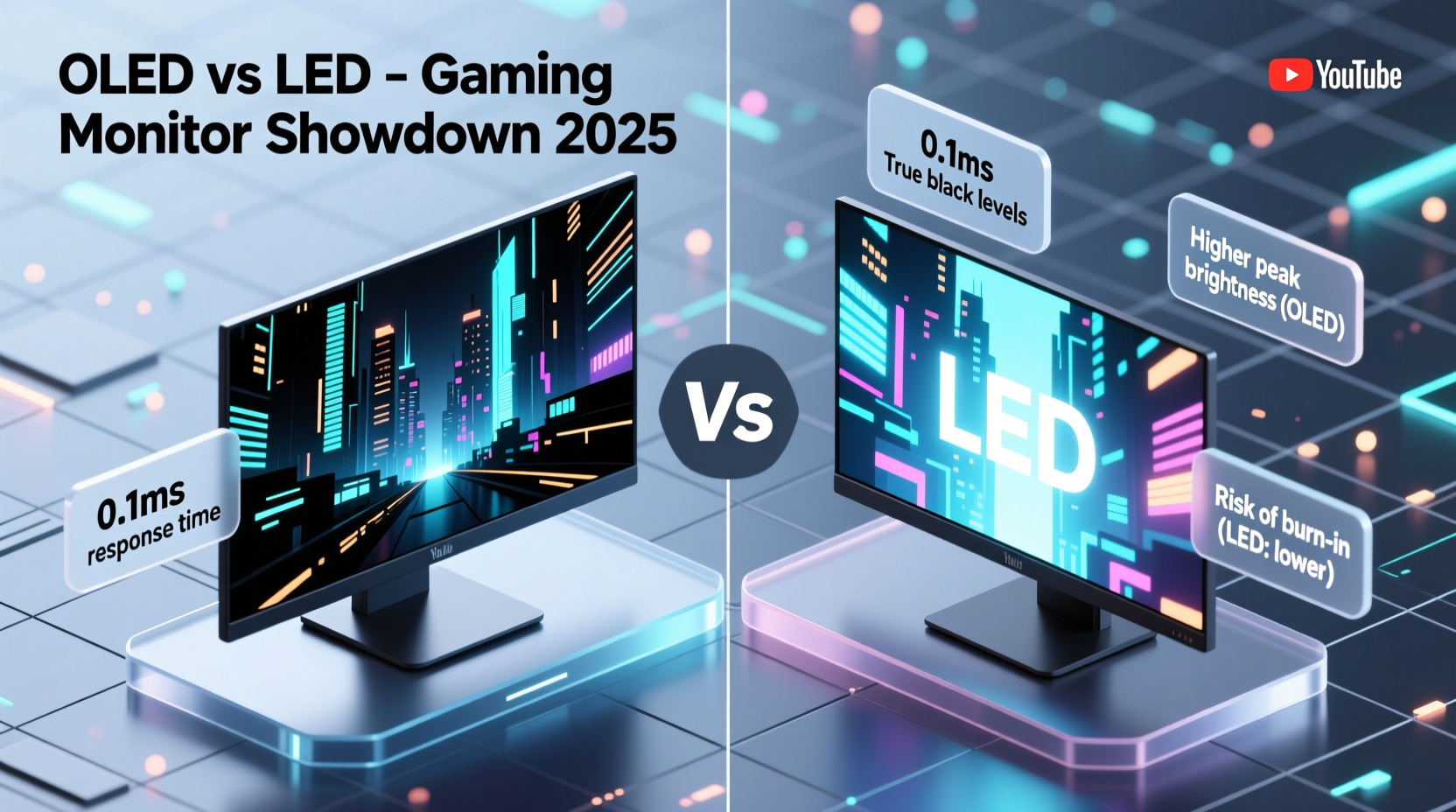
OLED (Organic Light-Emitting Diode) and LED (Light-Emitting Diode, commonly referring to LCDs with LED backlights) operate on fundamentally different principles. In an LED monitor, a backlight illuminates liquid crystals that modulate light to produce images. OLED pixels, by contrast, emit their own light when electrically stimulated—meaning each pixel can turn completely off for true blacks.
This self-emissive nature gives OLED several inherent advantages:
- Perfect blacks and infinite contrast ratio: When a pixel is off, it emits no light, resulting in absolute black levels impossible for LED backlights to match.
- Near-instantaneous response time: Typically under 0.1ms, eliminating motion blur and ghosting.
- Wider viewing angles: Color and contrast remain consistent even at extreme angles.
- Thinner panels: No need for a separate backlight layer allows for sleeker designs.
However, LED monitors—especially modern IPS and mini-LED variants—have closed the gap significantly. Mini-LED backlights now offer thousands of local dimming zones, improving contrast and reducing halo effects. High-end IPS panels boast 1ms GTG response times and excellent color accuracy, making them formidable competitors.
“OLED’s per-pixel lighting is a game-changer for immersion, especially in dark scenes. But for bright environments or mixed-use setups, LED still holds practical advantages.” — Dr. Lin Wei, Display Technology Analyst at DisplayMate
Performance in Real Gaming Scenarios
In fast-paced games like first-person shooters or competitive esports titles, every millisecond counts. OLED’s sub-0.1ms response time eliminates trailing behind fast-moving objects—a subtle but tangible advantage during intense gameplay. Gamers report smoother tracking and crisper visuals, particularly noticeable in dark environments where enemies hide in shadows.
Consider a scenario in Call of Duty: Black Ops 7 (2024), played in a dimly lit room. On an OLED monitor, muzzle flashes pop against pitch-black alleys, while enemy silhouettes remain sharply defined. On a standard LED monitor, even with local dimming, some blooming occurs around bright elements, slightly washing out nearby details. The depth and realism provided by OLED enhance spatial awareness, potentially giving players a perceptual edge.
However, in brightly lit rooms or productivity-heavy workflows, OLED’s lower peak brightness (typically 400–600 nits, with short bursts up to 1000) becomes a limitation. High-end mini-LED monitors now reach sustained 1000+ nits, making them more suitable for HDR content and daytime use. Additionally, OLED’s risk of burn-in remains a concern for users who frequently leave static HUDs (like health bars or minimaps) on-screen for hours.
Longevity and Burn-In: Are the Fears Overblown?
Burn-in—the permanent discoloration caused by uneven pixel degradation—has historically been the Achilles’ heel of OLED. However, manufacturers have implemented multiple safeguards by 2025:
- Pixel shifting: Subtle movement of UI elements to prevent static image retention.
- Logo dimming: Automatically reduces brightness of known static logos.
- Lifetime balancing algorithms: Monitor pixel usage and adjust brightness dynamically.
- Improved blue emitter materials: Extend panel lifespan significantly compared to early OLED models.
According to recent tests by Rtings and TFT Central, modern OLED gaming monitors can withstand 30,000+ hours before noticeable degradation—equivalent to five years of eight-hour daily use. That said, heavy gamers who play the same titles for months (e.g., MMOs with persistent UIs) should remain cautious.
“We’ve seen a dramatic reduction in burn-in reports since 2022, thanks to smarter firmware and better materials. Still, I recommend enabling screen savers and using dark mode UIs when possible.” — Sarah Kim, Senior Technician at PanelCare Labs
Comparative Analysis: OLED vs. LED in 2025
| Feature | OLED | LED (Mini-LED / IPS) |
|---|---|---|
| Contrast Ratio | Infinite (true blacks) | 1,000,000:1 (with full-array local dimming) |
| Response Time (GTG) | 0.03 – 0.1ms | 0.5 – 1ms |
| Peak Brightness (HDR) | 800–1000 nits (short burst) | 1000–1600 nits (sustained) |
| Lifespan (Half-brightness) | ~30,000 hours | ~60,000 hours |
| Color Accuracy (Delta E < 2) | Excellent (factory calibrated) | Excellent (high-end models) |
| Risk of Burn-In | Low (with precautions) | None |
| Average Price (27” 4K 144Hz) | $900–$1,300 | $600–$900 |
| Best Use Case | Dark-room gaming, cinematic experiences | Bright rooms, mixed productivity/gaming |
The data shows that OLED excels in contrast and speed, while LED maintains superiority in brightness, durability, and cost. Your choice depends heavily on your environment and usage patterns.
Expert Recommendations and Usage Tips
Selecting between OLED and LED isn’t just about specs—it’s about aligning technology with lifestyle. Here are actionable insights for making the right decision in 2025:
Who Should Choose OLED?
- Gamers who play in dim or controlled lighting.
- Users prioritizing visual immersion in story-driven or horror games.
- Owners of next-gen consoles (PS6, Xbox Velocity Series) or high-end PCs capable of leveraging HDMI 2.1 and VRR.
- Those willing to follow best practices to minimize burn-in risks.
Who Should Stick with LED?
- Users in brightly lit spaces without ambient light control.
- Multi-purpose setups involving prolonged desktop use, spreadsheets, or video editing.
- Budget-conscious buyers seeking reliability over premium visuals.
- Fans of MMOs, RTS games, or any genre with static UI elements.
Step-by-Step Guide: Optimizing Your OLED Monitor for Longevity
If you’ve invested in an OLED gaming monitor, follow this routine to maximize its lifespan:
- Enable Pixel Refresh: Run the built-in pixel refresh cycle once every 2–3 weeks (accessible via monitor OSD).
- Use Dark Mode Interfaces: Opt for dark themes in Windows, Steam, Discord, and other apps to reduce static white elements.
- Limit Static Content Exposure: Pause games only briefly; avoid leaving system menus open for hours.
- Adjust Brightness Settings: Set SDR brightness to 200–300 nits for daily use. Reserve max brightness for HDR clips.
- Enable Auto Dimming Features: Allow the monitor to automatically lower brightness after inactivity.
- Rotate Wallpapers and Themes: Change desktop backgrounds weekly to distribute pixel usage.
Frequently Asked Questions
Can I use an OLED monitor for office work without burn-in risk?
Yes, but with caution. Modern OLEDs are resilient, but prolonged exposure to static toolbars, taskbars, or browser windows increases risk. Use auto-hide features, dark mode, and take regular breaks. For pure productivity, LED remains safer.
Do OLED monitors last as long as LED ones?
Not quite. While OLED lifespan has improved, LED monitors typically last twice as long before significant degradation. However, for most gamers, OLED’s 30,000-hour lifespan is sufficient for 5–7 years of regular use.
Are OLED monitors worth the price premium in 2025?
For immersive gaming experiences, yes. The leap in contrast, speed, and visual fidelity is immediately noticeable. However, if budget or mixed-use functionality is a priority, high-end LED monitors offer excellent value and durability.
Final Verdict: It Depends on Your Game
By 2025, OLED is no longer a gamble—it’s a refined option with clear strengths and manageable weaknesses. It delivers the closest thing to “perfect” black levels and motion clarity, transforming how games feel and look. Yet, it’s not universally superior. LED technology, especially with mini-LED backlights, has evolved to offer stunning HDR performance, higher brightness, and rock-solid reliability for everyday use.
The real question isn’t whether OLED is technically better, but whether its advantages align with your gaming habits and environment. In a darkened room, playing narrative adventures or competitive shooters, OLED is transformative. In a sunlit home office used for both work and gaming, a high-quality LED monitor may serve you better over the long term.
Ultimately, the “better” monitor is the one that enhances your experience without introducing new compromises. As display innovation continues, the gap will narrow—but for now, the choice rests on priorities: purity of image or practicality of use.




 浙公网安备
33010002000092号
浙公网安备
33010002000092号 浙B2-20120091-4
Comments
No comments yet. Why don't you start the discussion?