
For centuries, fiction has been both celebrated and criticized—praised for its beauty and imagination, yet sometimes dismissed as mere escapism. In schools, students are often steered toward nonfiction for \"real knowledge,\" while novels are seen as leisure reading. But a growing body of scientific research suggests that diving into a novel does far more than pass the time. It reshapes the brain, enhances empathy, strengthens cognitive function, and even improves mental resilience. The truth is, reading fiction isn’t just entertaining—it’s a powerful form of mental exercise.
The Cognitive Workout Hidden in Every Novel
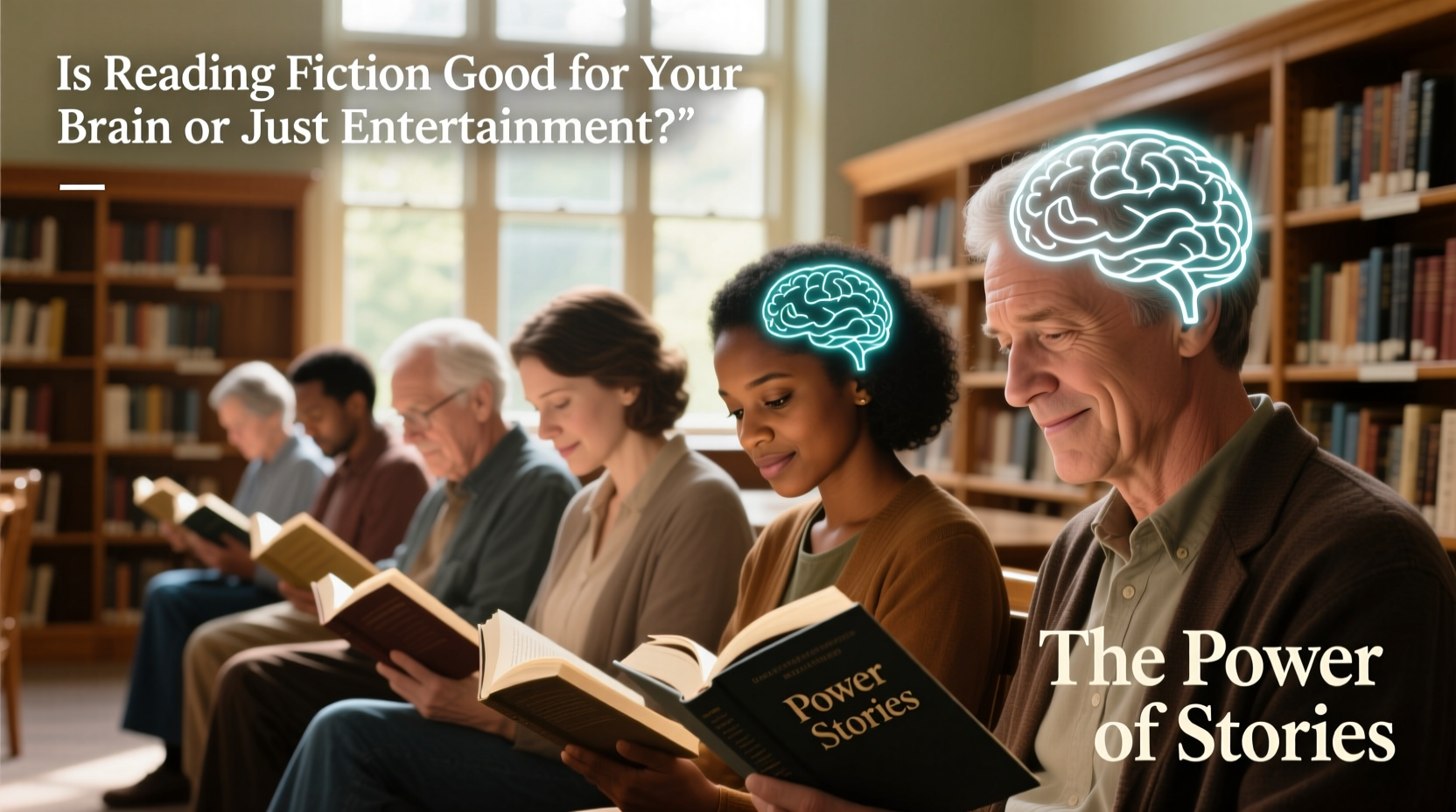
Fiction demands active engagement from the reader. Unlike passive forms of entertainment such as watching television, reading requires sustained attention, visualization, and inference. When you read a story, your brain doesn’t just decode words—it simulates entire worlds.
Neuroscientists have found that when people read descriptive passages about sensory experiences—such as walking through a forest or tasting a lemon—regions of the brain associated with smell, touch, and taste become activated. This phenomenon, known as neural coupling, means that the brain responds to fictional experiences almost as if they were real.
A 2013 study conducted at Emory University used fMRI scans to monitor brain activity in participants who read the novel *Pompeii* over nine days. Researchers observed heightened connectivity in the left temporal cortex, an area linked to language comprehension, and increased activity in the central sulcus, which is involved in physical sensation. These changes persisted for several days after reading ended, suggesting that fiction can induce lasting neurological shifts.
“Reading fiction activates the brain’s default mode network—the same system involved in introspection, theory of mind, and imagining future scenarios. It’s essentially a simulation of human experience.” — Dr. Gregory Berns, Neuroscientist, Emory University
Empathy and Emotional Intelligence: How Fiction Builds Compassion
One of the most compelling benefits of reading fiction is its ability to foster empathy. By immersing readers in the inner lives of characters—especially those from different backgrounds, cultures, or psychological states—fiction cultivates what psychologists call “theory of mind”: the capacity to understand others’ thoughts and emotions.
A landmark 2006 study published in *Science* demonstrated that individuals who regularly read literary fiction performed significantly better on tests measuring empathy, social perception, and emotional intelligence than those who read popular fiction or nonfiction. The researchers concluded that literary fiction, with its complex characters and ambiguous motivations, forces readers to engage in deeper cognitive and emotional processing.
This effect extends beyond the page. Teachers who incorporate novels into their curricula report that students become more sensitive to peer dynamics and more willing to consider multiple perspectives. In workplaces, leaders who read fiction regularly are often better at navigating interpersonal conflict and understanding team morale.
Memory, Focus, and Mental Resilience
In an age of constant digital distraction, the ability to focus for extended periods is increasingly rare. Reading fiction trains this skill. A novel requires linear attention, memory retention, and the ability to follow evolving plots and relationships across hundreds of pages.
Studies show that regular readers exhibit slower rates of cognitive decline in later life. According to research from the Rush Memory and Aging Project, individuals who engage in frequent cognitive activities—including reading—are 32% less likely to develop Alzheimer’s disease. Even reading for as little as 30 minutes a day has been linked to improved memory recall and executive function.
Fiction also plays a role in stress reduction. A 2009 study by the University of Sussex found that reading for just six minutes reduced stress levels by up to 68%—more than listening to music or taking a walk. The immersive nature of storytelling allows the mind to disengage from anxiety loops and enter a state of calm focus.
A Real Example: How Fiction Helped One Veteran Heal
James, a U.S. Army veteran who served two tours in Afghanistan, struggled with PTSD upon returning home. Traditional therapy helped, but he found himself emotionally closed off—until a counselor suggested he try reading Tim O’Brien’s *The Things They Carried*, a novel about soldiers in the Vietnam War.
At first, James resisted. He hadn’t read a book since high school. But within chapters, he found himself recognizing his own feelings in the characters’ internal struggles. “It was like someone finally understood,” he said. “I didn’t feel so alone.” Over time, reading became part of his healing process. He joined a veterans’ book group and eventually began writing his own stories.
His experience reflects a broader trend: bibliotherapy, the use of literature to support mental health, is now integrated into trauma recovery programs worldwide.
Structural Benefits: How Fiction Shapes Language and Creativity
Beyond emotional and cognitive gains, fiction enhances linguistic abilities. Exposure to rich vocabulary, varied sentence structures, and narrative techniques improves both written and spoken communication skills. Children who read fiction regularly score higher on verbal aptitude tests, and adults who read novels demonstrate greater rhetorical flexibility in professional settings.
Creativity, too, receives a boost. Fiction encourages divergent thinking—the ability to generate multiple solutions to a problem—by presenting alternative realities, unconventional characters, and imaginative plotlines. A 2013 study in the *Creativity Research Journal* found that participants who read a short story before completing a creative task generated more original ideas than those who read a newspaper article.
| Skill | Benefit from Reading Fiction | Real-World Application |
|---|---|---|
| Empathy | Improved understanding of others' emotions | Better teamwork, leadership, and conflict resolution |
| Focus | Extended attention span and concentration | Increased productivity and reduced distractibility |
| Memory | Stronger recall of details and sequences | Enhanced learning and problem-solving |
| Vocabulary | Exposure to nuanced language and expressions | More persuasive communication and writing |
| Creativity | Stimulation of imaginative thinking | Innovation in business, art, and personal projects |
How to Maximize the Brain Benefits of Fiction: A Practical Checklist
Not all reading is created equal. To truly harness the cognitive and emotional power of fiction, approach it with intention. Here’s how:
- Read diverse genres: Mix literary fiction with historical novels, speculative fiction, and global literature to expose your brain to varied perspectives.
- Engage actively: Pause to reflect on characters’ decisions. Ask yourself: “Why did she do that?” or “How would I react?”
- Discuss what you read: Join a book club or talk with friends. Dialogue deepens comprehension and reinforces memory.
- Read slowly and reread: Savor complex passages. Rereading a novel often reveals new insights and strengthens neural connections.
- Choose depth over volume: One challenging novel may offer more cognitive benefit than ten light beach reads.
- Pair reading with journaling: Write brief reflections on how a character’s journey relates to your own life.
Step-by-Step: Building a Brain-Boosting Reading Habit
- Set a daily goal: Start with 15–20 minutes. Use a quiet time, like before bed or during lunch.
- Choose one novel per month: Select a well-reviewed work of literary or thought-provoking fiction.
- Create a reading environment: Minimize distractions. Turn off notifications and find a comfortable spot.
- Take notes (optional): Jot down key themes, quotes, or questions in a notebook.
- Reflect weekly: At the end of each week, summarize what you’ve read and how it made you feel.
- Share insights: Post a review online or discuss it with someone. Teaching reinforces learning.
FAQ: Common Questions About Fiction and Brain Health
Does genre matter when it comes to brain benefits?
Yes. While all fiction engages the imagination, literary fiction—with its emphasis on character development, moral complexity, and psychological depth—has been shown to enhance empathy and theory of mind more than formulaic genres like romance or thrillers. That said, even genre fiction improves vocabulary, focus, and narrative comprehension.
Can audiobooks provide the same benefits as reading print?
To a significant extent, yes. Audiobooks still activate language centers and stimulate imagination, especially when listened to attentively. However, reading printed text adds visual processing and fine motor coordination (turning pages), and studies suggest that comprehension and retention are slightly higher with physical books. For optimal results, alternate between formats based on context—audiobooks during commutes, print at home.
Is there such a thing as reading too much fiction?
While rare, excessive escapism through fiction could potentially interfere with real-world responsibilities or emotional processing if used to avoid problems. Balance is key. Fiction should complement, not replace, direct human interaction and practical action. If reading becomes isolating or obsessive, it may be worth examining underlying motivations.
Conclusion: Fiction Is Far More Than Entertainment
Reading fiction is not a guilty pleasure—it’s a vital cognitive and emotional practice. From strengthening neural pathways to deepening empathy and sharpening focus, the act of losing yourself in a story is one of the most effective ways to train your brain without stepping into a classroom or clinic. The next time someone dismisses your novel as “just entertainment,” remember: you’re not merely escaping reality. You’re expanding your mind, enriching your emotional intelligence, and building mental resilience—one chapter at a time.




 浙公网安备
33010002000092号
浙公网安备
33010002000092号 浙B2-20120091-4
Comments
No comments yet. Why don't you start the discussion?