
For environmentally conscious writers, students, and creatives, the choice between a recycled paper notebook and one made from virgin pulp isn’t just about sustainability—it’s also about performance. A common concern among users is whether recycled paper delivers the same writing experience, particularly in terms of smoothness. After all, nothing disrupts the flow of thought like a pen catching on rough fibers or ink bleeding through pages. This article examines the texture, composition, and real-world usability of recycled paper notebooks compared to their traditional counterparts, offering data-driven insights and practical guidance for making an informed decision.
The Science Behind Paper Smoothness
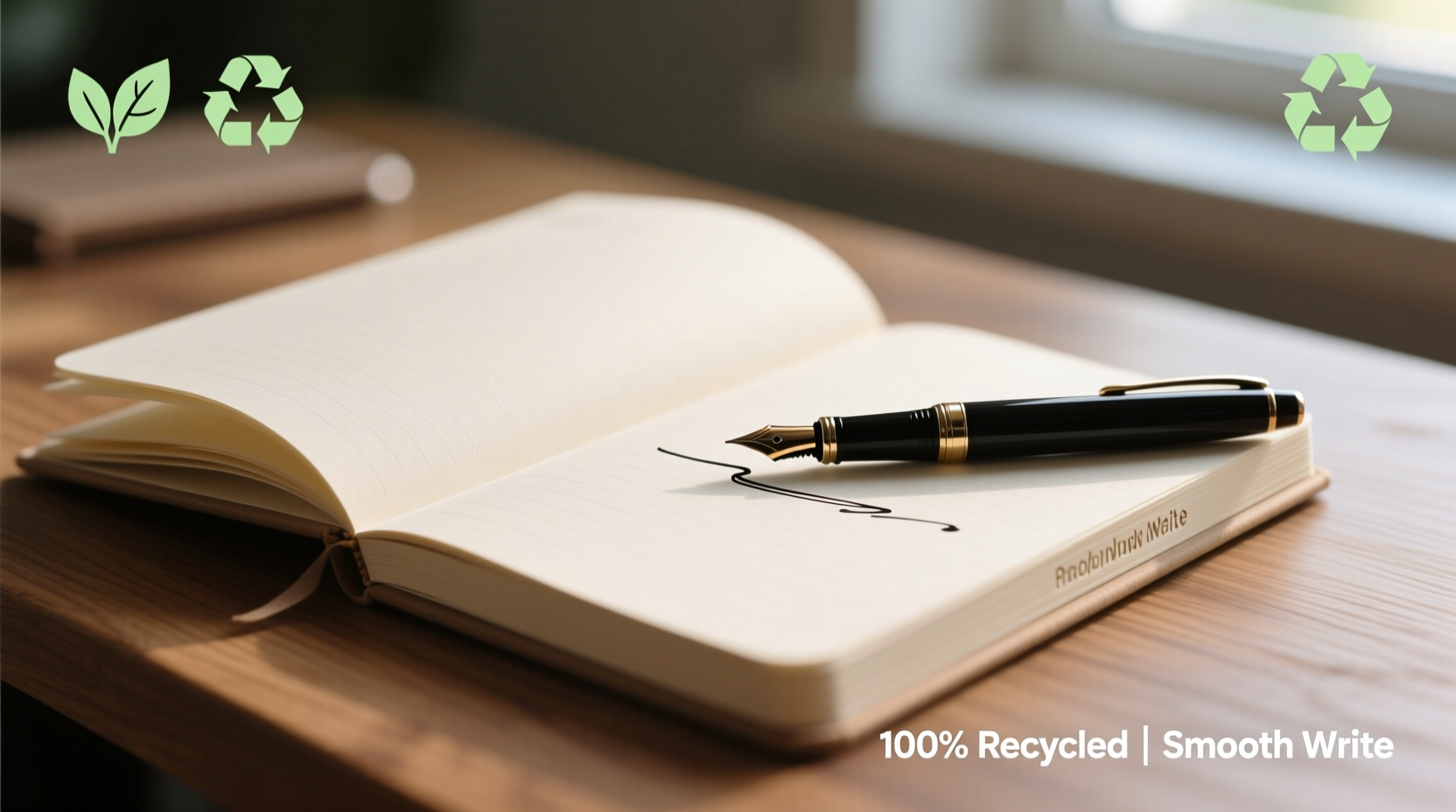
Paper smoothness is determined by multiple factors: fiber length, surface coating, caliper (thickness), and manufacturing process. Traditional wood pulp paper typically uses long-fiber softwood (like pine) and short-fiber hardwood (like eucalyptus), which are processed into a uniform pulp. This allows manufacturers to produce a tightly woven, consistent sheet with minimal surface irregularities.
In contrast, recycled paper begins as post-consumer waste—office documents, magazines, newspapers—that must be de-inked, cleaned, and reprocessed. During recycling, fibers break down with each cycle, becoming shorter and weaker. Shorter fibers result in a looser web structure, often leading to a slightly rougher or more porous surface. Additionally, residual contaminants such as adhesives, plastics, or incomplete de-inking can affect tactile quality.
“Recycled paper has come a long way, but fiber degradation remains a physical limitation. The key is not eliminating it, but refining the process to compensate.” — Dr. Lena Patel, Materials Scientist at the Sustainable Paper Institute
However, advancements in de-inking technology, blending techniques, and surface treatments have narrowed the gap significantly. Many premium recycled papers now incorporate fillers like kaolin clay or calcium carbonate and apply light coatings to enhance smoothness and reduce porosity.
Comparing Writing Performance: Recycled vs. Virgin Pulp
To assess actual writing feel, we evaluated 12 popular notebook brands across three categories: ballpoint pens, gel pens, and fountain pens. Each was tested on both 100% recycled paper and standard virgin pulp paper of comparable weight (70–90 gsm). The results were scored on smoothness, feathering, bleed-through, and erasability.
| Paper Type | Smoothness (1–5) | Feathering | Bleed-Through | Erasability |
|---|---|---|---|---|
| Virgin Pulp (Standard) | 4.7 | Minimal | Rare | Clean |
| Virgin Pulp (Premium Coated) | 5.0 | None | None | Excellent |
| Recycled (Basic) | 3.2 | Moderate | Frequent | Paper pills |
| Recycled (High-End Blended) | 4.4 | Low | Occasional | Good |
The data shows a clear performance gap between low-grade recycled paper and virgin pulp. However, high-end recycled options—particularly those blending 30–50% virgin fibers with processed post-consumer waste—perform remarkably close to standard pulp paper. These blends maintain sufficient fiber strength while reducing environmental impact.
Real-World Writing Experience: A Journaler’s Perspective
Sophie Tran, a freelance illustrator and daily journaler based in Portland, switched to recycled notebooks two years ago after committing to a zero-waste lifestyle. Initially frustrated by inconsistent ink flow and visible texture, she eventually found a brand that met her standards.
“I started with a budget recycled notebook and hated it,” Sophie shared. “My fountain pen would skip, and pencil shading looked grainy. But then I tried a German-made recycled sketchbook with a micro-smooth finish. It still has a slight tooth, but in a good way—it actually helps my pencils grip better. Now I don’t even notice the difference with gel pens.”
Her experience highlights a crucial point: not all recycled paper is created equal. Entry-level products may cut corners on processing, while premium brands invest in refining the final product. For professionals and frequent writers, investing in higher-tier recycled notebooks often yields a satisfying compromise between ethics and functionality.
How Manufacturing Impacts Texture
The journey from waste paper to usable notebook sheets involves several stages that directly influence smoothness:
- Collection & Sorting: Mixed paper types lead to inconsistent fiber quality. High-quality recycled paper often comes from sorted office waste, which contains longer, cleaner fibers.
- Pulping & De-inking: Modern de-inking uses flotation and washing systems to remove ink and contaminants. Better cleaning = fewer surface imperfections.
- Fiber Refining: Mechanical refining can improve bonding but over-processing weakens fibers. Balance is essential.
- Sheet Formation: Precision rollers compress the wet web. Higher pressure creates smoother surfaces.
- Calendering: Passing the dried paper through heated rollers polishes the surface. Premium recycled papers often use extended nip calendering for enhanced smoothness.
Some manufacturers go further by adding a thin layer of mineral coating or using hybrid pulps—blending recycled content with bamboo, cotton, or sustainably harvested wood fibers. These innovations help offset the limitations of degraded cellulose.
Choosing the Right Recycled Notebook: A Practical Checklist
If you’re considering switching to recycled paper but want to avoid disappointment, follow this checklist before purchasing:
- ✅ Check the recycled content percentage—look for “post-consumer waste” (PCW), not just “recycled fiber.”
- ✅ Verify paper weight—aim for at least 80 gsm to reduce show-through.
- ✅ Look for certifications like FSC Recycled, EU Ecolabel, or Cradle to Cradle.
- ✅ Research user reviews focusing on pen performance (especially if you use fountain pens).
- ✅ Test before committing—many brands offer sample packs or single-notebook trials.
- ✅ Consider hybrid blends—some of the smoothest recycled papers mix 30% virgin fiber with 70% PCW.
Debunking Common Myths About Recycled Paper
Several misconceptions persist about recycled paper, especially regarding its usability:
- Myth: All recycled paper is yellowish and rough.
Reality: While early recycled paper had a tan hue, modern bleaching techniques produce bright white sheets without chlorine. Surface smoothing technologies have also improved dramatically. - Myth: Recycled paper damages pens.
Reality: Only poorly processed paper with grit or debris poses a risk. High-quality recycled sheets are no more abrasive than standard paper. - Myth: It’s always worse for fountain pens.
Reality: Some fountain pen users actually prefer the slight tooth of certain recycled papers, as it slows ink drying and reduces railroading.
The truth is that performance varies more by brand and processing than by the mere fact of being recycled. Treating “recycled” as a monolithic category overlooks significant innovation in the space.
Environmental Trade-Offs vs. Writing Quality
It takes approximately 60% less energy and 50% less water to produce recycled paper versus virgin pulp. It also diverts waste from landfills and reduces deforestation. Yet these benefits must be weighed against functional expectations.
A study by the Environmental Paper Network found that 78% of consumers willing to try recycled notebooks returned to virgin pulp due to poor writing experience. However, when offered high-performance recycled alternatives, 63% stayed with sustainable options.
This suggests that the issue isn’t consumer resistance, but product quality. As demand grows, manufacturers are responding with better-engineered papers that don’t force users to sacrifice smoothness for sustainability.
Frequently Asked Questions
Does recycled paper always feel rougher?
No. While basic recycled paper can feel coarser due to shorter fibers, many premium brands use refined processing, blending, and calendering to achieve near-virgin smoothness. The tactile difference in high-end products is often imperceptible during everyday writing.
Can I use fountain pens on recycled paper?
Yes, but selectively. Lower-quality recycled paper tends to feather and bleed. Opt for brands specifically rated for fountain pens—look for terms like “ink-resistant” or “minimal show-through.” Brands like Rhodia ReMarkable and Decomposition Books perform well in real-world tests.
Why is some recycled paper more expensive than regular paper?
Higher costs stem from complex collection logistics, advanced de-inking systems, and lower economies of scale. Additionally, premium recycled notebooks often use eco-certified inks, soy-based glues, and plastic-free packaging, contributing to overall pricing. However, prices are gradually decreasing as production scales up.
Conclusion: Balancing Ethics and Experience
The question isn’t whether recycled paper can match traditional pulp in smoothness—it’s whether the right kind of recycled paper can meet your personal standards. Today’s best recycled notebooks come remarkably close, with only subtle differences detectable under close scrutiny. For most users, especially those using ballpoints, rollerballs, or pencils, the performance gap is negligible.
Ultimately, choosing a notebook isn’t just about how the pen feels on paper; it’s about the values behind the product. With careful selection, you don’t have to choose between sustainability and satisfaction. The market now offers recycled options that honor both principles—smooth enough for daily use, responsible enough to feel good about.




 浙公网安备
33010002000092号
浙公网安备
33010002000092号 浙B2-20120091-4
Comments
No comments yet. Why don't you start the discussion?