
The Reolink Argus 3 launched in 2020 as a standout in the budget-friendly, wire-free security camera market. With its 2K resolution, solar compatibility, and local storage support, it quickly gained popularity among homeowners seeking reliable outdoor surveillance without breaking the bank. But nearly half a decade later, with rapid advancements in AI detection, cloud integration, and hardware design, many users are asking: does the Argus 3 still hold up?
This article dives deep into how the Reolink Argus 3 stacks up against current-gen competitors like the Arlo Pro 5, Eufy SoloCam S40, and Reolink’s own newer models such as the Argus 4 and TrackMix. We’ll examine image quality, smart features, battery life, software support, and real-world usability to determine whether this older model remains a viable choice—or if it's time to upgrade.
Image Quality and Low-Light Performance
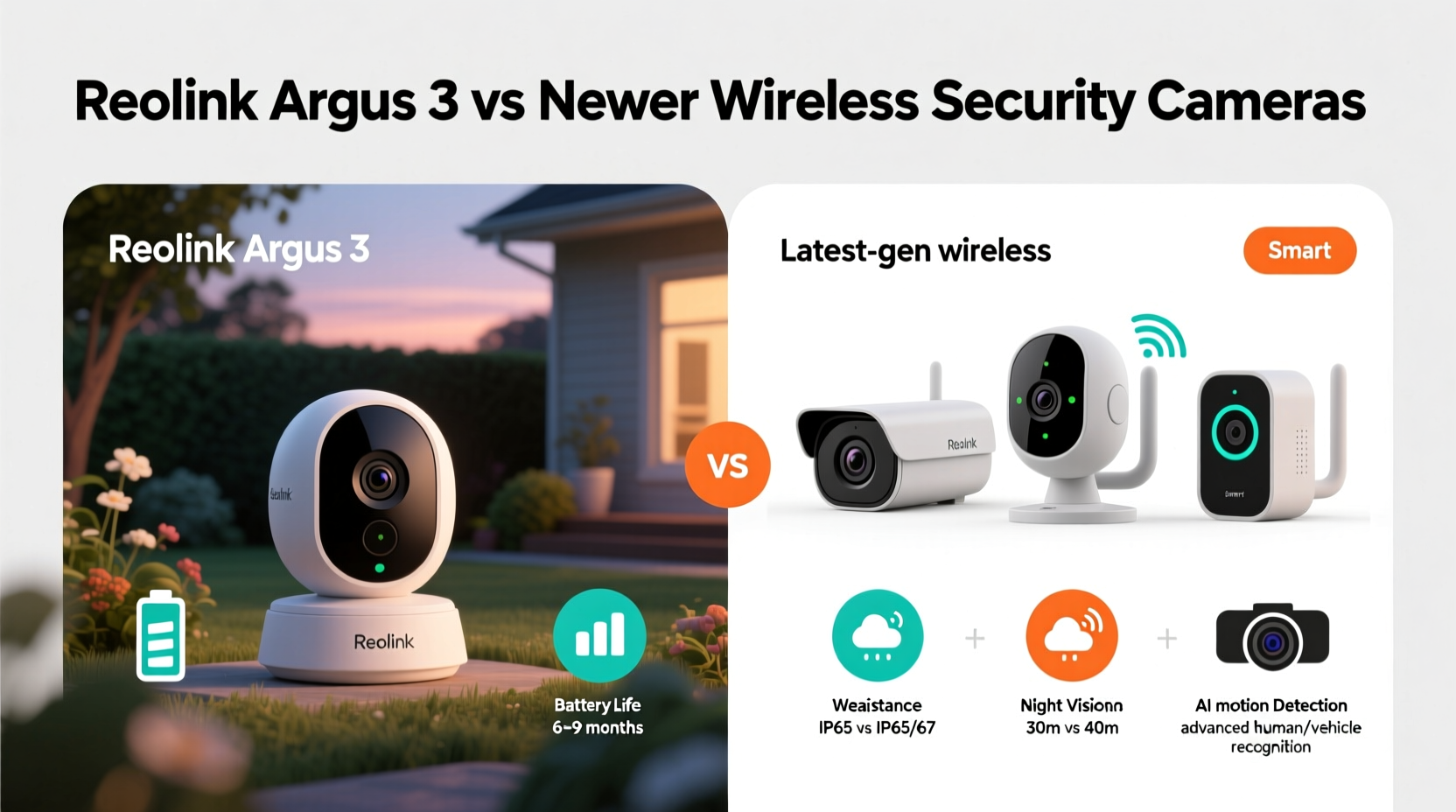
One of the Argus 3’s strongest selling points at launch was its 2K (4MP) sensor, which delivered noticeably sharper footage than the standard 1080p offerings common at the time. Even today, 2K resolution remains relevant—especially for identifying faces or license plates from moderate distances. The wide 130° field of view ensures broad coverage, reducing blind spots around driveways or entryways.
However, newer models have pushed beyond raw resolution. Many now include HDR processing, improved dynamic range, and larger image sensors that perform better in mixed lighting. For example, the Eufy SoloCam S40 uses a 1/1.8” sensor compared to the Argus 3’s smaller 1/2.7”, resulting in cleaner low-light images with less noise.
Night vision on the Argus 3 relies on infrared LEDs with a claimed range of up to 33 feet. In practice, this works well for detecting motion but struggles with fine detail beyond 20 feet. Newer cameras often feature color night vision using spotlight illumination or starlight sensors, offering more natural nighttime footage. While the Argus 3 lacks these enhancements, its IR performance is still acceptable for basic monitoring.
Smart Detection and AI Capabilities
Advanced motion detection has become a defining feature of modern security cameras. Today’s top models use on-device AI to distinguish between people, vehicles, pets, and even packages—reducing false alerts caused by leaves or shadows.
The Argus 3 supports basic person and vehicle detection, but it lacks the precision and customization found in newer systems. For instance, Reolink’s newer firmware updates added AI filtering for the Argus 3, but performance varies depending on Wi-Fi strength and app settings. Users report higher rates of missed detections or false positives compared to cameras running dedicated neural processors.
In contrast, devices like the Arlo Pro 5 and Google Nest Cam Battery use powerful edge computing to analyze scenes locally before sending alerts. This not only improves accuracy but also enhances privacy. The Argus 3 processes most analytics through the cloud unless paired with a Reolink NVR, putting it at a disadvantage in both speed and data control.
“AI-powered detection isn’t just about convenience—it reduces alert fatigue, which is crucial for long-term system adoption.” — David Lin, Smart Home Security Analyst at TechWatch Weekly
Battery Life and Power Options
The Argus 3 shines in flexibility when it comes to power. It runs on a removable 5200mAh battery and can be charged via micro-USB or powered continuously with a solar panel (sold separately). Under average usage—around 10 motion events per day—users typically get 3–6 months of battery life.
Newer models have improved efficiency through better power management and lower-power sensors. The Argus 4, for example, extends battery life by up to 50% under similar conditions due to optimized wake cycles and faster sleep transitions. Still, the Argus 3 remains one of the longest-lasting wireless Reolink models available.
Its solar compatibility gives it an edge over brands like Ring or Blink, where third-party solar options are limited or non-existent. As long as sunlight reaches the panel, the Argus 3 can operate indefinitely—a major benefit for remote locations or renters who can’t hardwire cameras.
Power Comparison Table
| Model | Battery Capacity | Estimated Battery Life | Solar Compatible |
|---|---|---|---|
| Reolink Argus 3 | 5200 mAh | 3–6 months | Yes (RPB002) |
| Reolink Argus 4 | 8100 mAh | 6–12 months | Yes (RPB13B) |
| Eufy SoloCam S40 | 13,000 mAh | 6+ months | Yes |
| Arlo Pro 5 | Non-removable 5050 mAh | 3–4 months | Limited (official only) |
Software, App Experience, and Storage
The Reolink app has evolved significantly since the Argus 3’s release. While early versions were criticized for clunky navigation and inconsistent notifications, recent updates have streamlined the interface and improved reliability. The Argus 3 remains fully supported with firmware patches and app compatibility.
Local storage via microSD card (up to 256GB) is a major advantage, allowing users to avoid subscription fees entirely. This contrasts sharply with brands like Arlo or Ring, where cloud recording requires ongoing payments. Reolink offers optional cloud plans starting at $4/month, but they remain optional—an increasingly rare perk.
However, the Argus 3 doesn’t support advanced features like continuous recording unless connected to a Reolink NVR. Motion-triggered clips are stored either locally or in the cloud, which may not suit users wanting full-time surveillance. Newer models like the TrackMix combine spotlights, pan-tilt mechanisms, and 24/7 recording capabilities, making them more versatile despite higher prices.
Remote viewing works reliably over Wi-Fi (2.4 GHz only), though some users experience lag during live streaming. Dual-band support is absent, which can be a limitation in congested networks. Setup remains straightforward via QR code pairing, and two-way audio is clear and responsive.
Real-World Use Case: A Suburban Homeowner’s Perspective
Consider Mark, a homeowner in Ohio who installed three Argus 3 cameras in 2021 to monitor his front porch, backyard gate, and side driveway. He chose them for their ease of installation and lack of wiring requirements. Over four years, he’s replaced batteries twice using the solar panels, avoided any cloud subscriptions, and successfully captured footage of a package theft in 2023.
While satisfied overall, Mark recently considered upgrading after noticing that his neighbor’s Eufy camera sent fewer false alerts and provided color night vision. He tested the Eufy S40 but ultimately decided to keep his Argus 3s after realizing the cost of replacing all three units outweighed the marginal gains.
Instead, he optimized his existing setup: repositioning one camera for better sightlines, enabling AI filters in the Reolink app, and formatting his SD cards every six months to prevent corruption. His experience illustrates a growing trend—many users find that with proper maintenance, the Argus 3 continues to deliver solid value.
How the Argus 3 Compares to Newer Reolink Models
Reolink has released several successors that improve upon the Argus 3 in meaningful ways:
- Argus 4: Features 4K resolution, enhanced AI detection, longer battery life, and magnetic quick-release mounting.
- Argus Eco: Budget-focused with 1080p, no siren or spotlight, but lower price point.
- TrackMix: Adds motorized pan-tilt tracking, built-in spotlight, and alarm siren for active deterrence.
Despite these upgrades, the Argus 3 remains competitively priced at around $80–$100 per unit (often discounted), while the Argus 4 sells for $130+. For users already invested in the ecosystem, the incremental benefits may not justify replacement.
Additionally, accessories like the RPB002 solar panel and mounting kits remain widely available and compatible across generations—a testament to Reolink’s backward compatibility policy.
Checklist: Is Your Argus 3 Still Good Enough?
- ✅ Are you getting clear daytime and nighttime footage of key areas?
- ✅ Is battery life meeting your expectations (3+ months)?
- ✅ Are motion alerts accurate enough to avoid constant false alarms?
- ✅ Do you have reliable Wi-Fi signal at the camera location?
- ✅ Are you using microSD cards formatted regularly for optimal performance?
- ✅ Have you updated to the latest firmware version?
If you answered “yes” to most of these, your Argus 3 likely still serves its purpose effectively.
Frequently Asked Questions
Can the Reolink Argus 3 work without Wi-Fi?
No, the Argus 3 requires a 2.4 GHz Wi-Fi connection for setup, remote viewing, and motion alerts. However, it will continue to record locally to a microSD card during temporary outages and sync once connectivity is restored.
Does the Argus 3 support two-way audio?
Yes, it includes a built-in microphone and speaker for real-time communication through the Reolink app. Audio quality is clear within 10–15 feet, though background noise can interfere in windy conditions.
Will Reolink stop supporting the Argus 3?
As of 2024, Reolink continues to provide firmware updates and app support. There is no official end-of-life announcement. Given their track record with older models like the Argus 2, support could last several more years.
Final Verdict: Where the Argus 3 Stands Today
The Reolink Argus 3 is no longer cutting-edge, but it remains a capable and cost-effective option in today’s security camera landscape. Its combination of 2K video, strong battery life, solar readiness, and local storage keeps it relevant—especially for budget-conscious buyers or those avoiding monthly fees.
Against premium models with AI smarts, color night vision, and seamless integrations, the Argus 3 shows its age. Yet for basic home monitoring, it delivers consistent performance with minimal hassle. If you already own one or more units, upgrading isn’t urgent. With proper care and positioning, they can serve reliably for years to come.
New buyers should weigh whether the savings over newer models justify missing out on features like 4K, smarter alerts, and dual-band Wi-Fi. But for dependable, no-frills wireless surveillance, the Argus 3 still earns its place on the shortlist.




 浙公网安备
33010002000092号
浙公网安备
33010002000092号 浙B2-20120091-4
Comments
No comments yet. Why don't you start the discussion?