
Language acquisition is rarely a linear process. For learners of Japanese, especially those using informal or self-directed methods, finding consistent exposure to natural speech patterns is a persistent challenge. While textbooks and apps provide structure, they often lack the rhythm, intonation, and cultural context found in real-world usage. This is where anime—despite its stylized dialogue and exaggerated expressions—emerges as a surprisingly effective tool. But watching once isn’t enough. The real value lies in rewatching. Repeated exposure to the same anime episodes can significantly improve vocabulary retention, auditory processing, and grammatical intuition, making it a powerful supplement to formal study.
The benefits aren't just anecdotal. Cognitive science supports the idea that spaced repetition and contextual reinforcement strengthen memory formation. When applied to language learning, rewatching familiar content allows learners to shift focus from basic comprehension to deeper linguistic analysis. Each viewing builds on the last, transforming passive entertainment into active education.
How Rewatching Enhances Language Retention
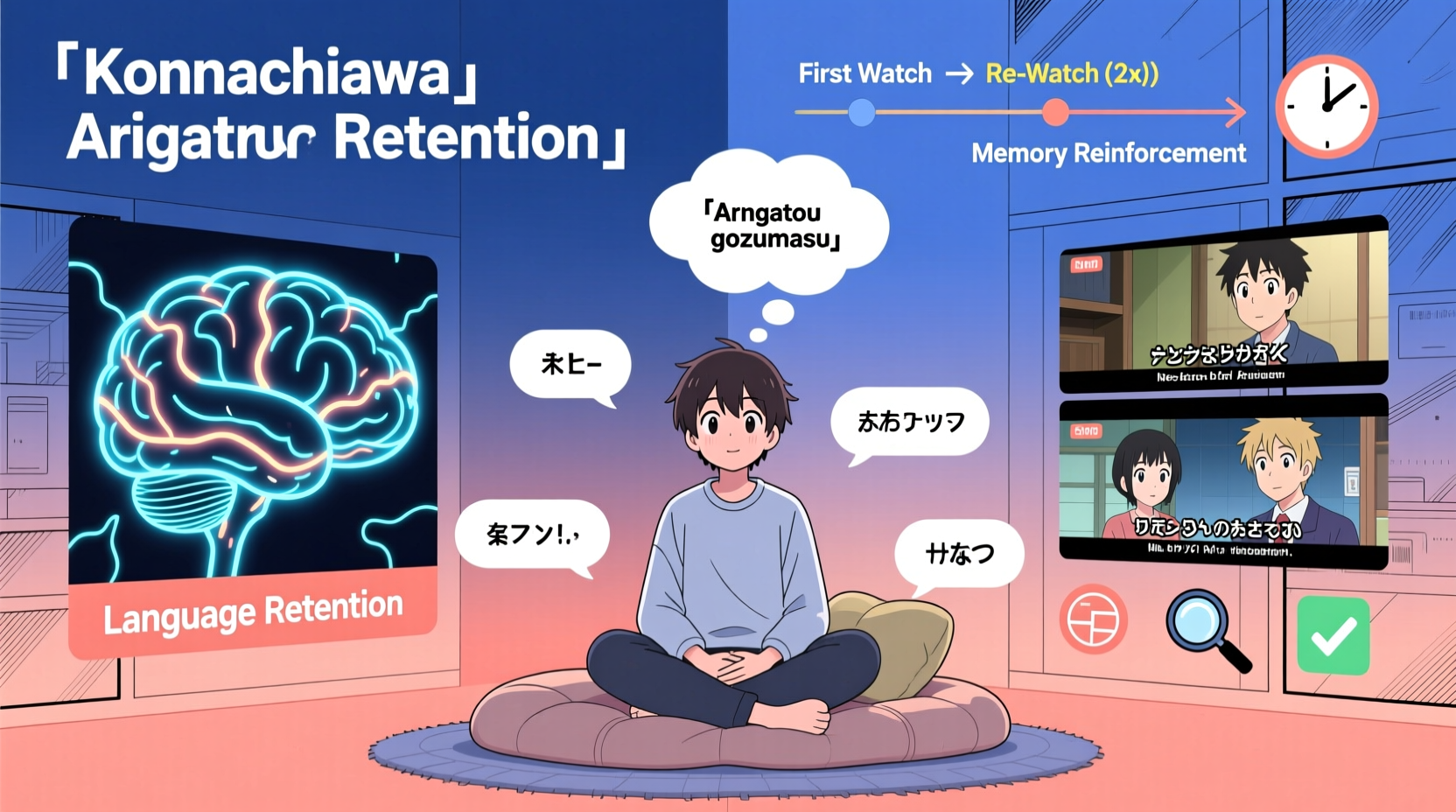
When you watch an anime episode for the first time, your brain is overwhelmed with new information: visuals, plot developments, character names, and rapid-fire dialogue. Your primary goal is understanding the story. On a second or third viewing, however, cognitive load decreases. You already know what happens next. This frees up mental bandwidth to focus on language details—word choice, sentence endings, honorifics, and pronunciation.
This phenomenon is known as \"comprehensible input plus one,\" a concept introduced by linguist Stephen Krashen. He argues that language learners acquire new structures most effectively when they understand messages that contain slightly more advanced language than they currently produce. Rewatching provides exactly that: familiar context with incremental linguistic challenges.
For example, in your first viewing of *Death Note*, you might grasp that Light says “Kira desu” (“I am Kira”) but miss the subtle shift in his tone and grammar as he becomes more arrogant. On a rewatch, you notice how his use of polite forms diminishes, replaced by blunt, authoritative speech—a reflection of his changing social stance. These nuances are critical for understanding not just words, but how language functions in real interactions.
The Cognitive Science Behind Repetition
Memory consolidation relies heavily on repetition. The brain strengthens neural pathways each time information is retrieved. In language learning, this means hearing the same phrases repeatedly helps embed them into long-term memory. However, massed repetition (cramming) is less effective than spaced repetition—reviewing material at increasing intervals.
Rewatching anime naturally incorporates spaced repetition. If you rewatch an episode a week after the first viewing, then again a month later, you're aligning with optimal memory retention curves. Each session reinforces vocabulary and grammar without requiring flashcards or drills.
A 2018 study published in Language Learning & Technology found that learners who engaged with the same video content multiple times showed significantly better recall of vocabulary and improved listening comprehension compared to those who watched different videos each time. The researchers concluded that familiarity with content allowed learners to allocate attention to linguistic form rather than meaning.
“Repeated exposure to authentic language in meaningful contexts is one of the most underutilized yet effective tools in second language acquisition.” — Dr. Naomi Fujita, Applied Linguistics Researcher, Osaka University
Strategic Rewatching: A Step-by-Step Approach
To maximize retention, rewatching should be intentional, not passive. Follow this five-step timeline to turn anime into a structured learning activity.
- First Watch – Focus on Comprehension: Watch with Japanese audio and English subtitles. Take notes on key plot points and any words you recognize. Don’t pause frequently; aim for overall understanding.
- Second Watch – Activate Listening Skills: Use Japanese audio with Japanese subtitles. Pause when you hear unfamiliar words. Look them up and add them to a vocabulary list. Pay attention to verb conjugations and particles.
- Third Watch – Shadowing Practice: Mute the subtitles. Try to repeat lines immediately after characters speak (shadowing). This improves pronunciation, rhythm, and speaking fluency.
- Fourth Watch – Grammar Mining: Choose 3–5 sentences per episode and analyze their structure. Identify the subject, object, verb tense, and any honorifics. Write simplified versions or create your own sentences using the same patterns.
- Fifth Watch – Passive Immersion: Watch without subtitles, purely for enjoyment. Notice how much more you understand. This reinforces confidence and consolidates learning.
This method transforms anime from passive entertainment into an active language lab. Over time, learners report recognizing phrases in other media, understanding native speakers more easily, and even dreaming in Japanese.
Benefits Beyond Vocabulary: Cultural Fluency and Pragmatics
Language is inseparable from culture. Anime, while fictional, reflects real sociolinguistic behaviors—how people address elders, express emotions, or navigate social hierarchies. Rewatching allows learners to absorb these pragmatic elements subconsciously.
For instance, in *My Hero Academia*, students use casual speech with peers but switch to polite forms with teachers. Characters like All Might use dramatic, archaic expressions that mirror heroic rhetoric in Japanese literature. By rewatching, learners internalize these shifts in register and context-appropriate language use.
Additionally, idiomatic expressions and slang appear frequently in anime. Phrases like “Yappari” (I knew it), “Dame da ne” (It’s no good), or “Mendokusai” (What a hassle) are common in daily conversation but rarely taught in textbooks. Hearing them repeatedly in context makes them easier to remember and use appropriately.
| Linguistic Feature | First Watch Focus | Second+ Watch Focus |
|---|---|---|
| Vocabulary Recognition | Identify basic nouns and verbs | Learn compound words and slang |
| Listening Comprehension | Follow main dialogue with subtitles | Pick up fast speech and contractions |
| Grammar Patterns | Notice simple sentence structures | Analyze conditionals, causatives, passive voice |
| Pronunciation & Intonation | Hear accents and pitch variation | Shadow characters and mimic tone |
| Sociocultural Cues | Observe character relationships | Understand honorifics and speech levels |
Mini Case Study: From Beginner to Conversational in 12 Months
Tyler, a 24-year-old software developer from Chicago, began studying Japanese with no prior experience. He committed to 30 minutes of textbook study daily and rewatched *Spy x Family* weekly. His approach was systematic: first with English subs, then Japanese subs, then without any subtitles.
Within three months, he recognized recurring phrases like “Omoshiroi!” (That’s interesting!) and “Shinjirarenai!” (I can’t believe it!). By month six, he could predict lines before characters spoke them. At nine months, he started thinking in Japanese during routine tasks. By the end of the year, he passed the JLPT N4 and held 15-minute conversations with native speakers on Discord.
“Rewatching helped me stop translating in my head,” Tyler said. “I didn’t memorize ‘kara’ as ‘because’—I learned how it sounds when someone explains a reason. That made all the difference.”
Common Pitfalls and How to Avoid Them
Rewatching anime isn’t automatically beneficial. Without intention, it becomes passive consumption. Here are common mistakes and solutions:
- Mistake: Relying on English subtitles indefinitely.
Solution: Phase them out after the first viewing. Use Japanese subtitles or none at all. - Mistake: Watching too many different series.
Solution: Stick to 1–2 shows for extended periods to build familiarity with character speech patterns. - Mistake: Ignoring pronunciation practice.
Solution: Incorporate shadowing and repeat aloud during rewatches. - Mistake: Not reviewing learned vocabulary.
Solution: Use SRS (Spaced Repetition Systems) like Anki to review anime-derived words regularly.
Actionable Checklist for Effective Rewatching
Use this checklist to ensure your anime sessions contribute meaningfully to language growth:
- ☐ Select one anime series to focus on for 4–8 weeks
- ☐ Watch the first episode with English subtitles to grasp the plot
- ☐ Rewatch with Japanese subtitles and note 5 new words
- ☐ Look up grammar points for 2 complex sentences
- ☐ Practice shadowing 3 key lines aloud
- ☐ Add new vocabulary to a digital flashcard system
- ☐ Watch once more without subtitles to test comprehension
- ☐ Repeat the process for the next episode, cycling back monthly
FAQ: Addressing Common Questions
Is anime too unnatural for real language learning?
Some anime dialogue is exaggerated or genre-specific, but many series use authentic conversational Japanese. Slice-of-life, comedy, and drama genres tend to reflect real speech more accurately than action or fantasy. The key is balance—use anime as a supplement, not your sole resource.
How many times should I rewatch an episode?
Three to five times is ideal. The first two focus on comprehension and vocabulary, the next on grammar and pronunciation, and the final viewing serves as a confidence check. After that, revisit the episode every few weeks for spaced repetition.
Can I learn kanji from watching anime?
Indirectly, yes. Seeing words in hiragana and kanji via subtitles helps associate spoken language with written form. However, dedicated kanji study is still necessary. Use anime as reinforcement, not replacement.
Conclusion: Make Rewatching a Habit, Not a Hobby
Rewatching anime is more than nostalgia—it’s a strategic language learning technique grounded in cognitive science and real-world success. When done intentionally, it builds vocabulary, sharpens listening skills, and deepens cultural understanding. The emotional connection to characters and stories enhances motivation, making sustained practice feel effortless.
The most successful language learners don’t just consume content—they engage with it repeatedly, extracting new insights each time. Start small: pick one episode, rewatch it three times this week using different techniques, and track what you learn. Over time, you’ll find yourself understanding more, speaking with greater confidence, and connecting with Japanese culture on a deeper level.




 浙公网安备
33010002000092号
浙公网安备
33010002000092号 浙B2-20120091-4
Comments
No comments yet. Why don't you start the discussion?