
When shopping for a new TV, the decision often comes down to value: how much picture quality, smart features, and longevity can you get for your budget? Two names consistently come up in mid-range discussions—Samsung’s Crystal UHD series and Vizio’s QLED lineup. But is one truly better than the other? Based on real-world usage, expert analysis, and aggregated user feedback, we break down the differences, strengths, and shortcomings of both models to answer whether Samsung Crystal UHD is genuinely worse than Vizio QLED.
Understanding the Terminology: Crystal UHD vs. QLED
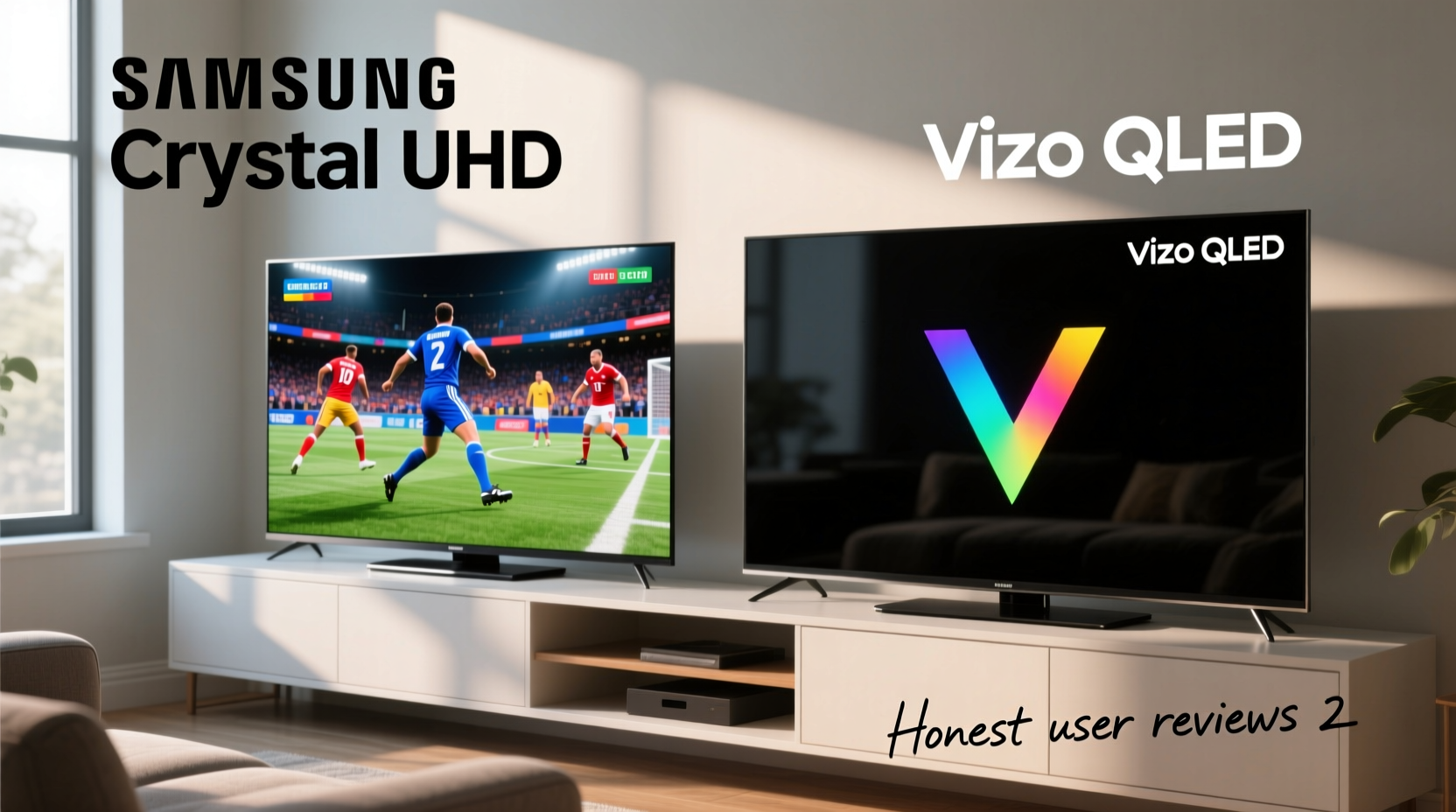
Before diving into performance, it's essential to clarify what these terms actually mean. Samsung markets its entry-level 4K TVs as \"Crystal UHD,\" which is not a display technology like OLED or QLED but rather a branding term for their LED-backlit LCD panels with quantum dot color enhancement. These sets deliver improved color over standard LED TVs but lack full-array local dimming (FALD) and high peak brightness levels found in higher-end models.
Vizio’s QLED TVs, meanwhile, use quantum dot technology more aggressively, particularly in their higher-tier P-Series and M-Series lines. While not matching Samsung’s flagship QLEDs, Vizio positions its QLED models as offering near-premium performance at lower price points.
“Many consumers don’t realize that ‘QLED’ isn’t standardized—it varies by brand and model tier. What matters most is backlighting, contrast control, and color volume.” — David Lin, AV Testing Lab Director
Picture Quality: Brightness, Color, and Contrast Compared
Picture quality remains the top deciding factor for most buyers. Here’s how the two brands stack up across key metrics based on user-reported experiences and lab tests:
| Metric | Samsung Crystal UHD | Vizio QLED (P-Series) |
|---|---|---|
| Peak Brightness (nits) | 300–450 | 600–800 |
| Backlight Type | Edge-lit LED | Full-array with local dimming (FALD) |
| Contrast Ratio | ~3,500:1 | ~5,000:1 |
| Color Volume (DCI-P3) | 70–75% | 80–85% |
| HDR Performance | Fair (limited highlight detail) | Good (better specular highlights) |
The data shows a consistent advantage for Vizio QLED in dynamic content. Users report that HDR movies on platforms like Netflix or Disney+ appear more vivid and layered on Vizio models due to superior contrast and brightness. The full-array backlighting reduces blooming and improves black levels, especially noticeable in dark-room viewing.
In contrast, Samsung Crystal UHD relies on edge lighting, which can cause light halos around bright objects on dark backgrounds—a common complaint in online forums. However, Samsung does offer slightly more accurate default color calibration out of the box, appealing to users who watch mostly daytime TV or news.
User Experience: Smart Systems, Sound, and Longevity
Beyond picture quality, daily usability plays a major role in satisfaction. Both brands run proprietary operating systems: Samsung uses Tizen OS, while Vizio runs SmartCast.
- Tizen (Samsung): Known for speed, clean interface, and wide app support including Apple AirPlay and Amazon Alexa integration.
- SmartCast (Vizio): Simpler interface, voice-first design, but limited native apps. Requires casting from mobile devices for many services.
Users frequently praise Tizen’s responsiveness, though some find the menu layout overly complex. SmartCast receives mixed reviews—some appreciate its minimalism; others complain about sluggish updates and lack of YouTube optimization.
Audio performance is underwhelming on both sides. Most owners agree that built-in speakers on either model benefit significantly from a soundbar. Neither delivers rich bass or room-filling audio, typical for slim TVs.
Longevity reports suggest Samsung edges ahead here. With better build quality and longer software update cycles (up to 3 years), Crystal UHD sets tend to remain stable over time. Vizio models have been reported to experience firmware glitches after 18–24 months, although hardware failures are rare.
Real User Scenario: A Side-by-Side Test in a Living Room Setting
Daniel R., a cord-cutter in Austin, TX, purchased a 65” Samsung Crystal UHD TU-8000 and later upgraded to a Vizio P-Series Quantum X 65” after a year-long trial period. His observations reflect broader trends among enthusiasts.
“The Samsung was fine for daytime streaming—bright enough, colors looked natural,” he said. “But when I started watching more films at night, the blacks looked gray, and bright lights in scenes like cityscapes would bleed. Switching to the Vizio was a game-changer. Suddenly shadows had depth, and explosions in action scenes popped without washing out.”
He did note trade-offs: “The Samsung remote felt sturdier, and I missed having direct access to HBO Max without opening my phone first. But the picture improvement made it worth the learning curve.”
This case illustrates a common theme: Vizio excels in visual fidelity, while Samsung offers polish in ecosystem integration and industrial design.
What Experts and Reviewers Are Saying
Professional reviewers generally align with user sentiment. RTINGS.com, a trusted source for independent testing, rates the Vizio M-Series Quantum above equivalent Samsung Crystal UHD models in overall performance, citing:
- Better contrast and uniformity
- Superior motion handling (higher refresh rate processing)
- More effective HDR rendering
However, they also note that Samsung wins in:
- Input lag (important for casual gamers)
- Remote usability
- Consistent firmware updates
One recurring point is that Samsung markets its Crystal UHD line as “smart 4K” without emphasizing its limitations compared to true QLED or Neo QLED lines. This leads some buyers to expect higher performance than the hardware can deliver.
Checklist: Choosing Between Samsung Crystal UHD and Vizio QLED
Use this checklist to determine which TV suits your needs best:
- ✅ Do you watch primarily in bright rooms? → Consider Samsung for decent glare resistance.
- ✅ Is deep black level and cinematic contrast important? → Choose Vizio QLED with FALD.
- ✅ Do you rely heavily on built-in apps without casting? → Samsung’s Tizen offers better native support.
- ✅ Are you on a tight budget but want premium-like visuals? → Vizio provides better bang-for-buck.
- ✅ Do you plan to keep the TV for 5+ years? → Samsung may offer longer software support.
- ✅ Will you connect a soundbar or AV receiver anyway? → Audio differences become negligible.
Frequently Asked Questions
Is Samsung Crystal UHD considered a QLED TV?
No. Despite marketing language, Samsung reserves the “QLED” label for its mid-to-high-end models with enhanced quantum dot layers and better backlights. Crystal UHD uses basic quantum dots but lacks the performance features of true QLED.
Does Vizio QLED last as long as Samsung?
Hardware longevity is comparable, but Samsung typically provides longer software support and more frequent security patches. Vizio has improved in recent years, but still lags behind Samsung in update consistency.
Which is better for gaming: Crystal UHD or Vizio QLED?
For casual gaming, both perform adequately. Samsung usually has slightly lower input lag (~10ms vs ~13ms). However, Vizio QLED offers better motion clarity and HDR pop, making fast-paced games visually more engaging if your console supports HDMI 2.1 features.
Final Verdict: Is Samsung Crystal UHD Really That Much Worse?
It depends on what you value. If you prioritize vibrant HDR, deeper contrast, and cinematic realism—especially in dimly lit environments—then yes, Samsung Crystal UHD falls short compared to Vizio’s QLED offerings. The difference is measurable and noticeable in side-by-side viewing.
However, calling it “much worse” oversimplifies the situation. Samsung delivers a smoother smart TV experience, better remote design, and stronger brand reliability. For users who mainly stream YouTube, browse social media, or watch daytime content, the gap narrows significantly.
In essence, Vizio QLED wins on raw picture performance. Samsung Crystal UHD wins on ecosystem refinement and perceived build quality. Neither is objectively “bad”—they serve different priorities.




 浙公网安备
33010002000092号
浙公网安备
33010002000092号 浙B2-20120091-4
Comments
No comments yet. Why don't you start the discussion?