
For many professionals, the traditional 9-to-5 workday involves long stretches of sitting—whether at a computer, in meetings, or commuting. As awareness of sedentary risks grows, standing desks have surged in popularity. But what if your routine already includes limited sitting time? Is investing in a standing desk still worthwhile when you're only seated for three to four hours daily?
The answer isn’t a simple yes or no. It depends on how you move throughout the day, your physical health, your work environment, and your long-term wellness goals. While standing desks are often marketed as a cure-all for office-related discomfort, their value varies significantly based on individual circumstances. For someone with low daily sitting exposure, the marginal benefit may be smaller—but not necessarily negligible.
This article examines the real-world impact of standing desks for light sitters, evaluates the science behind movement and posture, and offers practical guidance for deciding whether such an investment makes sense for your lifestyle.
Understanding Sedentary Behavior and Its Risks
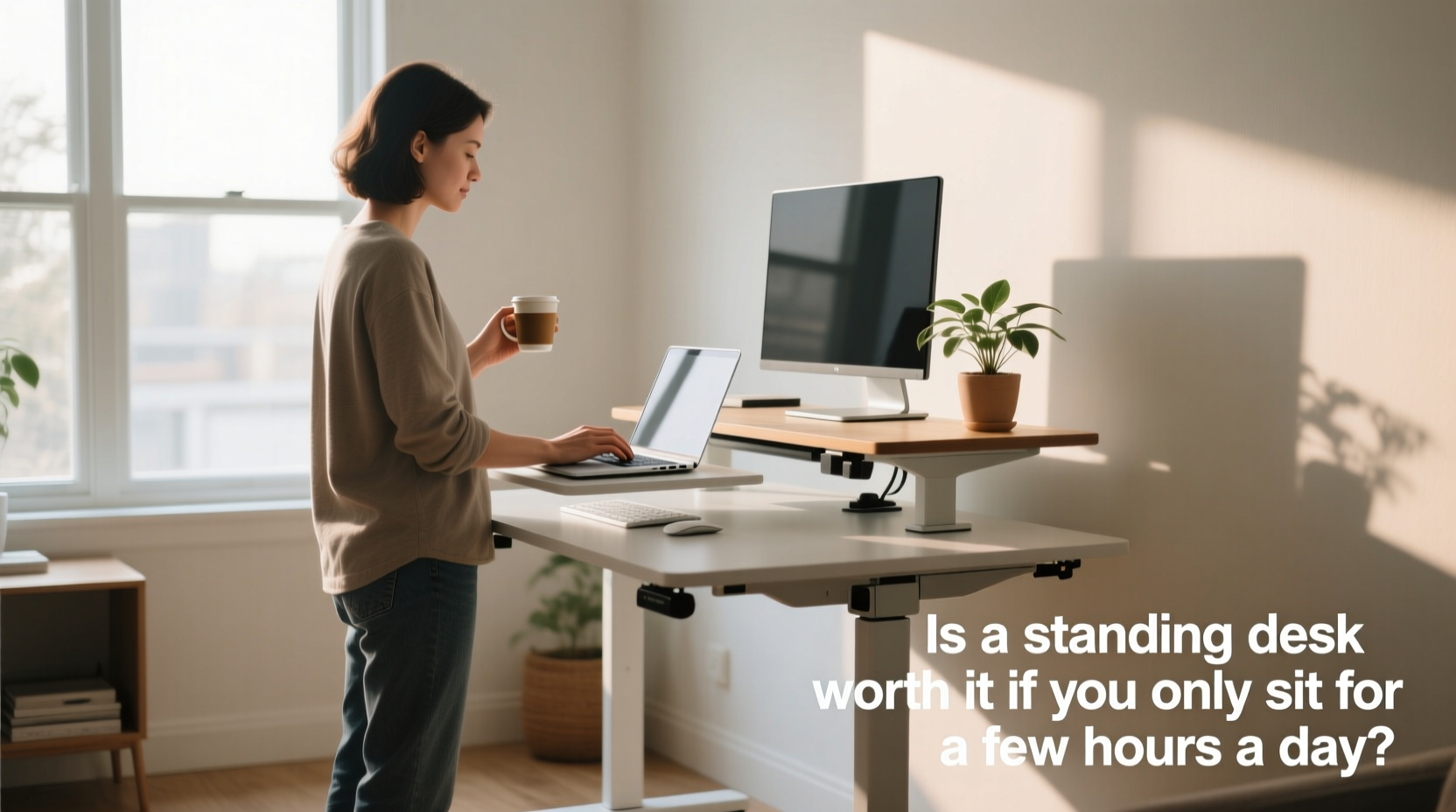
Sedentary behavior refers to any waking activity involving low energy expenditure while sitting or reclining—typically less than 1.5 metabolic equivalents (METs). Prolonged sitting has been linked to increased risks of cardiovascular disease, type 2 diabetes, obesity, musculoskeletal disorders, and even premature mortality, independent of exercise levels.
However, recent research suggests that total sitting time is only part of the equation. The *pattern* of sitting matters just as much. A 2021 study published in the British Journal of Sports Medicine found that breaking up long sitting bouts with brief periods of standing or walking reduced cardiometabolic risk markers more effectively than simply reducing overall sitting duration.
If you already spend only a few hours seated each day—and those sessions are frequently interrupted by walking, stretching, or light activity—the incremental benefit of a standing desk may be modest. On the other hand, if your few hours of sitting occur in unbroken blocks (e.g., two back-to-back two-hour meetings), introducing variability through standing could still offer meaningful physiological advantages.
“Even short interruptions to sitting can improve glucose metabolism and circulation. It’s not just about how much you sit, but how you break it up.” — Dr. Elaine Chen, Biomechanist and Ergonomics Researcher, University of Toronto
When a Standing Desk Adds Value—And When It Doesn’t
Standing desks aren't universally beneficial. Their effectiveness hinges on usage patterns, ergonomic setup, and personal physiology. Below is a comparison of scenarios where a standing desk is likely to help versus situations where it may offer little return on investment.
| Situation | Likely Benefit from Standing Desk | Why |
|---|---|---|
| You sit 3–4 hours daily in uninterrupted blocks | High | Standing breaks reduce blood pooling, improve posture transitions, and support metabolic function. |
| You alternate sitting with frequent walking or movement | Low to Moderate | Movement already provides the primary benefits; standing may add minimal extra value. |
| You experience lower back pain after sitting | Moderate to High | Standing can relieve disc pressure and encourage core engagement, reducing strain. |
| You stand or walk for most of the day outside work hours | Low | Your body already avoids prolonged inactivity; additional standing may increase fatigue. |
| You have circulatory issues (e.g., varicose veins) | Cautious Use | Excessive standing can worsen venous return problems without proper support. |
The key takeaway: standing desks are tools for *movement variation*, not replacements for activity. If your day naturally includes dynamic postures, adding a standing station might not shift the needle much. But if your few sitting hours are rigidly fixed, introducing postural change—even occasionally—can enhance comfort and long-term health.
Practical Alternatives to Full Standing Desks
Not every solution requires a $300–$600 adjustable workstation. Especially for light sitters, simpler, lower-cost strategies can deliver similar benefits without cluttering your space or draining your budget.
- Portable risers: These sit atop your existing desk and elevate your monitor and keyboard, allowing temporary standing sessions.
- Wall-mounted shelves: Install a fixed shelf at elbow height for quick standing tasks like reading emails or making calls.
- Active seating: Swap your chair for a stability ball or kneeling stool to engage core muscles while seated.
- Walking meetings: Replace seated discussions with outdoor or hallway walks, combining conversation with movement.
- Timed posture shifts: Use a smartwatch or app to prompt position changes every 25–30 minutes.
A 2020 pilot study at Stanford’s Occupational Wellness Lab showed that participants who used improvised standing setups (e.g., kitchen counters) for 20-minute intervals reported comparable reductions in neck and shoulder tension as those with motorized desks—so long as they maintained proper alignment.
Mini Case Study: Sarah, Part-Time Remote Worker
Sarah works remotely four days a week, primarily managing client communications. Her job involves about three and a half hours of sitting spread across morning and afternoon blocks. She initially considered buying a standing desk after reading about its benefits but hesitated due to cost and space constraints.
Instead, she experimented with alternatives: placing her laptop on a bookshelf for 15-minute check-ins, taking phone calls while pacing, and doing stretch breaks every hour. After six weeks, she noticed improved focus and fewer instances of mid-afternoon stiffness. When she did invest in a basic desktop riser ($79), she used it selectively—only during deep work sessions—and found it enhanced concentration without dominating her workflow.
Sarah’s experience illustrates that for light sitters, intentionality matters more than equipment. Strategic micro-movements provided most of the benefit; the desk was a helpful supplement, not a necessity.
Step-by-Step Guide to Evaluating Your Need
Before purchasing a standing desk, follow this five-step process to assess whether it aligns with your actual needs:
- Track your current posture habits. For three workdays, log how long you sit, stand, and move. Note when discomfort arises.
- Identify sitting patterns. Are your seated periods continuous or broken? Do they cluster in the late morning or early afternoon?
- Test standing manually. Use a counter, table, or stack of books to simulate a standing workstation for 15–20 minutes at a time. Pay attention to energy, focus, and physical feedback.
- Assess ergonomic feasibility. Ensure your makeshift setup allows wrists to stay neutral, elbows bent at 90°, and screen at eye level. Poor form negates any benefit.
- Decide based on results. If standing improves alertness or reduces discomfort, consider a dedicated solution. If not, prioritize movement over posture-switching.
This method prevents impulsive purchases and ensures decisions are grounded in real-world experience rather than marketing hype.
Frequently Asked Questions
Can standing too much be harmful?
Yes. Excessive standing—especially on hard surfaces without supportive footwear—can lead to lower limb swelling, varicose veins, and foot or knee pain. The goal is balance: aim for a ratio of approximately 1:1 to 2:1 (sitting to standing) during work hours, with regular movement interspersed.
Do standing desks boost productivity?
Some users report increased alertness and reduced fatigue during standing sessions, particularly in the mid-afternoon slump. However, productivity gains are highly individual. Tasks requiring fine motor control (like detailed writing or coding) may suffer if standing causes discomfort or instability.
Are there affordable ways to try a standing desk?
Absolutely. Desktop risers start around $50, and DIY options (like sturdy cardboard boxes or repurposed furniture) can serve as temporary trials. Many coworking spaces also offer standing stations you can use by the hour.
Action Plan: Making the Right Choice for You
So—is a standing desk worth it if you only sit for a few hours a day? The evidence suggests that for most light sitters, the answer is: only if your sitting is consolidated into long, static periods or if you experience discomfort that varies with posture.
If you're already active throughout the day, the added benefit of standing may be minimal. But if your few hours of sitting leave you stiff, unfocused, or sluggish, introducing controlled standing intervals—even without a dedicated desk—can make a noticeable difference.
Here’s a checklist to guide your decision:
- ☑ I sit in blocks longer than 60 minutes without moving
- ☑ I experience back, neck, or shoulder tension after sitting
- ☑ I have space and budget for a riser or adjustable desk
- ☑ I’m willing to experiment with posture changes gradually
- ☑ My workspace allows proper ergonomics when standing
If three or more apply, a standing solution—whether permanent or portable—could be a smart addition. Otherwise, focus on increasing overall movement: take the stairs, stretch between tasks, or schedule walking breaks. These habits yield broader benefits than posture alone.
“The best posture is the next one. Variety, not any single position, is what protects the body over time.” — Katy Bowman, Movement Scientist and Author of *Move Your DNA*
Conclusion
A standing desk isn’t a magic bullet—and it’s certainly not essential for everyone. If your workday already includes diverse movement and limited sitting, the marginal gain may not justify the expense or space. But if your few hours of sitting feel rigid or uncomfortable, introducing intentional standing breaks can enhance both well-being and performance.
Ultimately, the question isn’t just about desk type—it’s about designing a work life that supports natural human movement. Whether through a high-tech converter or a disciplined habit of rising every half hour, the goal remains the same: to avoid staying still for too long.




 浙公网安备
33010002000092号
浙公网安备
33010002000092号 浙B2-20120091-4
Comments
No comments yet. Why don't you start the discussion?