
When it comes to choosing an Apple Watch, the decision often boils down to balancing cost and capability. The Apple Watch SE sits at a compelling mid-point in Apple’s lineup—offering core smartwatch functionality without breaking the bank. On the other end of the spectrum, the Apple Watch Ultra is built for extreme conditions, endurance athletes, and users who demand ruggedness and advanced metrics. But for most people, the real question isn’t whether the Ultra is impressive—it’s whether its premium features are necessary. Is the Apple Watch SE actually good enough?
The answer depends on your lifestyle, fitness goals, and how deeply you integrate technology into daily routines. For casual users and even regular exercisers, the SE may be more than sufficient. But if you're diving into open water, navigating remote trails, or tracking granular health data, the Ultra brings tools the SE simply doesn’t offer.
Performance and Core Functionality: Where They Align
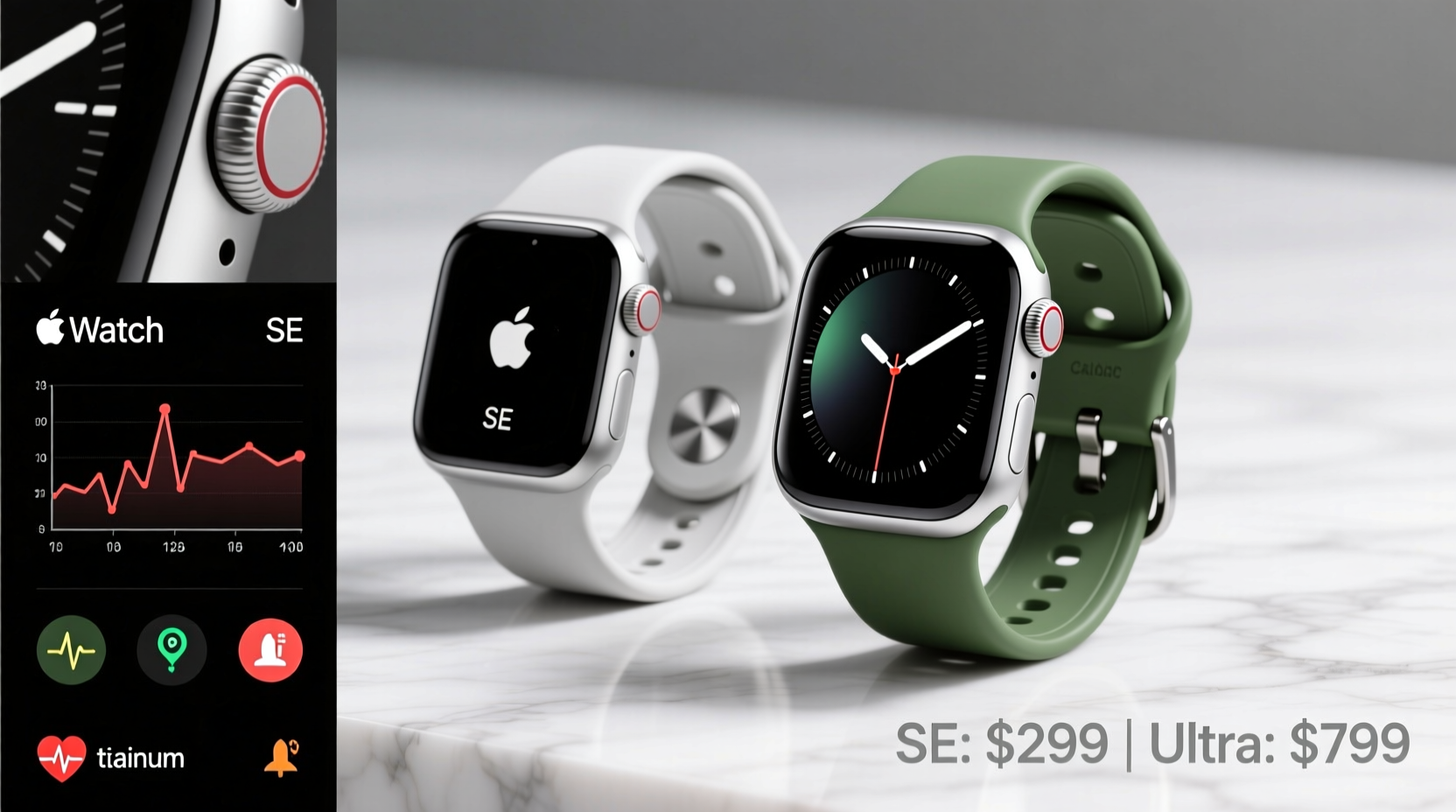
At their foundation, both the Apple Watch SE (second generation as of 2023) and the Apple Watch Ultra run on modern versions of watchOS and deliver nearly identical core experiences. You’ll get:
- Seamless iPhone integration
- iMessage, phone calls, and notifications
- Apple Fitness+ and third-party app support
- Siri, Apple Pay, and Find My
- Basic health monitoring: heart rate, sleep tracking, fall detection, and emergency SOS
Under the hood, the SE uses the S8 chip, which is powerful enough for smooth navigation, quick app launches, and reliable background processing. While the Ultra also runs on the S8, it benefits from better thermal management and sustained performance during long workouts—something only noticeable under extreme use.
“Most users won’t feel any lag difference between the SE and Ultra in everyday tasks. The experience is consistent across devices when it comes to core functionality.” — David Lin, Wearable Tech Analyst at TechPulse Insights
Design and Durability: Built for Different Worlds
This is where the gap widens. The Apple Watch Ultra is engineered for adventure. It features a titanium case, flat sapphire crystal front, and a rugged crown designed for glove use. Its 49mm size makes it easier to read in sunlight and interact with while wearing gloves. It’s also rated IP6X for dust resistance and WR100 for water resistance up to 100 meters—making it suitable for scuba diving with proper apps.
In contrast, the SE has an aluminum case, Ion-X glass (less scratch-resistant than sapphire), and a standard digital crown. It’s water-resistant to 50 meters (WR50), fine for swimming and showering, but not recommended for high-speed water sports or deep diving.
| Feature | Apple Watch SE | Apple Watch Ultra |
|---|---|---|
| Case Material | Aluminum | Titanium |
| Display | Ion-X Glass | Sapphire Crystal |
| Water Resistance | WR50 (50m) | WR100 (100m) |
| Dust Resistance | Not rated | IP6X |
| Brightness | 1000 nits peak | 2000 nits peak |
| Size | 40mm / 44mm | 49mm |
The Ultra’s screen brightness is a game-changer outdoors. At 2,000 nits, it remains readable in direct sunlight—a critical feature for hikers, cyclists, and sailors. The SE’s 1,000-nit display is adequate for city use but can struggle under harsh sun.
Fitness and Health Tracking: Know Your Use Case
Both watches include essential sensors: optical heart rate monitor, accelerometer, gyroscope, and compass. However, the Ultra adds several key upgrades that matter for serious athletes:
- Depth gauge and water temperature sensor (for swimmers and divers)
- Louder speaker and mic for noisy environments
- Longer battery life (up to 36 hours, extendable to 60 in low-power mode)
- Customizable Action Button for instant workout start, dive mode, or flashlight
- More precise GPS with dual-frequency support (improves trail accuracy)
The SE tracks workouts like running, cycling, swimming, and yoga effectively. It logs calories, distance, pace, and heart zones. But it lacks the Ultra’s ability to time-lap automatically during open-water swims or record elevation changes with the same precision.
For someone training for a marathon or logging daily steps, the SE is more than capable. But for a triathlete doing open-water segments or a mountaineer relying on GPS navigation, the Ultra’s tracking fidelity becomes invaluable.
Real-Life Example: Sarah’s Weekend Trail Run
Sarah is an intermediate runner who recently upgraded from an older Fitbit to the Apple Watch SE. She loves tracking her weekly jogs around the city park and receives motivation from closing her activity rings. Last month, she joined a trail-running group for a weekend excursion in the mountains.
During the hike, her SE struggled to maintain GPS lock through dense tree cover. She couldn’t see her screen clearly in the midday sun, and by hour five, the battery dropped below 30%. Her friend Mark, wearing an Ultra, had no issues—he used the Action Button to instantly mark split times, followed turn-by-turn directions on his wrist, and still had 40% battery after 10 hours.
Sarah didn’t regret her SE purchase—she uses it daily and values its simplicity—but she now understands why the Ultra exists. For occasional outdoor adventures, the SE works. But when the environment turns demanding, the Ultra’s specialized tools make a tangible difference.
Battery Life and Charging Habits
Battery life is one of the most practical differentiators. The Apple Watch SE lasts about 18 hours under typical use—meaning daily charging is non-negotiable. Some users stretch it to 30–36 hours with aggressive power-saving, but it’s not designed for multi-day trips.
The Ultra, in contrast, offers up to 36 hours in normal mode and can extend to 60 hours in Expedition Mode (which disables always-on display and background heart rate checks). This makes it viable for ultramarathons, backpacking, or international flights without access to charging.
“For travelers and outdoor enthusiasts, the ability to go two full days without charging removes a major logistical hurdle. That alone justifies the Ultra for many.” — Lena Patel, Outdoor Gear Reviewer at TrailWired
If you charge your watch every night and don’t venture beyond cellular coverage, the SE’s battery is acceptable. But if you’re ever off-grid or need uninterrupted tracking, the Ultra’s endurance is a significant advantage.
Price and Value Comparison
The pricing difference is substantial:
- Apple Watch SE: starts at $249 (GPS model)
- Apple Watch Ultra: starts at $799 (GPS + Cellular standard)
That’s a $550 gap—enough to buy two SEs and still have money left over. For budget-conscious buyers, the SE offers exceptional value. It includes family setup support (allowing kids or elders to use it without an iPhone), automatic crash detection, and all the core health alerts found on pricier models.
The Ultra, meanwhile, justifies its cost through niche capabilities. You’re paying for materials, sensors, and software tailored to professionals and adventurers. Most consumers will never use the depth gauge, dual-frequency GPS, or Action Button modes.
“The Ultra isn’t a better Apple Watch for everyone—it’s a better tool for specific users. If you don’t need those tools, you’re essentially paying for unused potential.” — Michael Tran, Senior Editor at WearableHQ
Checklist: Which Apple Watch Is Right for You?
Use this checklist to determine whether the SE meets your needs or if the Ultra is worth the investment:
- Do you swim regularly or dive? → If yes, especially in open water, the Ultra’s deeper water resistance and swim-specific features matter.
- Do you spend extended time outdoors without charging access? → If yes, the Ultra’s 36+ hour battery is a necessity.
- Do you rely on GPS for navigation during hikes or trail runs? → If yes, the Ultra’s superior GPS accuracy is beneficial.
- Are you sensitive to screen visibility in sunlight? → If yes, the Ultra’s 2,000-nit display outperforms the SE.
- Is your budget under $300? → If yes, the SE is the clear choice.
- Do you want a rugged, durable device for tough environments? → If yes, the Ultra’s titanium build and sapphire glass add meaningful protection.
If you answered “yes” to three or more of the first five questions, the Ultra may be justified. If most of your answers point to everyday use, the SE is likely good enough.
Frequently Asked Questions
Can the Apple Watch SE do everything the Ultra can?
No. While both run the same operating system and support similar apps, the SE lacks hardware features like the depth sensor, Action Button, louder speaker, dual-frequency GPS, and ultra-bright display. It also has shorter battery life and less durable construction.
Is the Apple Watch SE worth buying in 2024?
Absolutely. For most users, the SE delivers the essential Apple Watch experience at a fair price. It supports health monitoring, fitness tracking, communication, and safety features like fall and crash detection. Unless you have specialized outdoor or athletic needs, it remains one of the best values in wearable tech.
Does the Apple Watch Ultra work with older iPhones?
Yes, but compatibility depends on iOS version. Both the SE and Ultra require iPhone 8 or later running iOS 17 or newer. As long as your iPhone meets that requirement, either watch will pair successfully.
Conclusion: Making the Right Choice for Your Life
The Apple Watch SE is not just “good enough”—it’s excellent for what it’s designed to do. It brings the core Apple Watch experience to a broader audience without compromising on reliability, design, or essential features. For students, office workers, parents, and casual fitness enthusiasts, it checks every box.
The Apple Watch Ultra, however, isn’t trying to be all things to all people. It’s a specialist device—one built for extremes. If your lifestyle involves endurance sports, frequent travel to remote areas, or professional outdoor work, then its premium price translates into real-world utility.
Ultimately, the decision isn’t about which watch is better overall. It’s about alignment with your actual needs. Most people don’t need a Ferrari to commute to work—and similarly, most don’t need an Ultra to stay active and connected.




 浙公网安备
33010002000092号
浙公网安备
33010002000092号 浙B2-20120091-4
Comments
No comments yet. Why don't you start the discussion?