
In the vast tapestry of college football history, few plays transcend their immediate context to become cultural touchstones. For Texas Tech fans, one moment stands above all others: Michael Crabtree’s iconic touchdown catch against Texas in 2008. Nearly two decades later, the play is more than just a highlight—it’s a shared memory, a symbol of resilience, and the emotional cornerstone of a rivalry that still simmers. But is the Crabtree catch truly the reason Texas Tech continues to revisit that Texas game? The answer isn’t just yes—it’s layered with legacy, identity, and what sports can mean beyond the scoreboard.
The Game That Defied Expectations
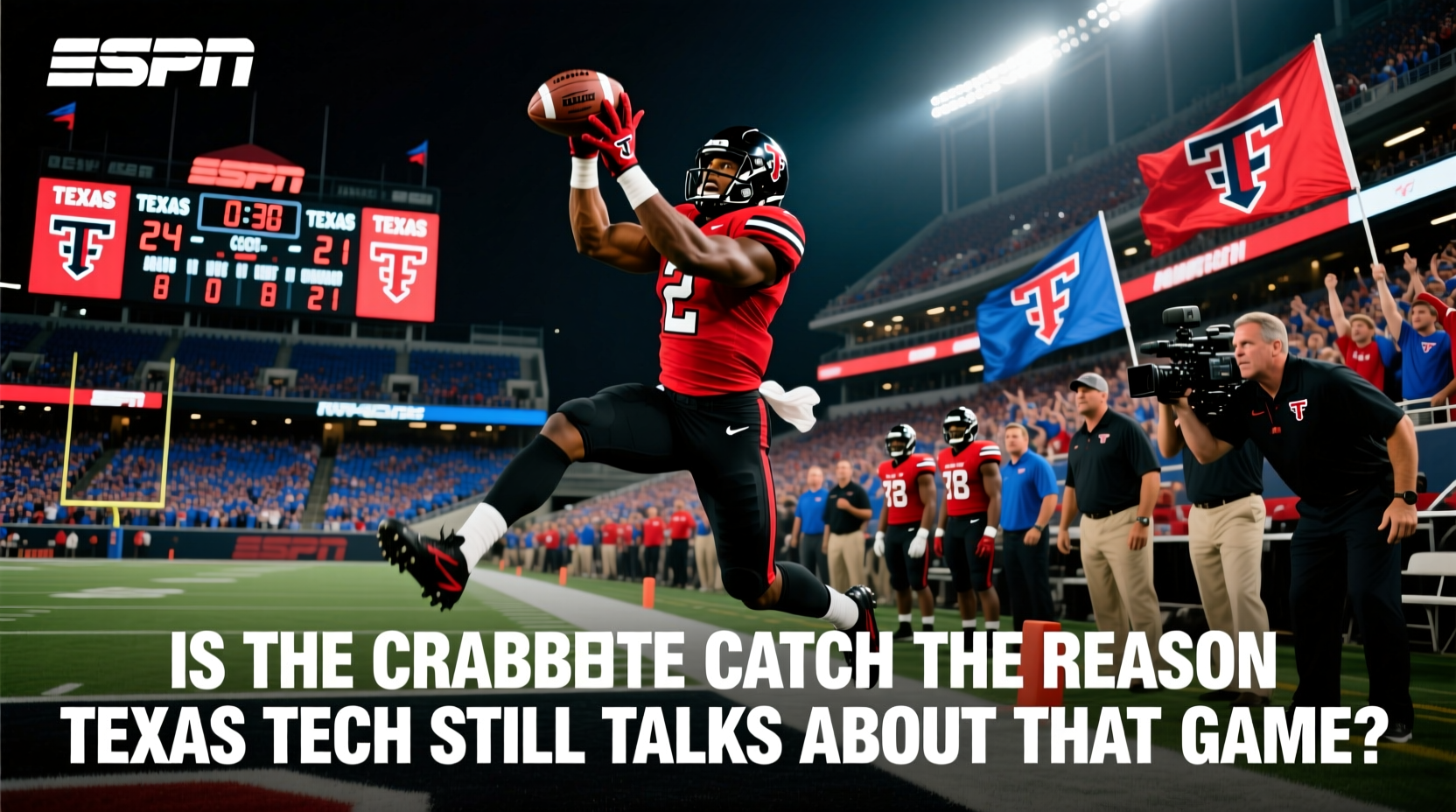
On November 1, 2008, Texas Tech traveled to Austin as underdogs against the No. 1 ranked Texas Longhorns. The Longhorns, led by quarterback Colt McCoy, were undefeated and on a collision course with the BCS National Championship. Texas Tech, meanwhile, was coming off a strong start but largely seen as a mid-tier Big 12 contender. Few predicted an upset. Yet, the Red Raiders didn’t just win—they dismantled expectations with a 35-7 victory in the fourth quarter after trailing 28-7.
The turning point came late in the third quarter when freshman wide receiver Michael Crabtree caught a 28-yard touchdown pass from quarterback Graham Harrell. It wasn’t the longest or flashiest score of the night, but its timing, execution, and aftermath made it legendary. The catch ignited a 28-point unanswered run and shifted momentum permanently. From that moment, Texas Tech played with the confidence of a team that believed it could beat anyone, anywhere.
“Crabtree’s catch wasn’t just a play. It was the moment we realized we belonged at that level.” — Coach Tommy Tuberville, Texas Tech Head Coach (2010–2012)
Why the Catch Still Resonates
The longevity of the Crabtree catch in Texas Tech lore isn’t due solely to its impact on the game. It represents something deeper: a rare triumph over a powerhouse program during a golden era for Texas football. At the time, the Longhorns were national favorites, recruiting elite talent, and dominating the conference. For Texas Tech—a program historically overshadowed by larger rivals like Texas and Oklahoma—to not only win but dominate in Austin was seismic.
Moreover, Michael Crabtree himself became a folk hero. A true freshman stepping up in a hostile environment, catching crucial passes throughout the second half, and finishing with 11 receptions for 184 yards and three touchdowns, including the pivotal third-quarter score. His performance earned him the Biletnikoff Award that season—the first freshman ever to do so—and cemented his legacy before he’d even completed his first year.
The Cultural Afterlife of the Play
What separates great plays from legendary ones is repetition and reverence. The Crabtree catch has been replayed endlessly in fan forums, highlight reels, and campus events. It’s featured in Texas Tech’s official athletic department retrospectives and frequently resurfaces on social media whenever the two teams are scheduled to meet again.
But beyond nostalgia, the catch has taken on symbolic weight. It’s invoked during recruiting pitches, used in motivational speeches, and referenced in alumni conversations as proof that Texas Tech can compete with the best. In a state where football is religion and hierarchy is rigid, the 2008 game—and specifically the Crabtree catch—became an article of faith.
How the Rivalry Evolved After the Catch
After 2008, the Texas-Texas Tech rivalry took on new energy. While the two schools hadn’t historically been fierce rivals—geographically distant and with differing levels of success—the outcome of that game forced a recalibration. Texas fans remember it as a blip; Tech fans remember it as a breakthrough.
Subsequent matchups have carried extra tension. Even after Texas moved to the SEC in 2024, fans on both sides continue to bring up the 2008 result. For Texas Tech supporters, it’s validation. For Texas loyalists, it’s a reminder of vulnerability. The catch, therefore, functions as both a trophy and a taunt—depending on who’s telling the story.
A Legacy Cemented in Moments, Not Just Stats
To understand why this particular catch endures, consider the difference between statistics and symbolism. Statistically, Crabtree had better games. He once recorded 232 receiving yards in a single contest. But none carried the narrative weight of the 2008 Texas game.
The catch occurred on 3rd-and-13, with Tech facing a potential punt. Harrell rolled right, evaded pressure, and fired a bullet to Crabtree near the sideline. He secured the ball despite tight coverage, dragged a defender into the end zone, and emerged with the ball raised high. The image—Crabtree standing tall, arms outstretched, crowd stunned—is etched into collective memory.
| Aspect | Texas Tech Perspective | Texas Perspective |
|---|---|---|
| Game Significance | Defining program moment | Anomalous loss |
| Crabtree’s Role | Legendary arrival | Freshman surprise |
| Rivalry Intensity | Peak competitive achievement | Minor setback |
| Lasting Memory | “We beat No. 1” | “We lost focus” |
Real Impact Beyond the Field
The ripple effects of the catch extended well beyond the final whistle. In the weeks following the game, Texas Tech rose to No. 2 in the national rankings—the highest in school history. The victory boosted recruiting, increased media exposure, and gave the program a newfound credibility.
More importantly, it altered the internal narrative. Before 2008, Texas Tech was often seen as a fun, high-scoring team that couldn’t win big games. Afterward, that label began to fade. The Crabtree catch became shorthand for proving doubters wrong.
“The beauty of college football is that one play can change everything. That catch didn’t just win a game—it changed how people saw our program.” — Kliff Kingsbury, Texas Tech Quarterback (2000–2002), later Head Coach
Mini Case Study: The Recruiting Ripple Effect
In 2009, Texas Tech landed its highest-rated recruiting class in over a decade. Among the recruits was future NFL player Eric Ward, who cited the 2008 Texas game as a major factor in his decision. “I watched that catch,” he said in an interview, “and I thought, ‘These guys aren’t scared of anybody.’ That’s the kind of place I wanted to play.”
Programs build legacies not just through championships, but through moments that inspire belief. The Crabtree catch did exactly that—it convinced young athletes that Texas Tech could compete with the giants.
FAQ: Why Does This Moment Still Matter?
Didn’t Texas Tech beat other ranked teams?
Yes, but none came against the No. 1 team in such dramatic fashion, especially on the road. The combination of ranking, opponent prestige, and comeback magnitude makes this unique.
Wasn’t Crabtree involved in other big plays?
Absolutely—he had many standout performances. But this catch came at the exact pivot point of the game, shifting momentum irreversibly. Timing elevated it beyond mere stats.
Do younger fans still care about a 2008 game?
Yes. Newer generations inherit the story through family, alumni networks, and university culture. It’s taught as part of Tech’s football identity.
Step-by-Step: How One Play Became a Legacy
- The Setup: Texas enters as No. 1, Tech as underdog.
- The Struggle: Tech trails 28-7 in the third quarter.
- The Spark: Crabtree scores to make it 28-14, igniting the comeback.
- The Surge: Tech scores 28 unanswered points.
- The Aftermath: National recognition, program elevation, lasting mythos.
Conclusion: More Than a Catch—A Cultural Beacon
So, is the Crabtree catch the reason Texas Tech still talks about that Texas game? In short: yes, but not just because of the yards or the points. It’s remembered because it represents defiance, excellence, and the unpredictable magic of college football. It was a moment when a program punched above its weight and left a mark that time hasn’t erased.
Legends aren’t built solely on wins—they’re built on moments that resonate across generations. The Crabtree catch wasn’t just a touchdown. It was a declaration. And as long as Texas Tech football tells its story, that play will remain at the heart of it.




 浙公网安备
33010002000092号
浙公网安备
33010002000092号 浙B2-20120091-4
Comments
No comments yet. Why don't you start the discussion?