
The Dyson Airwrap revolutionized at-home hairstyling when it launched in 2018. With its innovative Coanda airflow technology, it promised salon-quality curls, smooth blowouts, and frizz control without extreme heat damage. But at a retail price of $549 (and sometimes more), it’s never been an impulse buy. Now, nearly six years later, dozens of budget-friendly alternatives—often called \"dupes\"—have flooded the market, some priced under $100. So, is the Dyson Airwrap still worth the splurge, or have dupes finally closed the gap?
To answer that, we need to look beyond marketing claims and examine real-world performance, build quality, versatility, long-term value, and user experience. The truth isn’t binary: for some, a dupe may be perfectly sufficient. For others, especially those with thick, curly, or hard-to-manage hair, the original remains unmatched.
How the Dyson Airwrap Works: Technology That Set It Apart
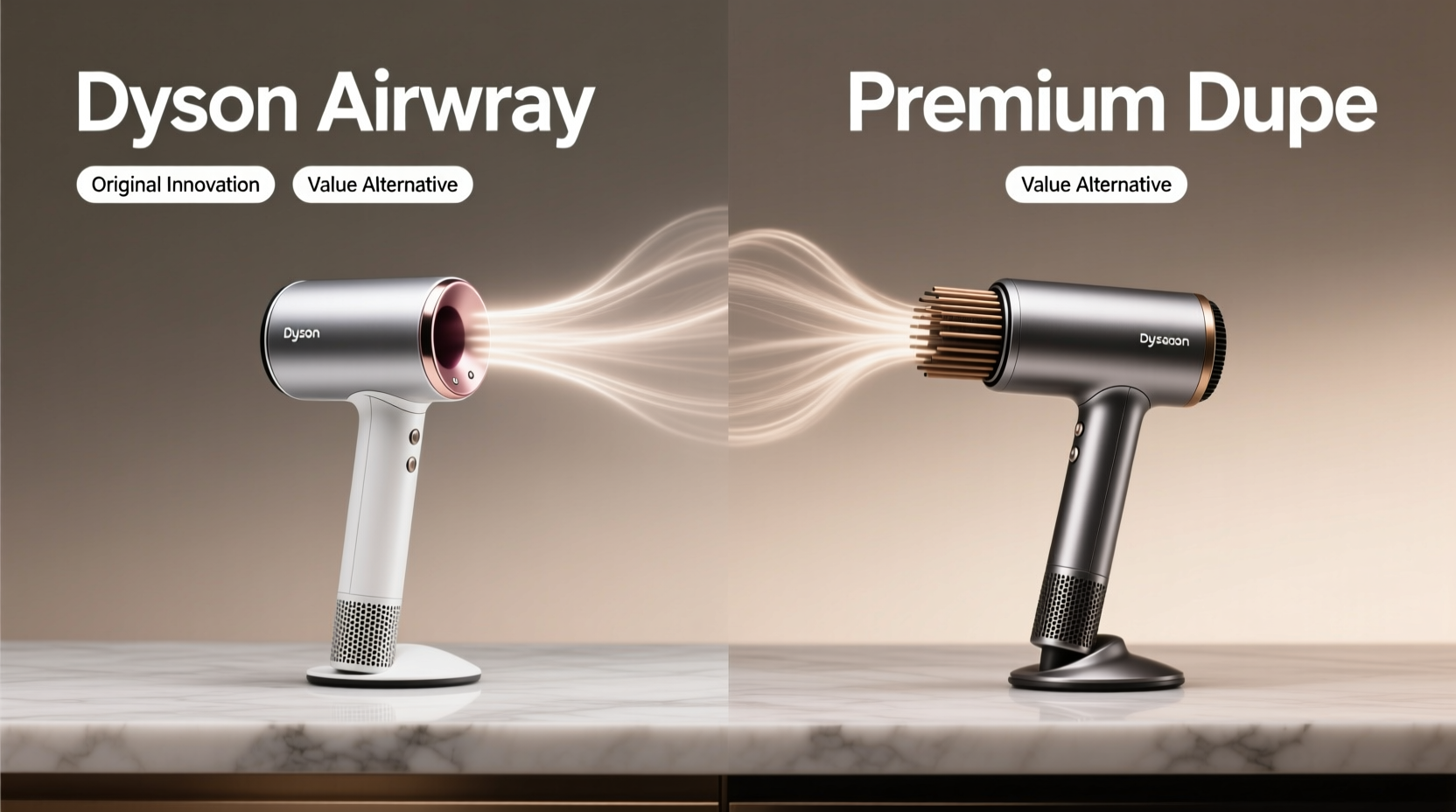
The Dyson Airwrap uses Dyson’s patented Coanda effect—a principle in fluid dynamics where air flows along a surface and pulls surrounding particles with it. In practice, this means the tool attracts hair to the barrel without clamps or excessive tension, wrapping strands gently around the barrel using airflow alone. This reduces pulling, minimizes breakage, and allows for lower heat settings compared to traditional curling irons.
It also features intelligent heat control, measuring temperature over 40 times per second to prevent extreme heat exposure. Combined with magnetic attachments (easily swappable between styles), it delivers multiple functions: smoothing, curling, volumizing, and drying—all in one device.
“Dyson didn’t just make a new styling tool—they rethought how hair interacts with heat and airflow.” — Lena Park, Trichologist & Hair Tech Analyst
This level of engineering doesn’t come cheap. The motor, digital control system, and precision airflow design contribute significantly to the cost. But does that engineering translate into tangible benefits users can see and feel every day?
Dupes vs. Original: A Side-by-Side Comparison
Today’s most popular Airwrap alternatives include brands like Revlon, T3, Conair, and even Amazon Basics. These tools often mimic the look and function—multiple attachments, cool-shot buttons, dual voltage—but they rarely replicate the core technology.
Most dupes rely on traditional ionic or ceramic heating elements and mechanical clamping mechanisms. They don’t use Coanda airflow. Instead, they require users to manually wrap hair around barrels or use clamp-assisted rotation. This increases handling time and potential for uneven results, especially on shorter layers or fine hair.
| Feature | Dyson Airwrap | Top Dupe (e.g., Revlon One-Step Volumizer + Styler) |
|---|---|---|
| Coanda Airflow | Yes – auto-wrapping via airflow | No – manual wrapping required |
| Heat Control | 40+ measurements/sec, adaptive | Fixed settings, no real-time adjustment |
| Attachments | 4–6 magnetic, interchangeable | 2–3 snap-on, less secure |
| Motor Power | Dyson digital motor V9 (high torque) | Standard AC motor (lower suction) |
| Price (MSRP) | $549 | $70–$120 |
| Lifespan (avg. user report) | 5+ years with care | 1.5–3 years |
| Noise Level | Moderate (noticeable but not loud) | Higher pitch, often louder |
The table reveals a clear divergence in engineering philosophy. Dupes prioritize affordability and accessibility; Dyson prioritizes precision, consistency, and hair health. Neither is inherently better—it depends on your needs.
Who Benefits Most From the Dyson Airwrap?
Not every hair type responds equally to styling tools. The Dyson Airwrap excels in specific scenarios:
- Thick, coarse, or curly hair: The strong motor and consistent airflow help manage volume and create defined waves without constant reworking.
- Frizz-prone or damaged hair: Lower heat exposure and reduced mechanical stress mean less cuticle disruption over time.
- Busy professionals or frequent stylers: The speed and reliability save time during morning routines. Users report cutting styling time by 30–50% after mastering the technique.
- People with shoulder-length to long hair: The full-size barrels and airflow efficiency make sectioning and styling more manageable.
In contrast, those with very short hair, naturally straight textures, or minimal styling needs may find the Airwrap overengineered. For someone who only wants a quick root lift or occasional wave, a simpler, cheaper tool might suffice.
“I’ve used both the Dyson and a $90 dupe. On my 4B/4C hair, the difference is night and day. The dupe tugs, overheats, and doesn’t hold the curl. The Airwrap gives me salon results in half the time.” — Jasmine R., Atlanta, GA
Real-World Case Study: Two Years of Daily Use
Consider Sarah K., a 34-year-old marketing executive in Seattle. She has thick, wavy hair that frizzes easily in humidity. She purchased the Dyson Airwrap in 2022 for $549. Prior to that, she relied on a flat iron and round brush, spending 45 minutes each morning.
After a two-week learning curve, she mastered the Airwrap technique. Her routine now takes 20–25 minutes. She uses the soft diffuser to dry, the smoothing brush for roots, and the 1.2-inch barrel for loose waves. Over two years, she estimates she’s saved over 30 hours of styling time and reduced her reliance on heat protectants and anti-frizz serums by half.
She also avoided two salon visits per month at $75 each—saving $1,800 over two years. When factoring in time savings, product reduction, and salon avoidance, her effective ROI began within 14 months.
Sarah did experience one issue: the charging cord degraded after 18 months. Dyson replaced it free of charge under warranty. Meanwhile, her friend Lisa bought a $75 dupe from a drugstore chain. It worked well for three months but then began overheating and emitting a burning smell. It lasted eight months total.
Sarah’s experience illustrates a broader trend: higher upfront cost, but longer lifespan and better integration into daily life.
Are Dupes Good Enough? The Short Answer
For casual users, yes—many dupes are “good enough.”
If you style your hair once or twice a week, have fine to medium hair, and want a quick blowout or light wave, tools like the Revlon One-Step or T3 Whirl Trio offer solid performance. Some even include cool-shot buttons, ionic technology, and adjustable heat settings. They’re lightweight, easy to store, and replaceable if they fail.
However, “good enough” doesn’t mean “equal.” Dupes generally lack:
- Consistent airflow for automatic wrapping
- Precision temperature regulation
- Durable construction (plastics degrade faster)
- Quiet operation
- Strong suction for lifting roots
And while they cost less upfront, their shorter lifespans mean you may replace them every 1–2 years. Over five years, that could mean spending $200–$300 on multiple dupes—still less than Dyson, but with inconsistent results and more e-waste.
Expert Checklist: Is the Dyson Airwrap Right for You?
Answer these questions honestly to determine whether the investment makes sense for your lifestyle:
- Do you style your hair daily or almost daily?
- Is your hair thick, curly, frizzy, or hard to manage?
- Do you currently spend significant time (30+ minutes) on styling?
- Have you spent over $100 on salon blowouts or treatments in the past year?
- Do you value long-term durability over low upfront cost?
- Are you willing to learn a new technique (first 1–2 weeks may be frustrating)?
If you answered “yes” to three or more, the Dyson Airwrap is likely a worthwhile investment. If most answers are “no,” a dupe may serve you just as well.
When a Dupe Might Be the Smarter Choice
Certain situations make dupes not just acceptable, but practical:
- Travel use: Carry a lightweight, inexpensive styler instead of risking damage to your Dyson.
- Teens or college students: A lower-cost option teaches styling skills without financial pressure.
- Trial phase: Test the Airwrap method with a dupe before committing to the full price.
- Secondary device: Keep a dupe in the gym bag or guest bathroom.
Some users adopt a hybrid approach: they own a Dyson for home use and a compact dupe for travel. This balances performance with convenience.
Frequently Asked Questions
Can I get the same results with a dupe as with the Dyson Airwrap?
You can achieve similar-looking styles—especially loose waves or smooth blowouts—but the process is different. Dupes typically require more manual effort, higher heat, and longer styling time. Results may not last as long or look as polished, particularly in humid conditions.
Does Dyson offer refurbished or discounted models?
Yes. Dyson occasionally sells certified refurbished units through its official website with a one-year warranty. These can save $100–$150 and are thoroughly tested. Third-party sellers like Best Buy or Sephora also run seasonal promotions, especially around holidays.
Are there any true Coanda-effect dupes?
As of 2024, no major brand has replicated Dyson’s Coanda airflow system at a lower price. Some claim “air wrap” technology, but these are typically mislabeled. True Coanda engineering requires a powerful, compact motor and precise vent design—patented and expensive to produce.
Final Verdict: Value Over Price
The Dyson Airwrap isn’t for everyone. It’s overkill for someone who throws their hair in a bun most days. But for those who rely on consistent, high-quality styling—especially with challenging hair types—it remains the gold standard.
The rise of dupes hasn’t made the Airwrap obsolete. Instead, it’s created a spectrum of choice. Consumers can now decide based on lifestyle, not just budget. The key is understanding what you’re paying for: not just a tool, but time saved, hair health preserved, and confidence built through reliable results.
Think of it like buying a high-end kitchen blender. If you make smoothies once a month, a $30 model works fine. But if you cook daily, host dinner parties, and value precision, a $400 Vitamix pays for itself in performance and longevity.
Take Action: Make an Informed Decision
Don’t buy based on hype or TikTok trends. Test tools if possible. Watch real-user reviews—not influencer demos with perfect lighting. Calculate your current styling costs: time, products, salon visits. Then ask: will this tool simplify my life, improve my results, and last long enough to matter?




 浙公网安备
33010002000092号
浙公网安备
33010002000092号 浙B2-20120091-4
Comments
No comments yet. Why don't you start the discussion?