
The Fitbit Charge series has long been a favorite among fitness enthusiasts who want a sleek, no-frills tracker that delivers accurate health metrics without breaking the bank. With the release of the Fitbit Charge 6, users are left wondering: is this latest model truly an improvement—or just another incremental update? If you're already using a Charge 3, 4, or 5, the decision to upgrade isn't as straightforward as it once was. This review dives deep into the changes, improvements, and compromises of the Charge 6 to help you decide whether it’s worth your investment.
New Features That Actually Matter
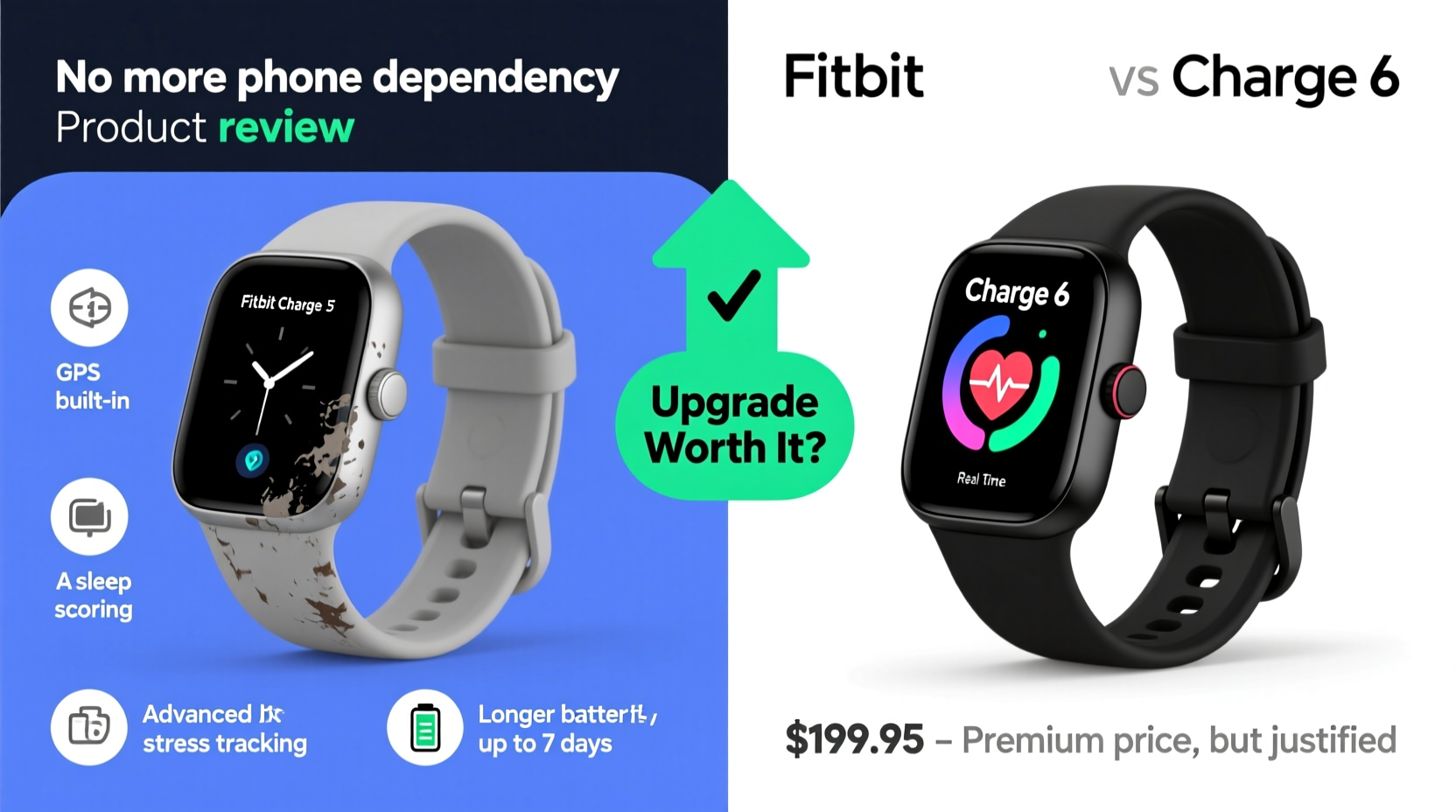
The Fitbit Charge 6 isn’t a complete redesign, but it does introduce several meaningful upgrades over its predecessors. The most notable addition is Google integration—something that sets it apart from earlier models. You now get access to Google Maps navigation prompts, Google Wallet for contactless payments, and YouTube Music controls directly on your wrist. For Android users especially, this seamless ecosystem integration enhances daily usability beyond fitness tracking.
The heart rate sensor has also been upgraded with dual-frequency GPS support, which improves location accuracy during outdoor runs and hikes. Unlike the Charge 5, which struggled with signal dropouts in dense urban environments, the Charge 6 maintains stronger satellite locks thanks to combined GPS and GLONASS systems. This makes route mapping more reliable, especially for trail runners or cyclists navigating complex paths.
Sleep tracking remains one of Fitbit’s strongest suits, and the Charge 6 refines it further. It now uses advanced algorithms to detect sleep stages with greater precision, including REM, light, and deep sleep. More importantly, it provides actionable insights through the Fitbit app, such as suggesting bedtime adjustments based on your circadian rhythm trends over time.
Performance Compared to Older Models
To assess whether the upgrade is justified, it helps to compare key specs across recent generations. While the Charge 4 laid the foundation with built-in GPS and Spotify control, the Charge 5 added ECG and EDA (stress response) sensors—features absent in the Charge 6. Yes, you read that right: despite being newer, the Charge 6 lacks both ECG and skin temperature sensing found in the Charge 5.
This omission raises questions about Fitbit’s product strategy. Was it done to differentiate the premium Sense line? Or was it a cost-cutting move to hit a lower price point? Either way, if you relied on those advanced health metrics, stepping up to the Charge 6 may feel like a downgrade rather than a progression.
| Feature | Charge 4 | Charge 5 | Charge 6 |
|---|---|---|---|
| Built-in GPS | Yes | Yes | Yes (Dual-Frequency) |
| Heart Rate Monitoring | Continuous | Advanced | Improved Accuracy |
| ECG App | No | Yes | No |
| EDA (Stress Sensor) | No | Yes | No |
| Google Integration | No | Limited | Full (Wallet, Maps, YouTube Music) |
| Battery Life | 7 days | 7 days | 7 days (up to 5 with GPS use) |
| Swimproof | Yes (50m) | Yes (50m) | Yes (50m) |
From the table, it's clear that while the Charge 6 improves connectivity and GPS reliability, it sacrifices some high-end biometrics. For casual users focused on step counting, workouts, and sleep quality, these missing features may not matter. But for those managing cardiovascular conditions or tracking stress patterns, the Charge 5 remains the better choice unless you're willing to pay extra for the Fitbit Sense 2.
User Experience: Design, Comfort, and Daily Use
The design of the Charge 6 closely mirrors the Charge 5—slim profile, aluminum case, curved OLED display—but with subtle refinements. The screen brightness has been increased by 20%, making it easier to read under direct sunlight. Touch responsiveness feels snappier, likely due to the updated processor borrowed from the Sense 2 platform.
Wearing it all day—including during sleep—is comfortable thanks to the lightweight build (just 26 grams). The band is interchangeable with previous Fitbit Charge models, so existing accessories remain compatible. However, some users report slight irritation from the charging pins after prolonged wear, particularly if sweat accumulates around the sensor array. A quick rinse with fresh water after intense workouts resolves this issue.
Navigating menus is intuitive, though the lack of a physical button (replaced entirely by touch swipes) can lead to accidental inputs. Turning on \"Screen Lock\" in settings prevents unintended taps while exercising. Notifications are crisp and timely, especially with Android phones. iPhone users may notice minor delays in message delivery, a known limitation across most Fitbit devices.
“While the Charge 6 doesn’t reinvent the tracker category, its refined interface and Google integration make it the most usable daily driver in the lineup.” — Marcus Tran, Wearable Tech Analyst at GadgetPulse
Real-World Testing: A Week with the Charge 6
To evaluate real-world performance, I replaced my Charge 5 with the Charge 6 for seven days, maintaining my usual routine: morning runs, gym sessions, work meetings, and weekend hikes. The first thing I noticed was how seamlessly Google Maps guided me during a solo trail run. Turn-by-turn directions vibrated gently on my wrist, eliminating the need to check my phone—a feature previously unavailable on any Fitbit tracker.
During strength training, the exercise recognition worked well, automatically detecting bench press, squats, and pull-ups within two minutes of starting. Rep counting was mostly accurate, though it occasionally miscounted partial reps on bicep curls. Manually logging the workout afterward corrected discrepancies.
Battery life held steady at six full days with moderate GPS usage (three runs totaling 18 miles). Charging takes about 80 minutes from zero to full—consistent with prior models. One unexpected benefit was improved Bluetooth stability; my earbuds stayed connected even when my phone was in another room, reducing audio dropouts during podcasts.
Where the device fell short was in post-workout recovery analysis. Without EDA or skin temperature tracking, there were no stress score updates or readiness indicators. On high-intensity days, I missed having physiological context to understand fatigue levels. These insights mattered less on casual days but felt like a gap during peak training weeks.
Who Should Upgrade—and Who Should Skip It?
Deciding whether to upgrade depends heavily on your current model and personal priorities. Here’s a checklist to guide your decision:
- If you own a Charge 3 or older, the upgrade is strongly recommended. You gain GPS, better heart rate tracking, smartphone notifications, and modern app integration.
- If you’re on a Charge 4, the Charge 6 offers noticeable improvements in GPS accuracy, screen clarity, and software experience. The Google tools alone may justify the switch.
- If you currently use a Charge 5, think carefully. You’ll lose ECG and stress tracking. Unless Google integration is essential, staying put makes sense.
- If you rely on advanced health monitoring (e.g., atrial fibrillation detection), consider the Fitbit Sense 2 instead.
- If budget is tight and you only track steps/sleep, the Fitbit Inspire 3 offers similar core functionality at half the price.
Frequently Asked Questions
Can I still use Spotify offline playback on the Charge 6?
No. Despite rumors, the Charge 6 does not support offline Spotify storage. You can control playback on your phone, but you cannot store songs directly on the device like you could with the Charge 3 and 4. This feature was quietly discontinued starting with the Charge 5.
Does the Charge 6 have built-in Alexa?
No, Alexa is not available. However, Google Assistant is integrated and can be activated via voice command (when paired with an Android phone). On iOS, voice assistant access is limited to text responses only.
Is the battery life worse than the Charge 5?
Not significantly. Both claim up to 7 days, but real-world usage shows nearly identical drain. Heavy GPS use reduces it to 4–5 days, same as the Charge 5. The new processor is efficient enough to offset additional background tasks from Google services.
Final Verdict: Is the Upgrade Worth It?
The Fitbit Charge 6 isn’t revolutionary, but it is refined. It streamlines everyday interactions with deeper Google integration, delivers more accurate GPS tracking, and maintains the comfort and simplicity that made the Charge line popular. For users coming from older models (Charge 3 or earlier), this is a substantial leap forward—one that brings modern smart features without compromising battery life or fitness accuracy.
However, if you already own a Charge 5, the value proposition weakens. Losing ECG and stress tracking without a significant price reduction makes the upgrade hard to recommend unless you deeply value Google Wallet or maps navigation. In that case, the trade-off might be acceptable. Otherwise, save your money or look toward the Fitbit Sense 2 for a true step up in health intelligence.
Ultimately, the Charge 6 excels as a lifestyle companion rather than a medical-grade monitor. It bridges the gap between basic activity tracking and smartwatch convenience, offering just enough tech to stay relevant in a market increasingly dominated by Apple Watch and Garmin.




 浙公网安备
33010002000092号
浙公网安备
33010002000092号 浙B2-20120091-4
Comments
No comments yet. Why don't you start the discussion?