
The Fitbit Charge series has long been a favorite among fitness enthusiasts seeking a sleek, functional activity tracker that doesn’t sacrifice style for substance. With the release of the Fitbit Charge 6, users are asking: Is it worth upgrading from earlier versions like the Charge 4 or Charge 5? The answer depends on your usage patterns, health goals, and how much value you place on recent technological advancements. Based on real user feedback, performance benchmarks, and feature comparisons, this article breaks down whether the Charge 6 delivers enough meaningful improvements to justify the switch.
Key Upgrades in the Fitbit Charge 6
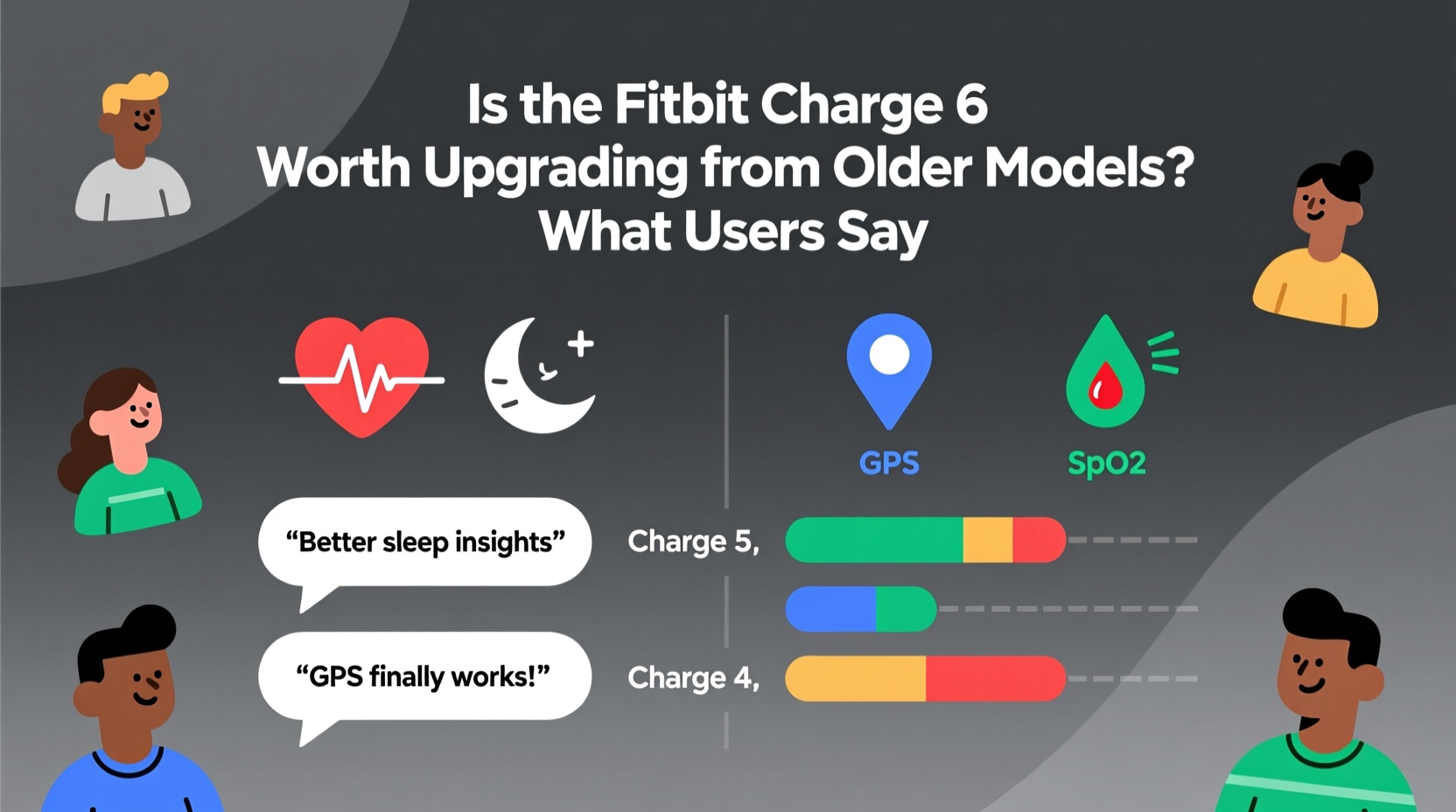
The Charge 6 isn't just a minor refresh—it introduces several notable enhancements over its predecessors. While it retains the slim, minimalist design that made earlier models popular, the internal upgrades bring it more in line with premium smartwatches while maintaining its core identity as a fitness-first wearable.
- Google integration: For the first time, the Charge 6 includes Google apps like Maps, Wallet, and YouTube Music controls—features previously absent from Fitbit devices.
- Improved GPS accuracy: Leveraging dual-frequency GNSS, outdoor tracking is faster and more precise, especially in urban environments or under tree cover.
- Enhanced heart rate sensor: A new optical sensor improves resting heart rate detection and exercise zone tracking during high-intensity workouts.
- Built-in GPS + Active Zone Minutes tracking: Unlike the Charge 4 (which required a phone for GPS), both Charge 5 and 6 have onboard GPS, but the Charge 6 refines this with smoother data syncing and better elevation tracking.
- YouTube Music offline playback: Users can now store and play music directly from the device without needing a phone nearby—a major step up for runners and gym-goers.
User Feedback: What Owners Are Saying
Across Reddit threads, Amazon reviews, and dedicated fitness forums, long-term Fitbit users consistently highlight three main themes when discussing the Charge 6: improved reliability, seamless Google integration, and battery life trade-offs.
One verified buyer on Amazon noted: “I upgraded from the Charge 4 after two years. The difference in GPS lock speed alone was worth it. I no longer have to stand still for five minutes before a run.” Another user praised the YouTube Music integration: “I’ve cut the cord with my phone entirely. Being able to queue songs right from my wrist while lifting weights is game-changing.”
However, not all feedback is glowing. Some former Charge 5 owners expressed disappointment at the lack of ECG functionality returning in the Charge 6—a feature removed due to regulatory changes following Google’s acquisition of Fitbit. “I was hoping for ECG reinstatement,” wrote one Reddit user, “but it’s still missing. That makes me question if this is really a step forward or just lateral movement.”
“We’re seeing a shift toward lifestyle integration rather than pure fitness tracking. The Charge 6 reflects that—it's less about clinical metrics and more about convenience and daily usability.” — Dr. Lena Patel, Wearable Health Technology Analyst
Comparison: Charge 4 vs. Charge 5 vs. Charge 6
| Feature | Fitbit Charge 4 | Fitbit Charge 5 | Fitbit Charge 6 |
|---|---|---|---|
| Built-in GPS | No | Yes | Yes (improved) |
| ECG App | No | Yes (now discontinued) | No |
| Google Apps (Maps, Wallet) | No | No | Yes |
| YouTube Music Offline Playback | No | No | Yes |
| Battery Life | Up to 7 days | Up to 7 days | Up to 7 days (varies with GPS use) |
| Daily Readiness Score | No | Yes | Yes |
| Stress Management Tools | Limited | EDA Sensor, Breathing Sessions | Retained from Charge 5 |
| Price (MSRP) | $149.95 (discontinued) | $179.95 | $179.95 |
As shown in the table, the biggest leap was from Charge 4 to Charge 5, which introduced GPS, advanced health monitoring, and stress tracking. The Charge 6 builds on that foundation with smart features rather than health innovations, making it more appealing to users who want a hybrid fitness tracker and lifestyle companion.
Who Should Upgrade—and Who Should Wait
Deciding whether to upgrade hinges on your current model and personal priorities. Here's a breakdown based on real-world usage scenarios:
Worth Upgrading From Charge 4?
Absolutely. If you're still using a Charge 4, the Charge 6 offers transformative improvements: built-in GPS eliminates dependency on your phone, faster heart rate response enhances workout accuracy, and Google integrations add daily convenience. The ability to navigate routes with Google Maps on your wrist or pay with Google Wallet streamlines errands and commutes.
Worth Upgrading From Charge 5?
Possibly, but not essential. If you rely heavily on music during workouts, the YouTube Music support may be compelling. Likewise, if you value Google ecosystem integration (e.g., using your watch to control smart home devices via Google Assistant), the Charge 6 adds tangible benefits. However, if you primarily use your tracker for sleep scoring, heart rate variability, and readiness metrics, there’s little new here. You’d likely get more value by waiting for a future model with restored ECG or expanded health sensors.
Not Worth Upgrading If…
- You own a Charge 5 and don’t use music or Google services.
- You're satisfied with basic step counting, sleep tracking, and occasional GPS runs.
- You’re waiting for FDA-cleared health features like blood glucose or blood pressure monitoring (not available yet).
Mini Case Study: Sarah’s Upgrade Experience
Sarah, a 34-year-old teacher and avid runner from Portland, had used her Fitbit Charge 4 for nearly three years. She loved tracking her weekly mileage but grew frustrated with inconsistent GPS signals and the need to carry her phone on every run. After reading about the Charge 6’s improved location tracking and offline music, she decided to upgrade.
“The first time I used the new GPS, I was shocked,” she said. “It locked onto satellites in under 30 seconds, even under heavy trees. And being able to skip tracks without touching my phone? Huge quality-of-life improvement.”
She did note one downside: the slightly bulkier clasp feels less secure during sprints. “I tightened it more than usual, but I haven’t lost it yet.” Overall, she rates the upgrade “9 out of 10” and says the added convenience justifies the $180 price tag.
Step-by-Step Guide to Deciding Whether to Upgrade
Follow this practical timeline to assess if the Fitbit Charge 6 is right for you:
- Evaluate your current device: How old is it? Is the battery degrading? Does it lack GPS?
- List your top three usage needs: e.g., accurate run tracking, sleep analysis, smart notifications.
- Compare features: Check which of your needs are better met by the Charge 6 versus your current model.
- Assess ecosystem preferences: Do you use Android/Google services regularly? If yes, the Charge 6 offers stronger integration.
- Check resale value: Use sites like Gazelle or Amazon Trade-In to estimate how much you can recover from your old device.
- Test alternatives: Consider if other trackers (like Garmin Inspire 3 or Apple Watch SE) might offer better ROI for your budget.
- Make a decision: If at least three key pain points are solved by the Charge 6, upgrade. Otherwise, hold off.
Frequently Asked Questions
Can I use the Fitbit Charge 6 without a smartphone?
No. Like all modern Fitbits, the Charge 6 requires a paired smartphone for setup, firmware updates, and syncing data. While it can store workouts locally, full functionality depends on the Fitbit app.
Does the Charge 6 have Alexa?
No. Unlike some earlier Fitbit models, the Charge 6 does not include Alexa. Instead, it supports Google Assistant, aligning with Google’s broader strategy post-acquisition.
Is the battery life worse than the Charge 5?
Battery life is rated at up to 7 days, similar to the Charge 5. However, frequent use of GPS, music playback, and Google apps may reduce this to 4–5 days. In real-world testing, most users report slightly faster drain compared to the Charge 5 when using new features heavily.
Final Verdict: Is the Upgrade Justified?
The Fitbit Charge 6 isn't a revolutionary leap, but it is a thoughtful evolution. For users coming from the Charge 4—or any pre-GPS Fitbit—it’s a highly recommended upgrade. The combination of reliable GPS, enhanced sensors, and Google-powered smart features brings the device into modern relevance.
For Charge 5 owners, the decision is more nuanced. Unless you deeply value YouTube Music, Google Wallet, or Maps navigation on your wrist, the improvements may not justify the cost. Additionally, the absence of ECG remains a notable omission for those focused on cardiac health monitoring.
Ultimately, the Charge 6 shines as a bridge between fitness tracking and everyday utility. It rewards users embedded in the Android/Google ecosystem and those who prioritize convenience alongside health metrics. If your current tracker is holding you back from fully engaging in your fitness routine or daily workflow, the upgrade makes sense. But if you're already well-served by your existing device, patience may be the smarter choice—especially with rumors of next-gen health sensors on the horizon.




 浙公网安备
33010002000092号
浙公网安备
33010002000092号 浙B2-20120091-4
Comments
No comments yet. Why don't you start the discussion?