
If you’ve been using the Samsung Galaxy Note 10 Plus since its 2019 release, you're likely due for an upgrade. The device was a powerhouse in its time—offering a large AMOLED display, a precise S Pen, and top-tier specs. But nearly five years later, technology has evolved dramatically. The Galaxy S24, released in 2024, represents a generational leap. So, is the jump from the Note 10 Plus to the S24 truly worthwhile? More importantly, what tangible benefits do you gain beyond marketing hype?
The answer isn’t just about raw speed or camera megapixels. It’s about daily usability, long-term support, AI integration, security, and how well the phone fits into modern digital lifestyles. Let’s break down exactly what you stand to gain—and whether those improvements justify the investment.
Performance: From Capable to Future-Proof
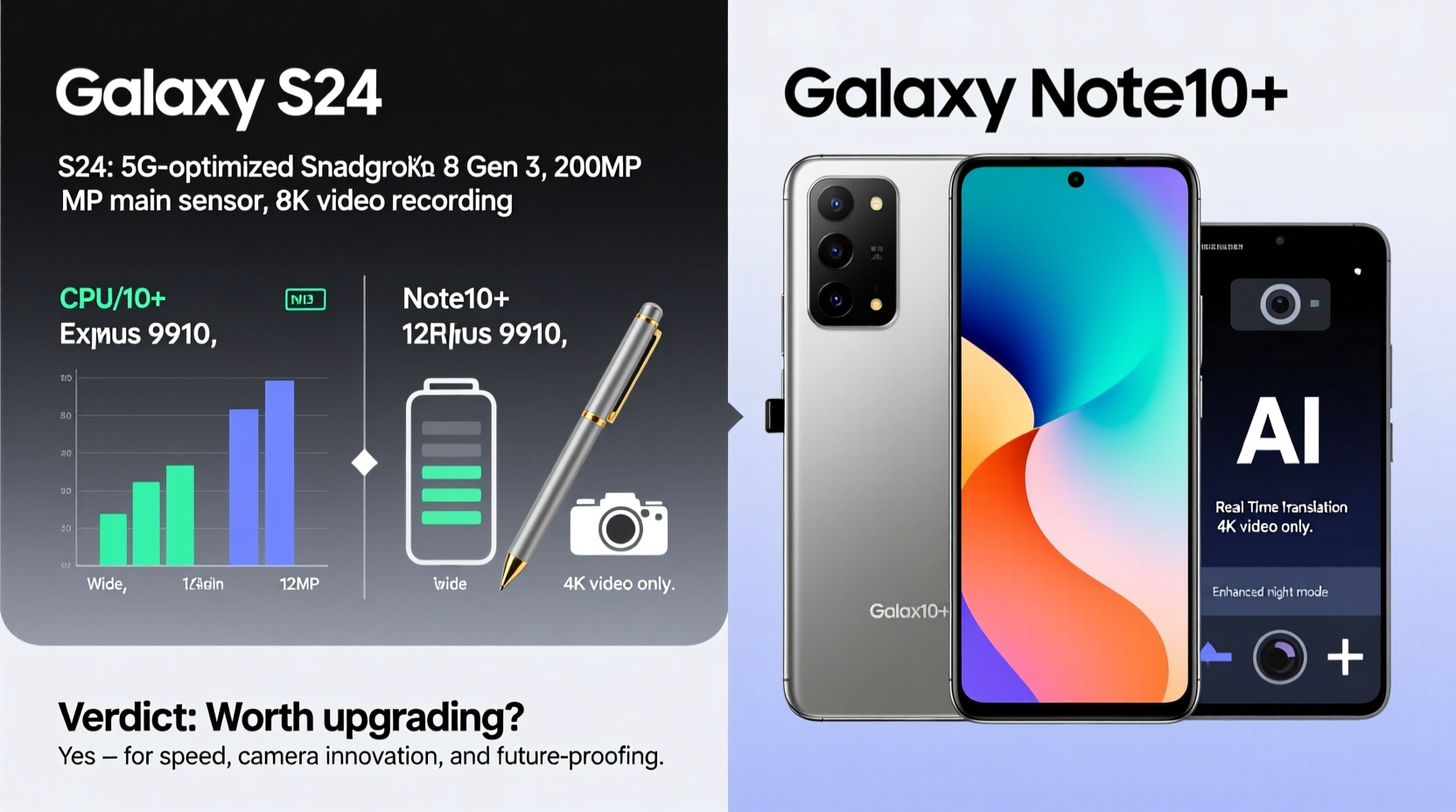
The Galaxy Note 10 Plus launched with either the Snapdragon 855 or Exynos 9825, depending on region. At the time, these chips delivered excellent multitasking and gaming performance. Today, however, they struggle with heavier apps, longer video editing sessions, and even some newer social media features that rely on real-time processing.
In contrast, the Galaxy S24 runs on the Snapdragon 8 Gen 3 (globally), a chip built on a 4nm process with vastly superior efficiency and power. This isn't just faster—it's smarter. The new processor handles AI workloads natively, enabling features like real-time call translation, photo cleanup, and predictive text actions that weren’t possible in 2019.
Benchmarks tell part of the story: the S24 scores roughly 2.5x higher in multi-core performance and over 3x better in graphics rendering. But real-world impact matters more. Apps launch instantly, animations are buttery smooth, and background tasks no longer cause hiccups during calls or navigation.
Camera Evolution: Night Mode, Zoom, and AI Smarts
The Note 10 Plus had a solid triple-camera system: 12MP wide, 12MP telephoto, and 16MP ultra-wide. For its era, it captured rich colors and good dynamic range. However, low-light performance was inconsistent, and digital zoom degraded quickly beyond 2x.
The Galaxy S24 introduces a completely re-engineered imaging pipeline. Its 50MP main sensor uses pixel-binning for exceptional clarity in daylight and remarkable noise reduction at night. The 10MP periscope telephoto now supports up to 5x optical zoom and 30x “AI-enhanced” digital zoom—making distant subjects far more usable.
But the biggest leap is software intelligence. With Samsung’s new AI-powered Photo Edit tools, you can remove unwanted objects, enhance blurry faces, or adjust lighting after the shot is taken. These aren’t gimmicks—they’re practical tools that improve real photos.
“Modern smartphone photography isn’t just about hardware anymore. It’s about computational intelligence. The S24 processes light, depth, and context in ways that were science fiction five years ago.” — David Lin, Mobile Imaging Analyst at TechPulse Asia
Display and Design: Subtle Refinements, Big Comfort Gains
Both phones feature stunning 6.8-inch Dynamic AMOLED displays, but the S24 improves on brightness, color accuracy, and durability. The older Note 10 Plus peaks at around 1200 nits; the S24 hits 2600 nits in HDR, making outdoor visibility significantly better.
The design shift is also meaningful. While both devices are large, the S24 feels lighter (192g vs. 208g) and more compact due to reduced bezels and a taller 19.5:9 aspect ratio. The flat screen eliminates glare-prone curves, and Gorilla Glass Victus 2 offers better scratch and drop resistance.
One often-overlooked upgrade: the S Pen experience. On the Note 10 Plus, the stylus was built-in. The S24 Ultra retains this feature, but with lower latency (2ms vs. 9ms) and enhanced air command gestures powered by AI. You can now circle text in any app to translate it instantly or convert handwritten notes into typed documents with near-perfect accuracy.
Software and Longevity: A Critical Upgrade Path
This may be the most compelling reason to upgrade. The Galaxy Note 10 Plus stopped receiving major Android OS updates after Android 12. It still runs One UI 4.1 at best—missing out on four years of interface refinements, privacy controls, and performance optimizations.
The Galaxy S24, however, promises seven years of OS and security updates—a first in the industry. That means it will receive Android upgrades through 2031. For users who keep phones for three years or more, this is a game-changer. You’re not just buying a phone; you’re investing in sustained relevance.
New features like Circle to Search, Live Translate, and Generative Edit showcase how deeply AI is now integrated into daily use. These tools don’t require manual setup—they work intuitively across apps, reducing friction in everyday tasks.
What You Actually Gain: A Feature-by-Feature Breakdown
| Feature | Galaxy Note 10 Plus | Galaxy S24 | Real-World Impact |
|---|---|---|---|
| Processor | Snapdragon 855 / Exynos 9825 | Snapdragon 8 Gen 3 | Smaller apps, faster AI, smoother multitasking |
| RAM & Storage | 8/12GB RAM, 256/512GB + microSD | 8/12GB RAM, 256GB–1TB (no SD) | Better app retention, no expandable storage |
| Rear Cameras | 12+12+16MP | 50+12+10MP + 10MP periscope | Sharper zoom, cleaner night shots, AI editing |
| Software Support | Ended (Android 12) | 7 years from 2024 (until 2031) | Longer lifespan, consistent security |
| Display Brightness | ~1200 nits peak | Up to 2600 nits peak | Much better outdoors, HDR content pops |
| S Pen Latency | ~9ms | ~2ms | Feels like writing on paper, instant response |
| AI Features | Limited Bixby routines | Live Translate, Circle to Search, Generative Edit | Proactive assistance across all apps |
Mini Case Study: Sarah’s Upgrade Experience
Sarah, a freelance graphic designer based in Austin, used her Note 10 Plus for field sketches, client calls, and light photo editing. By late 2023, she noticed delays when exporting layered PSD files via mobile apps and frustration with dim screen visibility during outdoor meetings.
After upgrading to the S24 Ultra, her workflow transformed. She now uses Circle to Search to quickly find design references without leaving her sketch app. The improved S Pen allows her to annotate mockups with pixel-perfect precision, and the brighter screen ensures accurate color review under sunlight.
“It’s not just faster,” she says. “It anticipates what I need. Translating a client’s feedback in real time during a call saved me hours of back-and-forth. That kind of efficiency pays for the phone over time.”
Step-by-Step: How to Decide If the Upgrade Makes Sense
- Evaluate your current pain points: Does your Note 10 Plus lag, overheat, or fail to install certain apps?
- Assess your usage: Do you rely on photography, multitasking, or stylus input? The S24 excels in all three.
- Check battery health: If your battery lasts less than half a day, replacement costs may approach one-third of a new phone’s price.
- Consider future needs: Will you keep your phone for 3+ years? The S24’s 7-year update promise adds significant value.
- Test before buying: Visit a store to try the S24’s weight, screen, and S Pen responsiveness.
Frequently Asked Questions
Can I transfer everything from my Note 10 Plus to the S24?
Yes. Samsung Smart Switch seamlessly migrates apps, messages, photos, settings, and even home screen layouts. Most data transfers wirelessly or via USB-C cable.
Is the lack of a microSD slot a dealbreaker?
For most users, no. Base models start at 256GB, and cloud storage (Samsung Cloud, Google Drive) is more reliable than physical cards. Only heavy local media collectors might miss expandable storage.
Does the S24 still support DeX mode?
Absolutely. Samsung DeX remains a standout feature, turning the S24 into a desktop-like experience when connected to a monitor—ideal for productivity-focused Note users.
Final Verdict: Yes, It’s Worth It—If You Use Your Phone Actively
For casual users who make calls and check messages, the upgrade might feel excessive. But if you depend on your phone for creativity, communication, or business, the Galaxy S24 delivers meaningful, lasting improvements.
You gain not just better hardware, but a smarter, more secure, and longer-supported device. The integration of AI into core functions—from search to translation to photo editing—redefines what a smartphone can do. And with full S Pen support and DeX compatibility, the legacy of the Note series lives on stronger than ever.




 浙公网安备
33010002000092号
浙公网安备
33010002000092号 浙B2-20120091-4
Comments
No comments yet. Why don't you start the discussion?