
In 2025, both the Samsung Galaxy S5 and the Apple iPhone 5 are relics of a bygone smartphone era. Released in 2013 and 2012 respectively, these devices were once flagships. Today, they linger in secondhand markets, often sold for under $20. For budget-conscious buyers—especially those seeking a basic phone or a temporary solution—the question arises: is the Galaxy S5 actually a better choice than a used iPhone 5? The answer isn’t as straightforward as specs might suggest.
While both phones are obsolete by modern standards, subtle differences in hardware longevity, software flexibility, and ecosystem support can influence which device offers slightly more utility today. This analysis dives into real-world usability, security concerns, app compatibility, and practical ownership costs to determine whether the Galaxy S5 holds any meaningful advantage over its iOS counterpart in the current year.
Performance and Hardware Comparison
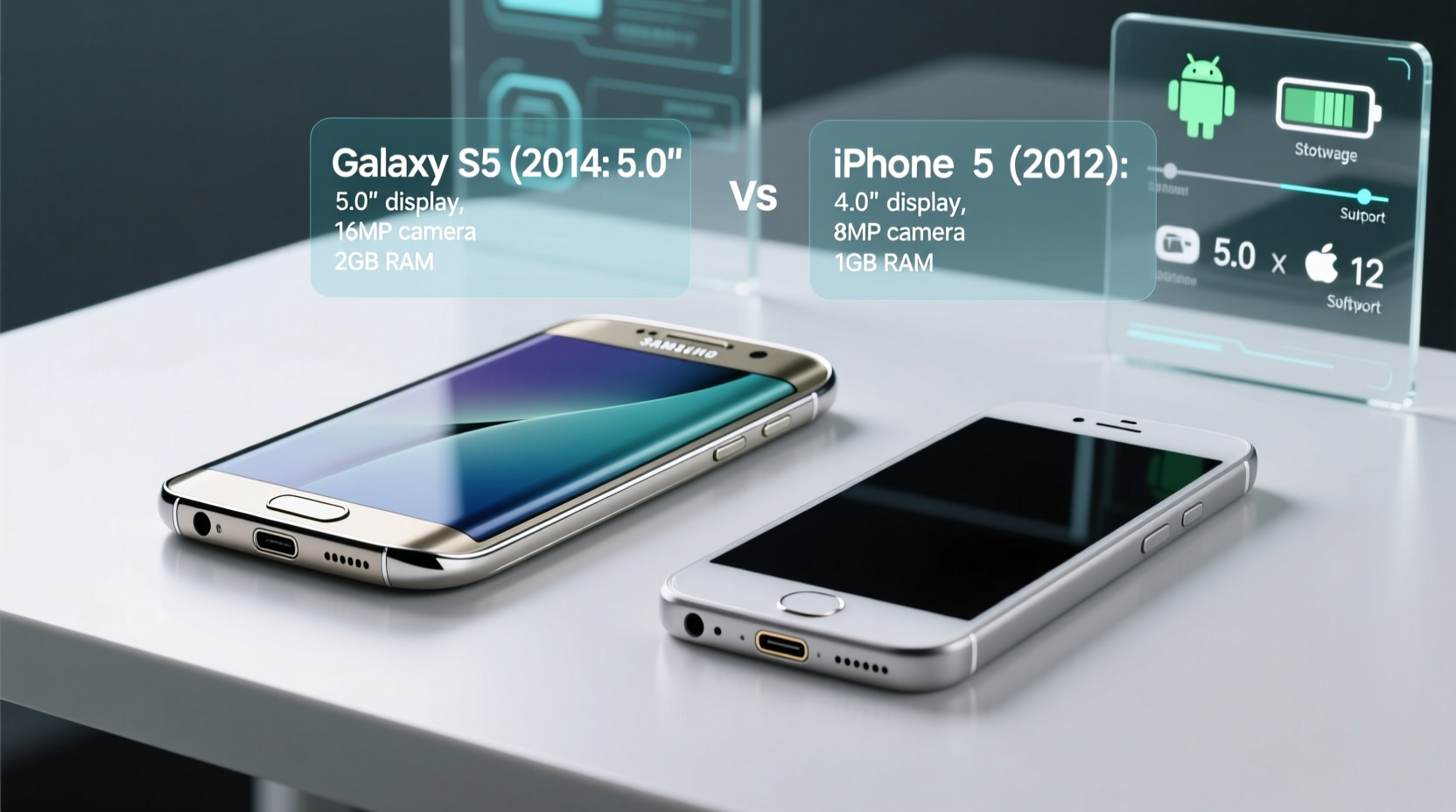
The Galaxy S5 launched with a Qualcomm Snapdragon 801 processor, 2GB of RAM, and Android 4.4 KitKat. The iPhone 5, on the other hand, ran on Apple’s custom A6 chip with 1GB of RAM and iOS 6. On paper, the S5 had superior raw specs at launch. In 2025, that edge remains noticeable in day-to-day responsiveness.
Android on the S5, even in its final supported version (Android 6.0.1 Marshmallow), allows for greater multitasking and background process handling than iOS 7—the last official OS for the iPhone 5. Users report that the S5 can still open lightweight web pages, run basic messaging apps, and play low-intensity games without complete system lockups. The iPhone 5, while smooth in its prime, struggles severely with modern web rendering due to outdated JavaScript engines and lack of TLS 1.2+ support in older Safari versions.
“Even minimal browsing on legacy iOS versions is risky and inefficient. The hardware simply can’t keep up with encrypted connections required by most websites today.” — Daniel Reeves, Mobile Security Analyst at CyberShield Labs
Software Support and Security Risks
This is where the debate shifts dramatically. Neither device receives official software updates. However, the Galaxy S5 benefits from a vibrant modding community. Custom ROMs like LineageOS 14.1 (based on Android 7.1) are still available and actively maintained by volunteers. These ROMs patch critical security vulnerabilities and restore partial functionality to modern services like Google Play and WhatsApp (with workarounds).
In contrast, the iPhone 5 cannot be jailbroken beyond iOS 7.1.2, and no credible community firmware exists to upgrade it beyond that point. Even if jailbroken, iOS 7 lacks support for modern encryption standards, making HTTPS connections unreliable and exposing users to man-in-the-middle attacks. Major services like Gmail, Facebook, and banking apps have dropped compatibility with devices running iOS 7 or earlier.
As of 2025, using an iPhone 5 for any online activity—including email or social media—is strongly discouraged from a security standpoint. The Galaxy S5, especially with a custom ROM, presents a less risky profile, though still far from secure.
App Compatibility and Daily Usability
Modern app ecosystems have moved far beyond what either device can natively support. However, there are nuances:
- WhatsApp: Officially dropped support for Android 4.4–6.0 in 2023, but some users report limited functionality using sideloaded APKs from third-party sources. On iOS, WhatsApp stopped working entirely on iPhone 5 after February 2023.
- Google Services: The S5 can run Google Play Services via microG or patched GApps on custom ROMs. The iPhone 5 cannot authenticate with Google accounts beyond basic browser login.
- Maps & Navigation: Google Maps on the S5 will load slowly but function in offline mode. Apple Maps on the iPhone 5 is non-functional for routing due to expired certificates.
| Feature | Galaxy S5 (Custom ROM) | iPhone 5 (Stock iOS 7) |
|---|---|---|
| Web Browsing | Limited, but possible with Firefox Klar or Brave Lite | Fails on most HTTPS sites; certificate errors common |
| Email Access | Works with IMAP clients (K-9 Mail) | IMAP fails on many providers due to SSL restrictions |
| Camera Functionality | Rear camera works; front camera laggy | Cameras functional but poor low-light performance |
| Battery Life | 1–2 hours active use (battery degradation common) | ~1 hour with screen on; frequent reboots |
| Security Updates | Possible via community ROMs | None available since 2016 |
Real-World Example: Emergency Use Case
Consider Maria, a rural community volunteer in upstate New York, who needed a backup communication device during power outages. She tested both phones with a prepaid SIM. The iPhone 5 powered on but failed to connect to her carrier’s LTE network—Apple discontinued carrier profile updates for the model in 2018. When she switched to the Galaxy S5 flashed with LineageOS 14.1, it connected instantly, allowed SMS, and could access a cached version of Google Maps for navigation.
Though neither phone served as a primary device, only the S5 provided reliable fallback functionality. “It’s not about convenience,” Maria said. “It’s about having something that connects when everything else fails.”
Step-by-Step: Getting Usable Life Out of a Galaxy S5 in 2025
If you’re determined to make the Galaxy S5 functional, follow this sequence:
- Inspect hardware: Check screen for cracks, test power button and volume keys, ensure USB port charges.
- Replace the battery: Original batteries are degraded. Purchase a new OEM-spec 2800mAh battery (~$8).
- Unlock bootloader: Use ODIN and Samsung USB drivers to gain access.
- Flash custom recovery: Install TWRP for easier ROM management.
- Install LineageOS 14.1: Download from official site, flash via TWRP.
- Install MicroG or OpenGApps: Enable basic Google services without full suite bloat.
- Optimize settings: Disable animations, reduce screen brightness, uninstall unused apps.
This process takes technical effort but can extend the phone’s life by another 1–2 years for ultra-light tasks.
Checklist: Is Either Phone Right for You?
Before buying either device, ask yourself:
- ✅ Do I need internet access or just calls/texts?
- ✅ Am I technically capable of flashing ROMs or troubleshooting boot loops?
- ✅ Will this be used by a child or elderly person unfamiliar with tech limitations?
- ✅ Is there a risk of accessing sensitive data (email, banking)?
- ✅ Are replacement parts (batteries, screens) available locally?
If you answered “no” to technical ability or “yes” to security-sensitive use, avoid both phones entirely.
FAQ
Can the Galaxy S5 run modern Android apps?
No—not reliably. Most apps require Android 8.0 or higher. Some lightweight alternatives (e.g., Kiwi Browser, Signal Lite) may install but perform poorly. Expect crashes and timeouts.
Is the iPhone 5 safer because it’s “offline”?
Only if completely disconnected. Once online, its outdated SSL/TLS stack makes it vulnerable to eavesdropping and spoofing. An unpatched Android 6.0 device is also insecure, but community patches reduce exposure.
What’s a better alternative under $50?
Refurbished models like the Moto G54 5G (2023) or Samsung Galaxy A14 5G often resell under $50 with Android 13, 4GB RAM, and ongoing security updates. These offer vastly superior performance and safety.
Final Verdict
The Galaxy S5 is marginally more viable than the iPhone 5 in 2025—but only if you're willing to invest time in customization. Its support for custom ROMs, slightly better hardware, and broader connectivity options give it a narrow lead. However, calling either phone “worth it” is a stretch. They are technological fossils, unsuitable for daily driving, online banking, or secure communication.
If your goal is nostalgia, collecting, or learning about mobile modding, the S5 offers a rewarding project. For anyone needing a functional, safe, and reliable device—even on a tight budget—spending slightly more for a newer entry-level smartphone is a smarter investment. Technology from a decade ago shouldn’t be your first line of digital defense.




 浙公网安备
33010002000092号
浙公网安备
33010002000092号 浙B2-20120091-4
Comments
No comments yet. Why don't you start the discussion?