
For many PC gamers, the GeForce GTX 1060 and GTX 1070 were defining graphics cards of their era—offering strong 1080p performance at accessible price points. Released in 2016 as part of NVIDIA’s Pascal lineup, both GPUs delivered excellent value during their prime. But nearly a decade later, with newer architectures like RTX 30 and 40 series dominating the market, the question arises: Is the GTX 1070 still meaningfully better than the GTX 1060, or has the time come to move on entirely?
The answer isn’t just about raw specs. It depends on your current setup, gaming habits, budget constraints, and future-proofing goals. Let’s break down where these two cards stand today, how they compare, and whether holding onto either makes sense in 2024 and beyond.
Performance Comparison: GTX 1070 vs. GTX 1060
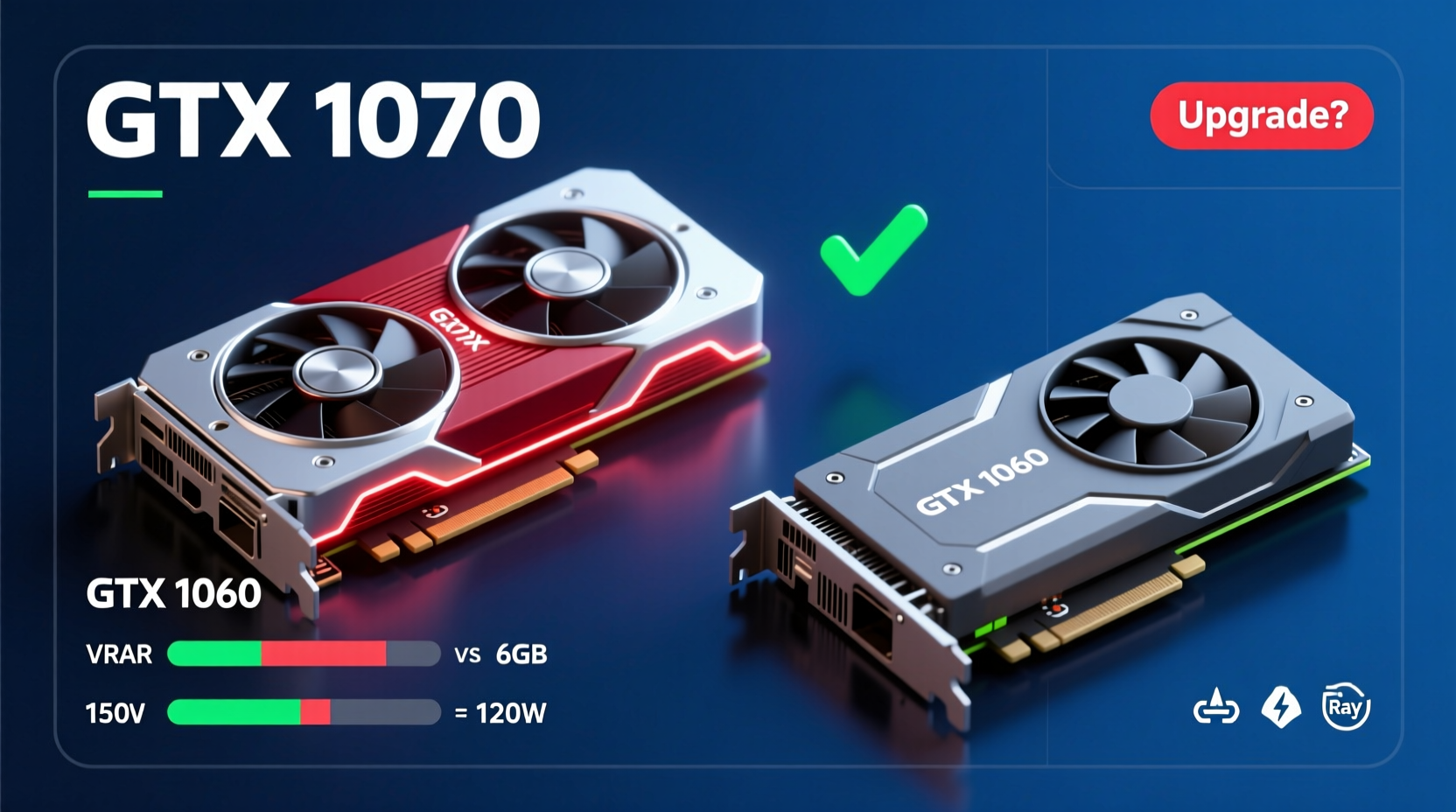
The GTX 1070 was positioned as a step above the 1060, targeting enthusiasts who wanted higher frame rates and better performance at 1440p. The GTX 1060 came in two variants—3GB and 6GB—with the latter being more relevant for this discussion due to its improved memory bandwidth and longevity.
Here's a direct comparison of key specifications:
| Specification | GTX 1060 (6GB) | GTX 1070 |
|---|---|---|
| Architecture | Pascal (GP106) | Pascal (GP104) |
| CUDA Cores | 1280 | 1920 |
| Base Clock / Boost Clock | 1506 MHz / 1708 MHz | 1506 MHz / 1683 MHz |
| VRAM | 6 GB GDDR5 | 8 GB GDDR5 |
| Memory Bus Width | 192-bit | 256-bit |
| Memory Bandwidth | 192 GB/s | 256 GB/s |
| TDP (Power Draw) | 120W | 150W |
| Approx. Launch Price (MSRP) | $249 | $379 |
In real-world gaming, the GTX 1070 typically delivers around **25–35% better performance** than the GTX 1060 6GB. At 1080p resolution, this means smoother frame rates in demanding titles and the ability to handle medium-to-high settings in most games released before 2020. In some optimized titles, the 1070 can even dabble in 1440p gaming, though not consistently.
Are These Cards Still Viable in 2024?
Modern AAA titles such as Alan Wake 2, Starfield, and Baldur’s Gate 3 push hardware significantly harder than games from 2016–2019. They often require features like ray tracing, DLSS, and advanced shading models that Pascal-based GPUs don’t support natively.
Without dedicated tensor cores or RT cores, neither the GTX 1060 nor the 1070 can leverage DLSS (Deep Learning Super Sampling), which has become essential for maintaining playable frame rates in newer games. Ray tracing is either absent or extremely slow when forced on these cards.
That said, both GPUs remain functional for:
- 1080p gaming at medium settings in recent non-demanding titles
- Esports titles like CS2, Valorant, Overwatch 2, and League of Legends
- Older AAA games (pre-2020) at high settings
- Productivity tasks and general computing
However, if you’re aiming for consistent 60+ FPS in current releases at 1080p with high settings, both cards will struggle—especially the GTX 1060. The 1070 holds up slightly better thanks to its extra VRAM and wider memory bus, but it’s increasingly hitting performance walls.
“Even with optimization, the GTX 1070 is approaching the limit of what 8GB VRAM and no AI upscaling can handle in modern engines.” — Mark Reynolds, Hardware Analyst at TechPulse Weekly
When the GTX 1070 Makes Sense Over the 1060
If you’re choosing between buying a used GTX 1060 or a used GTX 1070 today, the 1070 is clearly the superior option—if priced reasonably. Here’s when it still offers meaningful value:
- You play a mix of older and mid-tier new games: The 1070 handles titles like Elden Ring (with settings adjusted) and Horizon Zero Dawn more comfortably than the 1060.
- You have a 144Hz monitor: The 1070 can hit higher average frame rates in competitive games, making better use of high-refresh displays.
- You need more VRAM: With only 6GB, the 1060 stutters in games like Red Dead Redemption 2 or Assassin’s Creed Valhalla due to texture streaming issues. The 1070’s 8GB helps avoid this bottleneck.
- You’re on a tight budget and already own compatible hardware: If upgrading your entire system isn’t feasible, squeezing more life out of a GTX 1070 is reasonable.
Mini Case Study: Alex’s Gaming Rig Upgrade Dilemma
Alex has been using a GTX 1060 6GB since 2017. His build includes an Intel i5-7600K and 16GB RAM. Recently, he found a used GTX 1070 for $120 and wondered if it was worth upgrading. After testing it in Spider-Man Remastered and DOOM Eternal, he saw average gains of 28% and smoother gameplay at high settings. While not perfect, the improvement justified the cost—especially since he wasn’t ready to invest in a full RTX 3060 or higher.
For Alex, the GTX 1070 extended his system’s viability by another 1–2 years without breaking the bank.
Reasons to Upgrade Beyond Both Cards
While the GTX 1070 outperforms the 1060, both are now outdated by modern standards. Consider upgrading if:
- You want ray tracing or DLSS: Only RTX cards offer efficient ray tracing and AI-powered upscaling. Even entry-level RTX 3050 or 3060 outperform the GTX 1070 in supported titles thanks to DLSS.
- You game at 1440p or plan to: The GTX 1070 struggles here. Modern mid-range GPUs like the RTX 3060 Ti or RX 6700 XT deliver far better 1440p performance.
- Your PSU or CPU is aging: Older power supplies may not support newer GPUs efficiently. Upgrading the GPU alone might bottleneck with an outdated CPU.
- You care about driver and software support longevity: NVIDIA has announced reduced support for Pascal in future driver releases. Security and compatibility risks increase over time.
Upgrade Path Checklist
- ✅ Assess your current monitor resolution and refresh rate
- ✅ Check your PSU capacity and connector types (6-pin, 8-pin)
- ✅ Verify case clearance for larger modern GPUs
- ✅ Determine your budget range ($200–$400 for best value)
- ✅ Research current-gen alternatives (RTX 3060, 3060 Ti, RX 6600, RX 7600)
- ✅ Look for used RTX 2060 Super or 3060 as cost-effective upgrades
Frequently Asked Questions
Can the GTX 1070 run modern games smoothly?
It depends on settings and resolution. At 1080p with medium-to-high settings, many modern games are playable at 40–60 FPS, but expect drops in open-world or graphically intense scenes. Games with heavy texture loads may exceed the 8GB VRAM limit.
Is it worth buying a GTX 1070 in 2024?
Only if found at a very low price (under $100) and you cannot afford a newer GPU. For slightly more, you can get a used RTX 2060 Super or RX 6600, which offer better performance and modern features like ray tracing and FSR/DLSS equivalents.
Should I upgrade from GTX 1060 to GTX 1070?
If you already own a GTX 1060 and the upgrade costs less than $80, yes—it’s a noticeable leap. But if you have to spend $100+, consider skipping to a current-gen card instead. You’ll gain not just performance, but also better efficiency, features, and longer support.
Conclusion: Time to Move Forward
The GTX 1070 was a strong card in its day and still outclasses the GTX 1060 in every meaningful way. If you're stuck between the two, the 1070 is the better choice. But realistically, both belong to a previous generation. Holding onto them in 2024 means accepting compromises: lower frame rates, no AI upscaling, limited VRAM headroom, and diminishing driver support.
Technology moves fast, and today’s budget GPUs offer dramatically better value. Even modest upgrades open doors to smoother gameplay, higher resolutions, and next-gen features. If your budget allows, stepping into the RTX 30 or 40 series—or AMD’s RDNA2/RDNA3 lineup—is not just an improvement—it’s a transformation.




 浙公网安备
33010002000092号
浙公网安备
33010002000092号 浙B2-20120091-4
Comments
No comments yet. Why don't you start the discussion?