
In the fast-moving world of mobile technology, flagship tablets from just a few years ago often fade into obscurity. Yet, nearly a decade after their release, two mid-range Android tablets—Huawei’s MediaPad M3 Lite and Samsung’s Galaxy Tab S2—continue to spark discussion among budget-conscious buyers and retro tech enthusiasts. Despite being products of 2016, these devices still surface in online forums, Reddit threads, and secondhand marketplaces with surprising frequency. Why? Because for many users, especially those prioritizing audio quality, screen clarity, and long-term software stability on older systems, the choice between them isn’t as clear-cut as one might assume.
The debate persists not because either device is cutting-edge by today’s standards, but because both offered exceptional value at launch—and in some niche areas, they still outperform newer budget tablets. Let’s dissect the real differences, examine user experiences, and understand why this comparison remains relevant even now.
Design and Build: Substance Over Style?
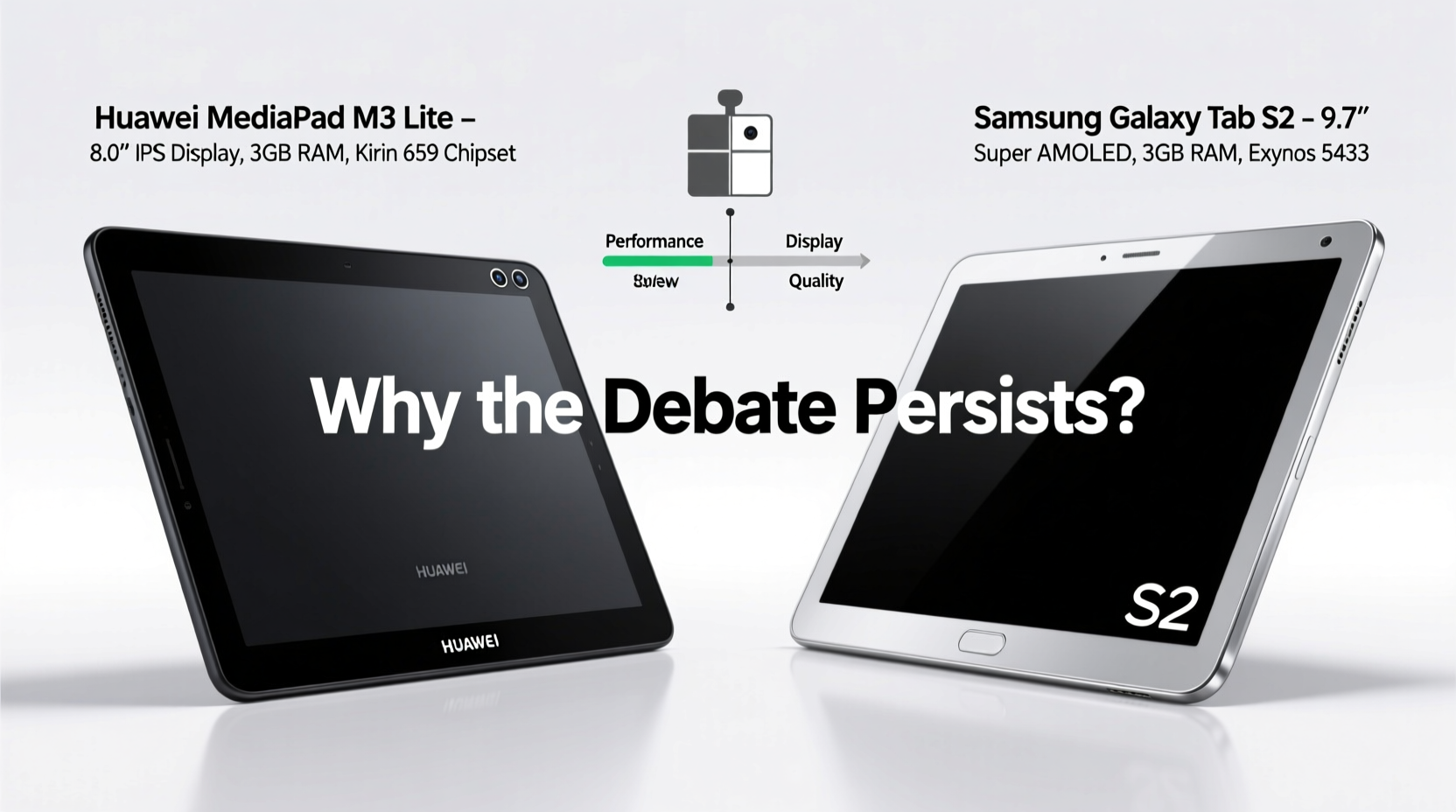
At first glance, the Galaxy Tab S2 leans into minimalist elegance. Its ultra-thin profile (5.6mm) and symmetrical bezels give it a sleek, premium feel. Constructed with an aluminum unibody, it feels solid in hand and was widely praised for its portability. In contrast, the MediaPad M3 Lite opts for a more utilitarian design. While also using metal construction, its slightly thicker frame (7.4mm) and asymmetrical front speaker placement make it less refined visually—but arguably more functional for media consumption.
Huawei integrated Harman Kardon-tuned speakers on the front-facing edge, a rare feature even among high-end tablets at the time. This gave the M3 Lite a significant edge in audio output, particularly when watching videos or listening to music in landscape mode. Samsung, meanwhile, placed stereo speakers on the back, which often muffled sound when the tablet rested on a surface.
Display and Visual Experience
The Galaxy Tab S2 wins hands-down in display technology. Available in 8.0” and 9.7” models, both featured Super AMOLED panels with deep blacks, vibrant colors, and excellent contrast ratios. The 9.7-inch version matched the iPad Air’s screen size and resolution (2048x1536), making it ideal for reading and media.
The MediaPad M3 Lite, however, used a 10.1-inch IPS LCD panel with Full HD resolution (1920x1200). While perfectly serviceable, it lacked the punch and energy efficiency of AMOLED. That said, its larger screen real estate appealed to users who preferred multitasking or extended video sessions. Some reviewers noted that Huawei calibrated the display for warmer tones, which reduced eye strain during prolonged use—an underrated benefit for students or commuters.
“Screen quality isn’t just about specs—it’s about how comfortable it is over hours of use. Sometimes, a slightly less sharp but warmer display beats a technically superior one.” — Lin Zhao, UX Researcher at Mobile Insights Group
Performance and Software: A Tale of Two Chips
Under the hood, the Galaxy Tab S2 ran on Samsung’s Exynos 5 Octa (5433)—a 64-bit processor built on a 20nm process. Paired with 3GB of RAM, it handled everyday tasks smoothly, though thermal throttling could occur during extended gaming or video playback.
The MediaPad M3 Lite used the Qualcomm Snapdragon 435, an entry-level octa-core chip with Adreno 505 graphics. On paper, this configuration was weaker. However, real-world performance told a different story. Huawei optimized EMUI heavily for battery life and background management, meaning the M3 Lite often felt snappier in day-to-day navigation despite lower benchmark scores.
Software updates were another key differentiator. Samsung provided timely Android upgrades for the Tab S2 up to Android 7.0 Nougat, while Huawei’s update policy was notoriously inconsistent. The M3 Lite launched on Android 7.0 but rarely received major OS updates, limiting its longevity in the face of modern app demands.
Performance Comparison Table
| Feature | Samsung Galaxy Tab S2 | Huawei MediaPad M3 Lite |
|---|---|---|
| Processor | Exynos 5 Octa 5433 | Qualcomm Snapdragon 435 |
| RAM | 3GB | 2GB / 3GB (varies) |
| Storage Options | 32GB/64GB + microSD | 16GB/32GB + microSD |
| Battery | 4000mAh | 6660mAh |
| OS Launch Version | Android 5.1.1 | Android 7.0 |
| Max Supported OS | Android 7.0 | Android 7.0 (EMUI 5.x) |
User Experience: Real-World Use Cases
Consider Maria, a university student in Manila who bought a used MediaPad M3 Lite in 2019 for ₱3,500 (~$65). Her primary needs were PDF annotation, YouTube lectures, and note-taking with a stylus. She found the large screen and loud speakers made her study sessions more engaging. Even though the device couldn’t run the latest Google Meet updates by 2022, she installed a lightweight browser and continued using it reliably until 2023.
On the other side, James, a freelance photographer in Berlin, picked up a Galaxy Tab S2 9.7” for reviewing RAW thumbnails on the go. He valued the color accuracy of the AMOLED screen and the ability to connect via Samsung DeX-like workflows with his older Galaxy phone. However, he reported increasing lag with photo apps after 2018 and eventually retired it due to app compatibility issues.
This illustrates a crucial point: perceived “betterness” depends entirely on usage patterns. For multimedia and casual browsing, the M3 Lite’s battery and audio win. For visual precision and interface polish, the Tab S2 retains an edge.
Why Are People Still Debating This?
The persistence of this debate stems from three core factors:
- Nostalgia Meets Practicality: Both tablets represented peak mid-range design in 2016. Enthusiasts remember them fondly and revisit them when seeking affordable secondary devices.
- Secondhand Market Longevity: Due to durable builds and replaceable batteries (in some variants), both units remain functional years later, fueling comparisons in refurbished electronics circles.
- Lack of Strong Modern Alternatives: Many current budget tablets under $150 use outdated chips, poor screens, and bloatware. By comparison, these 2016 models seem remarkably competent.
Moreover, regional availability plays a role. In parts of Southeast Asia, Africa, and Latin America, where new tablets are expensive, older high-performing models like the M3 Lite are actively traded and recommended in local tech communities.
Frequently Asked Questions
Can either tablet run modern apps in 2024?
Limitedly. Basic apps like WhatsApp, YouTube Go, and Firefox Lite work, but newer versions of Instagram, TikTok, or Zoom may crash or refuse installation due to API level restrictions. Chrome requires sideloading older APKs.
Which has better battery life?
The MediaPad M3 Lite clearly wins here. With a 6660mAh battery versus the Tab S2’s 4000mAh, it routinely delivers 10–12 hours of mixed use, compared to 6–8 on the Samsung—even accounting for the less efficient Snapdragon 435.
Is one safer to buy used today?
The Galaxy Tab S2 may be riskier due to aging AMOLED panels prone to burn-in and swollen batteries. The M3 Lite’s simpler hardware and larger battery margin make it more resilient, provided it hasn’t been overcharged.
Final Verdict: It Depends on Your Priorities
If you’re choosing between these two today—not as collectors, but as practical users—the decision comes down to intended use:
- Choose the Huawei MediaPad M3 Lite if you want longer battery life, louder audio, and a bigger screen for entertainment.
- Choose the Samsung Galaxy Tab S2 if display quality, build refinement, and smoother UI response matter most.
There is no definitive \"better\" device. There is only what serves your needs best.
Action Checklist: Buying a Used 2016 Tablet in 2024
- Verify battery cycle count or runtime under load
- Test all buttons, speakers, Wi-Fi, and touchscreen responsiveness
- Confirm software version and ability to log into your Google account
- Check for physical wear, especially around charging ports
- Install a lightweight launcher and disable auto-updates to extend usability
Conclusion
The ongoing debate between the Huawei MediaPad M3 Lite and the Samsung Galaxy Tab S2 isn't about technological superiority—it's about enduring value. These tablets remind us that well-built devices with thoughtful features can remain useful long after their prime. While neither should be anyone’s first choice in 2024, they represent a golden era of mid-tier innovation that today’s cost-cutting manufacturers have yet to match.




 浙公网安备
33010002000092号
浙公网安备
33010002000092号 浙B2-20120091-4
Comments
No comments yet. Why don't you start the discussion?