
If you're in the market for a compact, affordable iPhone in 2024, two models likely stand out: the iPhone 12 mini and the newer iPhone SE (third generation). Both offer iOS in a smaller footprint than Apple’s current Pro Max lineup, but they serve different needs. The decision isn’t just about price — it’s about how you use your phone, what features matter most, and how long you plan to keep it. Let’s break down the real differences and help you decide which one aligns with your lifestyle.
Design and Size: Pocketability vs. Practicality
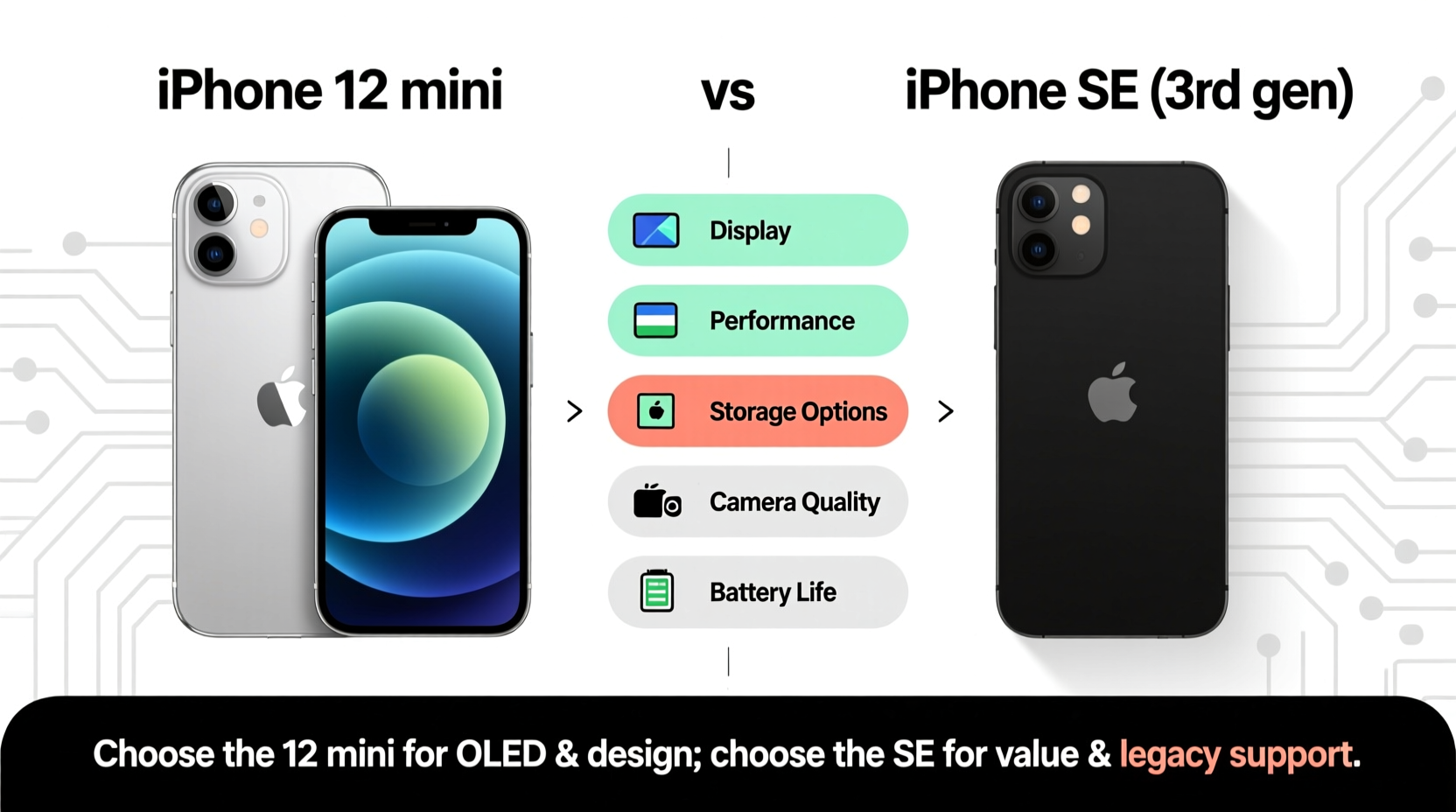
The iPhone 12 mini remains the smallest iPhone Apple has made since the iPhone SE (2020). At 5.18 x 2.53 x 0.29 inches and 135 grams, it fits comfortably in one hand and slips easily into tight pockets. Its flat edges and Ceramic Shield front give it a modern yet nostalgic feel, reminiscent of the iPhone 5 era. For users who prioritize portability over screen real estate, this is still unmatched.
The iPhone SE (2023), while slightly larger at 5.45 x 2.65 x 0.29 inches and 144 grams, uses the same chassis as the iPhone 8. That means thick bezels on all sides and a home button with Touch ID instead of Face ID. It feels more dated in design, but some users appreciate the physical button for accessibility or glove-friendly unlocking.
Performance: A Closer Race Than You’d Think
Under the hood, both phones are surprisingly capable. The iPhone 12 mini runs on the A14 Bionic chip, while the 2023 iPhone SE uses the A15 Bionic — the same chip found in the iPhone 14 (non-Pro). On paper, the SE has a slight edge in CPU and GPU performance, particularly in graphics-heavy tasks like gaming or AR apps.
However, real-world usage reveals minimal difference. Everyday operations — browsing, messaging, social media, and even multitasking — feel equally snappy on both devices. iOS optimization ensures that neither feels sluggish. Where the A15 pulls ahead is longevity: it will likely receive iOS updates for longer, possibly up to 2028 compared to the 12 mini’s expected end around 2027.
“Performance isn’t just about raw power — it’s about how long the device stays relevant. The A15 gives the SE an extra year or two of software support.” — David Kim, Mobile Analyst at TechPulse Insights
Battery Life: The Mini’s Achilles’ Heel
No discussion of the iPhone 12 mini is complete without addressing its weakest point: battery life. Apple rates it for up to 15 hours of video playback, but real-world usage — especially with 5G and high-brightness settings — often delivers closer to 8–9 hours of screen-on time. Heavy users may need to charge midday.
In contrast, the iPhone SE, despite having a similar-sized battery, benefits from less demanding hardware (LCD vs. OLED) and more efficient background processing. It averages 10–11 hours of screen time, making it more reliable for full-day use without a charger.
| Feature | iPhone 12 mini | iPhone SE (2023) |
|---|---|---|
| Chipset | A14 Bionic | A15 Bionic |
| Display | 5.4” Super Retina XDR OLED | 4.7” Retina HD LCD |
| Face ID / Touch ID | Face ID | Touch ID (in Home Button) |
| Rear Camera | 12MP f/1.6 + Ultrawide | 12MP f/1.8 (single lens) |
| Front Camera | 12MP TrueDepth | 7MP FaceTime HD |
| 5G Support | Yes (mmWave & sub-6GHz) | Yes (sub-6GHz only) |
| Battery Life (Screen-On) | ~8–9 hours | ~10–11 hours |
| Water Resistance | IP68 (6m for 30 mins) | IP67 (1m for 30 mins) |
| Starting Price (New) | Discontinued (~$599 used) | $429 |
Camera Capabilities: More Than Just Megapixels
The iPhone 12 mini has a clear advantage in photography. It includes a dual-camera system: a primary 12MP sensor and an ultrawide lens. This allows for greater creative flexibility — capturing sweeping landscapes or tight spaces without stepping back. It also supports Night mode on both cameras, Deep Fusion, and Smart HDR 3.
The iPhone SE relies on a single 12MP rear camera. While it shares some image-processing tech with newer iPhones (thanks to the A15), it lacks ultrawide capability, Night mode on portraits, and advanced video features like Dolby Vision at 30fps. The front-facing 7MP camera also limits selfie quality and FaceTime clarity compared to the 12 mini’s 12MP TrueDepth system.
If you frequently take photos — whether for social media, family memories, or creative projects — the 12 mini’s camera system offers noticeably better versatility and low-light performance.
Real-World Example: Choosing Based on Lifestyle
Meet Sarah, a freelance graphic designer who commutes daily by bike and values efficiency. She previously used a large Android phone but found it cumbersome to handle while riding. When downsizing, she considered both the 12 mini and the SE.
She ultimately chose the iPhone 12 mini because the OLED display offered better color accuracy for reviewing client work, and the ultrawide camera helped her document project spaces. However, she keeps a portable battery pack in her bag due to the shorter battery life. “It’s a trade-off,” she says, “but I’d rather carry a charger than miss a shot or struggle with a dim screen outdoors.”
Compare that to James, a college student who mainly uses his phone for notes, calls, and light social media. He bought the iPhone SE for $429. “I don’t take many photos, and I hate charging twice a day. The home button is actually faster for me, and the battery gets me through lectures without stress.”
Which One Should You Buy? A Decision Checklist
Use this checklist to determine which phone suits your needs:
- ✅ Do you prioritize a compact, modern design with Face ID? → iPhone 12 mini
- ✅ Do you want the best possible camera in this size class? → iPhone 12 mini
- ✅ Is battery life a top concern, especially for full-day use without charging? → iPhone SE
- ✅ Are you on a strict budget and buying new? → iPhone SE
- ✅ Do you prefer Touch ID for ease of use with masks or gloves? → iPhone SE
- ✅ Do you want longer software support (iOS updates until ~2028)? → iPhone SE
- ✅ Do you value 5G with broader carrier compatibility (including mmWave)? → iPhone 12 mini
FAQ
Can the iPhone 12 mini still run the latest apps smoothly?
Yes. The A14 Bionic handles iOS 17 and current apps without issue. Most developers optimize for devices going back to the A12, so performance remains strong. However, future apps may begin to favor A15+ chips.
Is the iPhone SE’s screen too small for streaming or reading?
For some users, yes. The 4.7-inch LCD is significantly smaller and less vibrant than modern OLED displays. If you watch videos regularly or read long articles, the 12 mini’s 5.4-inch OLED provides a much better viewing experience.
Will Apple release a new mini model soon?
Unlikely. Sales of the iPhone 12 and 13 mini were lower than expected, leading Apple to discontinue the line. There are no credible rumors of a 2024 mini release. If you want a small iPhone now, these two models are your last best options for several years.
Final Verdict: Worth It Depends on Your Priorities
The iPhone 12 mini is still a remarkable device — a technological marvel packed into a tiny frame. If you value design, display quality, camera flexibility, and Face ID, it’s absolutely worth considering, especially if purchased used or refurbished at a discount.
But the iPhone SE wins on practicality. It’s newer, cheaper when bought new, has better battery life, and will be supported longer. For users who don’t need advanced cameras or a sleek profile, it’s the smarter long-term investment.
Ultimately, ask yourself: do you want the best small iPhone ever made, knowing its limitations? Or do you want a reliable, budget-friendly iPhone that will last five years with fewer compromises?




 浙公网安备
33010002000092号
浙公网安备
33010002000092号 浙B2-20120091-4
Comments
No comments yet. Why don't you start the discussion?