
In today’s smartphone market, where mid-range devices offer near-flagship experiences, older models like the iPhone 6 Plus and Samsung Galaxy J7 Prime are often considered by budget-conscious buyers. Both phones were once popular in their time—Apple's flagship from 2014 and Samsung’s affordable 2016 contender—but nearly a decade later, they serve very different purposes. Is holding onto an iPhone 6 Plus practical, or does the Galaxy J7 Prime represent smarter value for someone needing a basic device?
This article breaks down key factors—performance, software support, camera quality, battery life, and real-world usability—to help determine whether either phone deserves a place in your pocket in 2024.
Performance and Hardware: A Reality Check
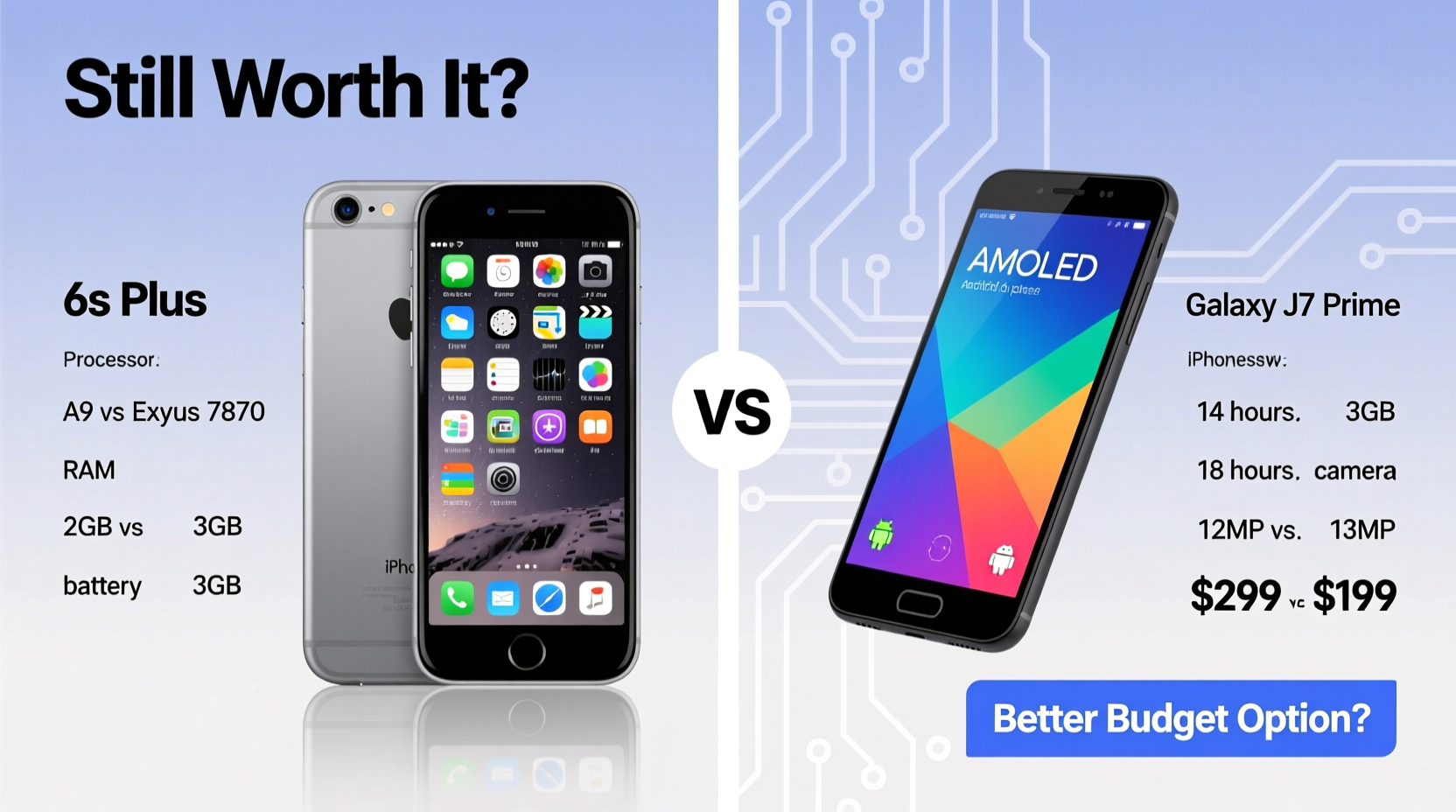
The iPhone 6 Plus runs on Apple’s A8 chip with 1GB of RAM. At launch, this was more than sufficient for iOS 8, but today it struggles even with basic tasks under iOS 12—the last version it officially supports. Apps like Chrome, Facebook, and WhatsApp run slowly, often crashing or taking several seconds to load. Multitasking is limited, and background app refresh barely functions.
In contrast, the Galaxy J7 Prime features Samsung’s Exynos 7870 processor, an octa-core 1.6GHz CPU paired with 3GB or 4GB of RAM depending on region. While not powerful by modern standards, it handles Android 8 Oreo (with some models updated to Android 9 via One UI) much more smoothly than the iPhone 6 Plus manages its final OS update.
Software Support and Security: The Hidden Cost of Aging Devices
Software updates are critical for security, app compatibility, and usability. The iPhone 6 Plus received its final major update with iOS 12 in 2018 and has seen no security patches since 2020. This means vulnerabilities remain unpatched, making the device risky for online banking, email, or any sensitive activity.
The Galaxy J7 Prime fared slightly better. Most units stopped receiving updates after Android 9 (2019–2020), but Samsung did roll out occasional monthly security patches until early 2021 in certain regions. Still, both phones are now completely unsupported.
“Devices without ongoing security updates become liability points in your digital life.” — Dr. Lena Patel, Cybersecurity Analyst at MobileTrust Labs
Modern apps increasingly require newer OS versions. Instagram dropped support for iOS 12 in late 2022. WhatsApp requires iOS 15 or Android 5.0+ as of 2023. Users of these older phones may find themselves locked out of essential services within months.
Camera Comparison: Nostalgia vs. Practicality
The iPhone 6 Plus launched with a respected 8MP rear camera featuring optical image stabilization—a rarity at the time. In good lighting, it captures decent photos with natural color reproduction and accurate white balance. However, low-light performance is poor, and video tops out at 1080p/30fps. The front-facing camera is only 1.2MP, limiting selfie quality.
The Galaxy J7 Prime steps ahead with a 13MP main sensor and an f/1.9 aperture, allowing better light capture. Its photos tend to be brighter and more detailed in daylight, though colors can appear oversaturated. It also includes a 8MP front camera—significantly better for selfies and video calls. Video recording remains capped at 1080p.
| Feature | iPhone 6 Plus | Galaxy J7 Prime |
|---|---|---|
| Rear Camera | 8MP, OIS, f/2.2 | 13MP, f/1.9 |
| Front Camera | 1.2MP | 8MP |
| Video Recording | 1080p@30fps | 1080p@30fps |
| Low-Light Performance | Poor | Moderate |
| Portrait Mode | No | No (software attempts exist) |
While Apple’s image processing was superior in its era, the hardware limitations of the 6 Plus make it less competitive today—even against similarly aged Android rivals.
Battery Life and Long-Term Usability
The iPhone 6 Plus came with a 2915mAh battery, which was large for its time. However, lithium-ion batteries degrade over time. After ten years, even a well-maintained unit likely holds less than 60% of its original capacity. Swapping the battery is possible but costs $49–$69 at Apple stores (if eligible), and third-party replacements vary in quality.
The Galaxy J7 Prime packs a 3300mAh battery and, crucially, offers removable batteries in some variants. This allows users to replace worn-out cells easily and cheaply. Combined with its more efficient processor under lighter system demands, the J7 Prime often delivers a full day of moderate use even with aging hardware.
Mini Case Study: Maria’s Experience in Rural Philippines
Maria, a schoolteacher in Palawan, needed a reliable phone for messaging parents and accessing educational materials offline. She inherited an iPhone 6 Plus from her brother but found it unusable—apps wouldn’t open, messages delayed, and the battery died by noon. She switched to a secondhand Galaxy J7 Prime bought locally for ₱1,200 (~$22). With its removable battery and smoother performance on lightweight Android apps, she reported consistent daily use, even charging only every other day with conservative settings.
Her case highlights a broader trend: in emerging markets and low-connectivity areas, repairability and predictable performance matter more than brand prestige.
Value Proposition in 2024: Who Should Consider These Phones?
Neither the iPhone 6 Plus nor the Galaxy J7 Prime should be purchased new today. But used or refurbished units still circulate in informal markets, especially in developing countries. Here’s how they stack up for different user types:
- First-time smartphone users: The J7 Prime offers better app responsiveness and longer battery life.
- Secondary/emergency phones: If already owned, the iPhone 6 Plus can function as a music player or GPS device—but disable iCloud and avoid logging into personal accounts.
- Elderly users needing simplicity: iOS on the 6 Plus is simpler to navigate, but app incompatibility makes it impractical. Android Go phones under $50 outperform both.
- Collectors or nostalgic users: The iPhone 6 Plus holds historical significance as Apple’s first large-screen iPhone. As a collector’s item, it has merit.
Checklist: Evaluating an Old Phone Before Use
- Verify the device boots and unlocks consistently.
- Check battery health (iOS: Settings > Battery; Android: dial *#*#4636#*#*).
- Ensure Wi-Fi and cellular connectivity work.
- Test camera, speaker, microphone, and touchscreen.
- Factory reset before setup to remove previous owner data.
- Avoid entering passwords or credit card details.
- Install only trusted, lightweight apps from official sources.
Frequently Asked Questions
Can I still use WhatsApp on the iPhone 6 Plus?
No. As of February 2023, WhatsApp requires iOS 15 or later. The iPhone 6 Plus maxes out at iOS 12, making it incompatible. Similarly, Signal and Telegram have dropped support for outdated Android versions that affect the J7 Prime.
Which phone lasts longer on a charge today?
The Galaxy J7 Prime typically performs better due to higher original battery capacity and easier replacement options. Even with degraded cells, swapping in a new battery restores functionality—something far more difficult and costly on the iPhone 6 Plus.
Are there safer, affordable alternatives?
Yes. Modern entry-level smartphones like the Nokia C12 ($60), Samsung Galaxy A05 ($90), or Xiaomi Redmi Note 12 (Android Go variant) offer updated operating systems, better cameras, faster processors, and guaranteed security patches—making them far wiser investments.
Final Verdict: Move On From Both
The emotional attachment to older devices is understandable. The iPhone 6 Plus defined a generation of smartphones, and the Galaxy J7 Prime brought premium design to budget buyers. But technology evolves, and so must our expectations.
If you’re relying on either of these phones in 2024, you're sacrificing security, app access, and everyday reliability. The Galaxy J7 Prime edges ahead in raw usability thanks to better RAM, larger battery, and simpler maintenance—but neither meets minimum standards for safe, functional smartphone ownership today.
For less than $100, you can purchase a new device with modern software, improved durability, and long-term support. Holding onto outdated tech isn't frugal—it's costly in time, frustration, and risk.




 浙公网安备
33010002000092号
浙公网安备
33010002000092号 浙B2-20120091-4
Comments
No comments yet. Why don't you start the discussion?