
Apple’s iPhone lineup continues to offer compelling options at every price point. The iPhone SE (third generation, released in 2022) stands out as the most affordable way to get into the iOS ecosystem with modern internals. But as time passes, older models like the iPhone 11 see their prices drop—often landing within striking distance of the iPhone SE. This raises a critical question: Is the iPhone SE still worth buying when you can get an iPhone 11 for only slightly more?
The answer isn’t straightforward. While both phones share core Apple strengths—excellent software support, strong resale value, and reliable performance—their differences in design, display, camera, and battery life create meaningful trade-offs. For budget-conscious buyers, this decision comes down to priorities: Do you want the latest chipset in a compact body, or a better-rounded experience with a larger screen and superior camera?
Performance: A Clear Win for the iPhone SE
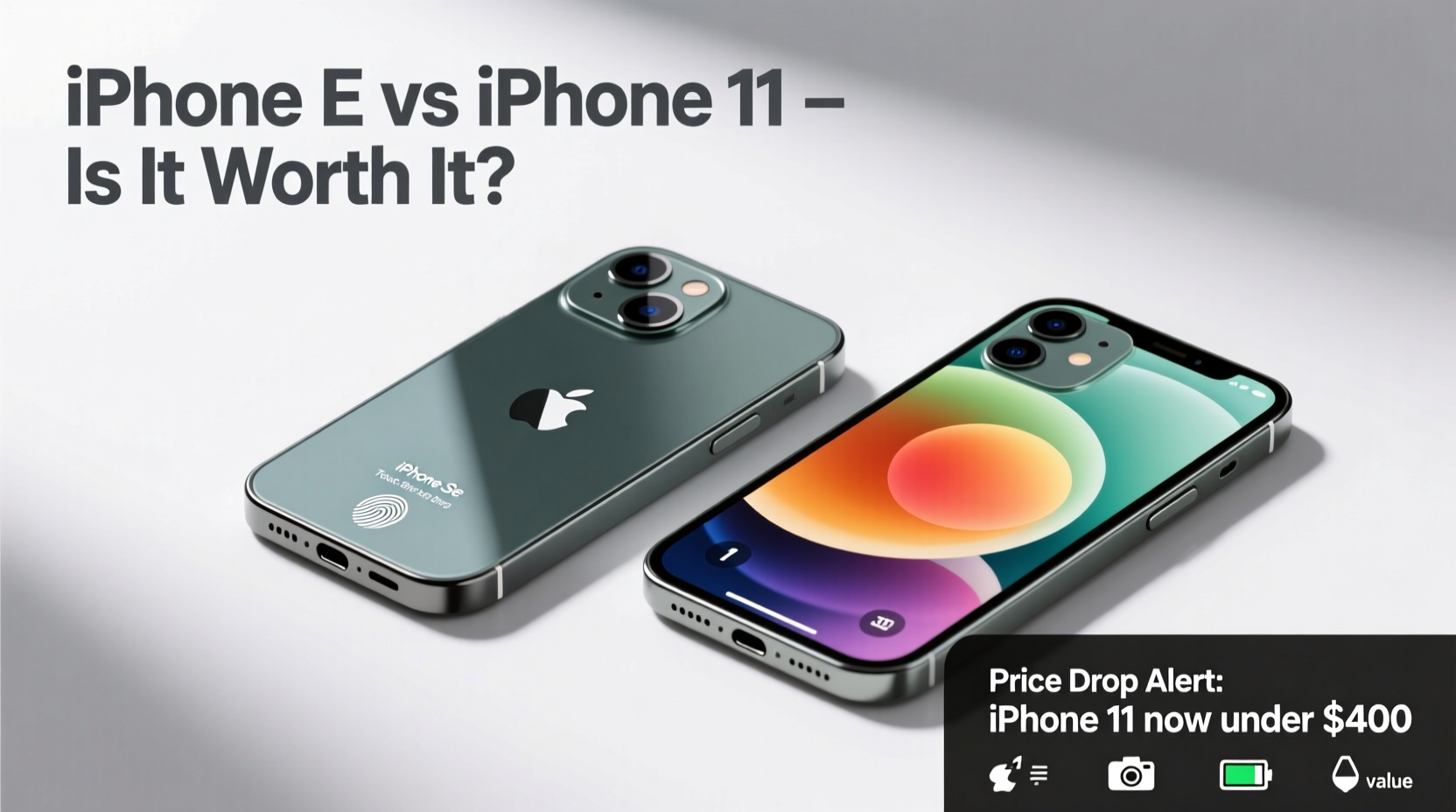
Under the hood, the iPhone SE packs the A15 Bionic chip—the same processor found in the iPhone 13 series. That gives it a significant edge over the iPhone 11, which uses the older A13 Bionic. Benchmarks show the A15 delivering up to 50% faster CPU performance and nearly double the GPU power.
This translates to real-world benefits: smoother multitasking, quicker app launches, and better longevity. The iPhone SE will likely receive iOS updates for five years from its release (until 2027), thanks to its modern architecture. In contrast, the iPhone 11, launched in 2019, may see support taper off sooner—though Apple’s track record suggests it could still get updates through 2025.
Display and Design: Where the iPhone 11 Pulls Ahead
The iPhone SE sticks to a retro design language: a 4.7-inch LCD display with thick bezels and a physical Home button with Touch ID. It’s compact and easy to use one-handed, but the screen feels outdated next to modern smartphones.
The iPhone 11, meanwhile, features a 6.1-inch Liquid Retina IPS display. While not OLED, it offers brighter colors, better contrast, and significantly more screen real estate. Watching videos, browsing social media, or reading articles is simply more enjoyable on the larger, edge-to-edge display.
Additionally, the iPhone 11 supports Face ID, offering a more seamless unlocking experience in varied lighting and angles. The SE’s Touch ID works reliably, but requires finger contact and can struggle with wet hands or gloves.
Camera Comparison: One Sensor vs. Two
The iPhone SE has a single 12MP rear camera. It performs well in daylight and leverages the A15’s image signal processor for improved Smart HDR and portrait mode, but it lacks key hardware advantages.
The iPhone 11 includes two rear cameras: a 12MP wide lens and a 12MP ultra-wide lens. This unlocks creative flexibility—zooming out to capture landscapes, group photos, or tight indoor shots without stepping back. The ultra-wide also improves depth mapping for more accurate portrait mode effects.
In low light, the iPhone 11’s Night mode is noticeably superior. It captures more detail and dynamic range, while the SE’s Night mode is limited by older sensor tuning. Video quality is another win for the 11: it supports 4K at 60fps across all cameras, while the SE caps at 30fps on the front camera.
“Camera versatility matters more than raw specs. Having an ultra-wide lens changes how you document everyday moments.” — David Lin, Mobile Photographer & Tech Reviewer
Battery Life and Charging: Practical Differences
Battery life is where the iPhone 11 clearly outperforms the SE. Despite having a smaller battery capacity on paper (3,110mAh vs. SE’s 2,018mAh), the iPhone 11 lasts significantly longer due to its more efficient display tuning and larger overall power reserve.
Apple rates the iPhone 11 for up to 17 hours of video playback; the SE manages about 13 hours. In daily use, that often means the SE needs a midday charge for moderate to heavy users, while the 11 can comfortably last a full day—and sometimes stretch into a second.
Both phones support fast charging (up to 50% in 30 minutes with an 18W adapter), but neither includes a charger in the box. Wireless charging works on both, though the SE uses a slower Qi standard compared to the 11’s optimized alignment.
Price and Value: The Critical Trade-Off
At launch, the iPhone SE started at $429. The iPhone 11 began at $699 but now commonly sells for $450–$550 unlocked, depending on storage and condition (refurbished units are especially common).
That narrow price gap—sometimes as little as $20–$50—makes the iPhone 11 an incredibly attractive option. For a small premium, you gain a bigger screen, better battery, dual cameras, and Face ID. However, if you’re strictly budget-limited or prefer a pocketable device, the SE remains a powerful performer in a tiny package.
Consider this comparison:
| Feature | iPhone SE (2022) | iPhone 11 |
|---|---|---|
| Chipset | A15 Bionic | A13 Bionic |
| Display | 4.7\" LCD, 1334x750 | 6.1\" IPS LCD, 1792x828 |
| Rear Cameras | 12MP (wide only) | 12MP wide + 12MP ultra-wide |
| Front Camera | 7MP | 12MP |
| Biometrics | Touch ID | Face ID |
| Battery Life (Video) | Up to 13 hours | Up to 17 hours |
| Water Resistance | IP67 | IP68 |
| Starting Price (Current) | $429 (new) | $450–$550 (refurb/new) |
Real-World Scenario: Who Should Choose Which?
Meet Sarah: A college student on a tight budget who needs a reliable phone for classes, messaging, and occasional photos. She values portability and long-term performance. After researching, she buys the iPhone SE for $429. She appreciates the compact size, fast app performance, and confidence that her phone will stay updated for years. She charges it daily before class but doesn’t mind the smaller screen.
Meet James: A freelance photographer looking for a secondary phone. He finds a certified refurbished iPhone 11 for $470. Though he pays slightly more, he gains the ultra-wide lens for architectural shots, better low-light performance, and longer battery life during shoots. The larger display helps him review images on-site. For him, the extra cost is justified by the camera and usability improvements.
Sarah prioritized affordability and future-proofing. James prioritized functionality and creative tools. Both made smart choices—because they aligned the device with their actual needs.
Checklist: How to Decide Between iPhone SE and iPhone 11
- ✅ Determine your budget ceiling. Can you stretch to $500+ for more features?
- ✅ Assess your camera needs. Do you take wide-angle shots or shoot in low light often?
- ✅ Test the size. Try holding both models (or similar-sized devices) to see what feels comfortable.
- ✅ Consider battery demands. Will you be away from charging for long periods?
- ✅ Evaluate biometric preference. Do you prefer Face ID or Touch ID?
- ✅ Think long-term. Are you keeping this phone for 4+ years? Prioritize the newest chip.
Frequently Asked Questions
Can the iPhone SE run the same apps as the iPhone 11?
Yes. Both run the latest version of iOS and handle demanding apps like Photoshop Express, YouTube, and mobile games. The iPhone SE’s A15 actually runs them faster, but some games may not support its smaller resolution.
Is the iPhone 11 waterproof?
It’s water-resistant with an IP68 rating, meaning it can survive submersion up to 2 meters for 30 minutes. The iPhone SE has IP67 (1 meter for 30 minutes), so the 11 has a slight edge in durability.
Should I buy refurbished to save money?
Yes—if purchased from reputable sources like Apple Certified Refurbished, Best Buy Renewed, or Amazon Renewed Premium. These come with warranties and rigorous testing, making them a safe way to get an iPhone 11 near the SE’s price.
Final Verdict: It Depends on Your Priorities
The iPhone SE is an engineering marvel: flagship-level performance in a no-frills package. It’s ideal for users who want speed, simplicity, and longevity without spending much. But its compromises—tiny screen, weak battery, basic camera—are real.
The iPhone 11, now priced just above the SE, offers a far more balanced experience. With a better display, superior camera system, longer battery, and modern Face ID, it delivers more value for a minimal increase in cost—especially when buying refurbished.
If you can afford $500 and don’t need a pocket-sized phone, the iPhone 11 is the smarter buy. But if you prioritize raw speed, love Touch ID, or need something ultra-compact, the iPhone SE still holds its ground.




 浙公网安备
33010002000092号
浙公网安备
33010002000092号 浙B2-20120091-4
Comments
No comments yet. Why don't you start the discussion?