
In 2024, finding a budget-friendly iOS device that still delivers a reliable Apple experience is tricky. The iPod Touch (6th generation) was discontinued in 2019, but units remain available through third-party sellers. Meanwhile, the iPhone 5c — released in 2013 — is even older but sometimes surfaces in refurbished markets. At first glance, both devices seem like nostalgic relics, but some buyers consider them entry points into the iOS ecosystem. So, which one actually makes sense today?
The answer depends on your needs: Are you looking for a music player, a retro gaming device, or a functional smartphone alternative? Let’s break down performance, software support, connectivity, and practical use cases to determine whether either device holds up in 2024.
Performance and Hardware Comparison
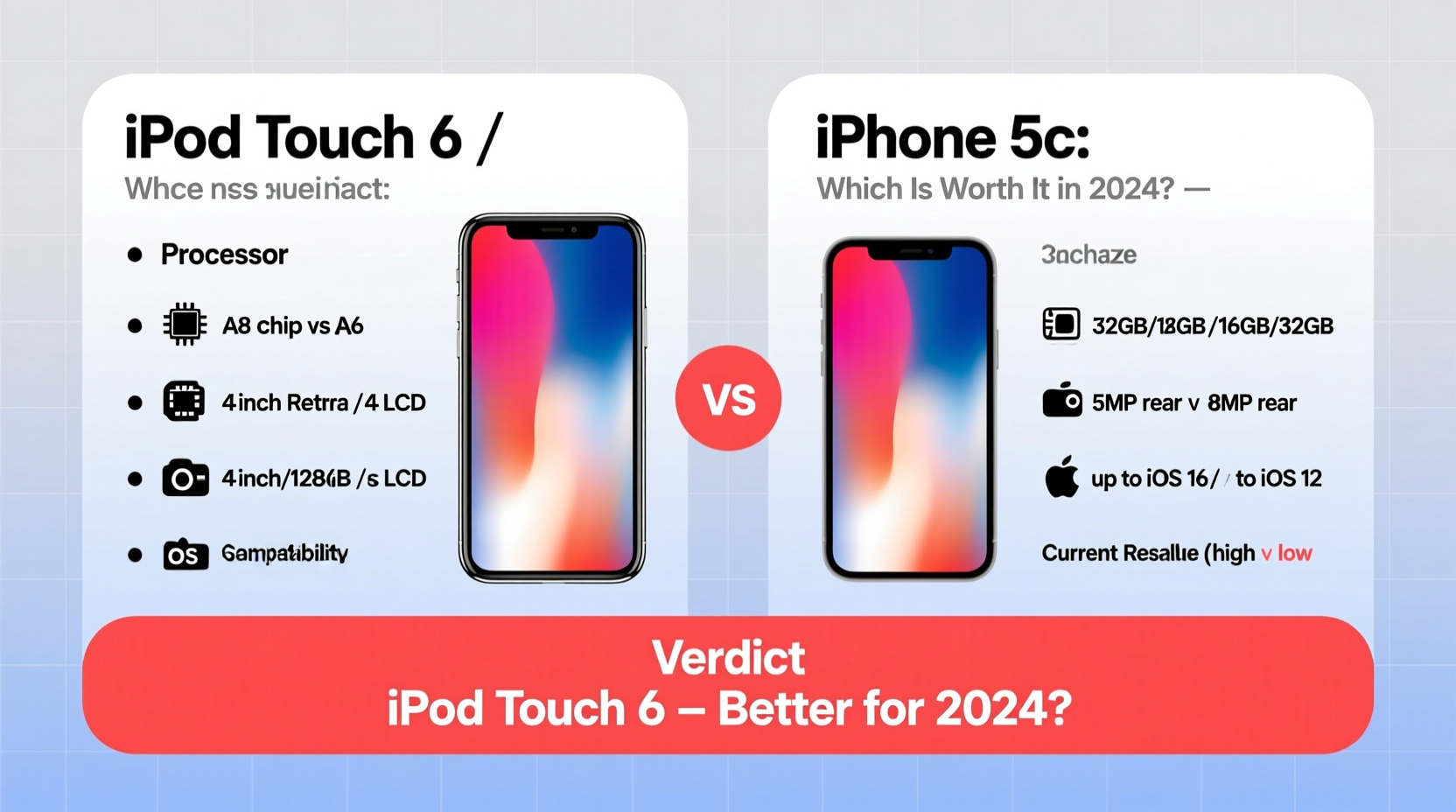
The iPod Touch 6th gen runs on Apple’s A8 chip with 1GB of RAM — the same processor found in the iPhone 6. In contrast, the iPhone 5c uses the older A6 chip and only 512MB of RAM. This difference isn’t trivial. The A8 supports Metal API, enabling smoother graphics performance and better app compatibility, while the A6 struggles with modern app demands.
Storage options also differ. The iPod Touch 6 comes in 32GB, 64GB, and 128GB variants, whereas the iPhone 5c maxes out at 32GB. If you plan to install games, apps, or media, the higher-capacity Touch models offer more breathing room.
| Feature | iPod Touch 6 | iPhone 5c |
|---|---|---|
| Processor | A8 chip | A6 chip |
| RAM | 1GB | 512MB |
| Max Storage | 128GB | 32GB |
| Camera | Rear: 8MP, Front: 1.2MP | Rear: 8MP, Front: 1.2MP |
| Battery Life | Up to 40 hours audio / 8 hours video | Up to 10 hours talk time / 40 hrs audio |
| Connectivity | Wi-Fi, Bluetooth 4.0 | Wi-Fi, Bluetooth 4.0, LTE (varies) |
While both devices have similar cameras, the iPod Touch benefits from slightly better image signal processing due to its newer architecture. However, neither supports Portrait mode or modern computational photography.
Software Support and App Compatibility
This is where things get critical. As of 2024, the iPod Touch 6 supports up to iOS 12.5.7 — the final update released in January 2023 for legacy devices. It cannot run iOS 13 or later. The iPhone 5c stopped at iOS 10.3.4, making it even more outdated.
Modern apps increasingly require iOS 13 or higher. Spotify, TikTok, Instagram, and most banking apps either don’t install or crash frequently on iOS 12 or earlier. Even Safari lacks support for many current web standards, leading to broken websites and login issues.
“Devices stuck on iOS 12 are effectively cut off from the modern app ecosystem. They’re not unsafe per se, but their utility is severely limited.” — David Liu, Mobile Software Analyst at TechInsight Weekly
If your goal is to use mainstream social media or productivity tools, neither device will suffice. However, if you're focused on offline media playback, classic games, or music syncing via iTunes, the iPod Touch remains functional.
Real-World Use Case: Can Either Serve as a Daily Driver?
Consider Sarah, a college student looking for an affordable way to listen to music, take notes, and stay connected without a monthly phone bill. She finds a used iPod Touch 6 for $60 and considers it a win. But within days, she discovers that her university’s learning management system requires a modern browser, and her preferred note-taking app no longer supports iOS 12. Messaging apps like WhatsApp don’t work without SMS verification, which the Touch can’t receive.
She then looks at an iPhone 5c listed for $40. While it has cellular capability, it doesn’t support VoLTE on most modern networks, meaning calls drop frequently. Plus, iOS 10 prevents her from downloading nearly any current app. After two weeks, she ends up spending $150 on a basic Android phone that offers far better functionality.
This scenario illustrates a key point: nostalgia and low cost don’t override fundamental usability issues. Neither device functions well as a primary communication tool in 2024.
When the iPod Touch 6 Still Makes Sense
Despite its age, the iPod Touch 6 retains niche value under specific conditions:
- Music-only portable player: With iTunes syncing, it handles MP3 and AAC files flawlessly and supports lossless audio over Lightning with adapters.
- Kid’s entertainment device: Parents can load games, videos, and educational apps (those still compatible with iOS 12) without exposing children to phones or data plans.
- Retro gaming: Many classic iOS games (e.g., *Monument Valley*, *Badland*, early *Angry Birds*) run smoothly and are enjoyable without needing updates.
- Digital photo frame or kitchen recipe viewer: Repurposed with static content, it can serve in fixed-location roles.
For these uses, the iPod Touch 6 is still viable — especially the 128GB model, which provides ample storage for offline content.
Step-by-Step: How to Decide Which Device (If Any) to Buy
- Define your primary use case: Is it music, gaming, communication, or general browsing?
- Check app requirements: Visit the App Store page of essential apps and verify minimum iOS version.
- Test battery health: If buying used, power the device on and let it idle for 30 minutes. If battery drains faster than 5%, it’s likely degraded.
- Evaluate connectivity needs: Do you need Wi-Fi calling, hotspot sharing, or LTE? The 5c has cellular, but network compatibility is spotty.
- Compare total cost: Factor in accessories, potential repairs, and opportunity cost versus buying a used iPhone SE (1st gen) or Android equivalent.
- Consider resale and longevity: Devices stuck on old OS versions lose value quickly and may become unusable within a year.
FAQ
Can I use FaceTime on the iPod Touch 6 in 2024?
Yes, FaceTime Audio and Video still work over Wi-Fi, provided the other user is on a supported device. However, group FaceTime and advanced features like Portrait mode are unavailable.
Does the iPhone 5c work on modern carriers?
Limitedly. AT&T and T-Mobile have phased out 3G, which the 5c relies on for voice. It may connect to LTE for data in some areas, but call reliability is poor. Verizon disabled CDMA support in 2023, rendering 5c models nonfunctional there.
Is jailbreaking either device a solution?
No. While jailbreaking once extended functionality, doing so now increases security risks without restoring app compatibility. Most modern jailbreak tools are abandoned, and sideloading apps requires complex setups with diminishing returns.
Final Verdict: Stick with the iPod Touch 6 — But Only If You Know Its Limits
The iPhone 5c is obsolete in every practical sense. Its hardware limitations, lack of iOS updates, and poor network compatibility make it unsuitable even as a backup device. The iPod Touch 6, while aging, offers better performance, more storage, and slightly more relevant software support.
Still, calling it “worth it” depends entirely on expectations. For under $70, it works as a dedicated music player or retro gaming handheld. But if you want messaging, web browsing, or app access, spend a little more on a used iPhone 6s or newer — or consider a budget Android phone with active software support.
Technology evolves fast. Holding onto older devices has charm, but usability should never be sacrificed for sentimentality.




 浙公网安备
33010002000092号
浙公网安备
33010002000092号 浙B2-20120091-4
Comments
No comments yet. Why don't you start the discussion?