
The Fitbit Charge 6 has arrived with upgraded sensors, improved heart rate monitoring, built-in GPS, and enhanced sleep tracking. With features that rival some clinical-grade tools, it's natural to wonder: can this sleek wristband truly step into the role of a medical device? The short answer is no — but the reality is more nuanced than a simple yes or no. While the Charge 6 delivers impressive accuracy for personal wellness tracking, it remains a consumer fitness tool, not a diagnostic instrument.
FDA-cleared functions like atrial fibrillation (AFib) detection have raised expectations, but even these are designed for screening, not diagnosis. Understanding the boundaries between health monitoring and medical evaluation is crucial for anyone relying on wearable data to manage their well-being.
Understanding the Fitbit Charge 6’s Health Tracking Capabilities
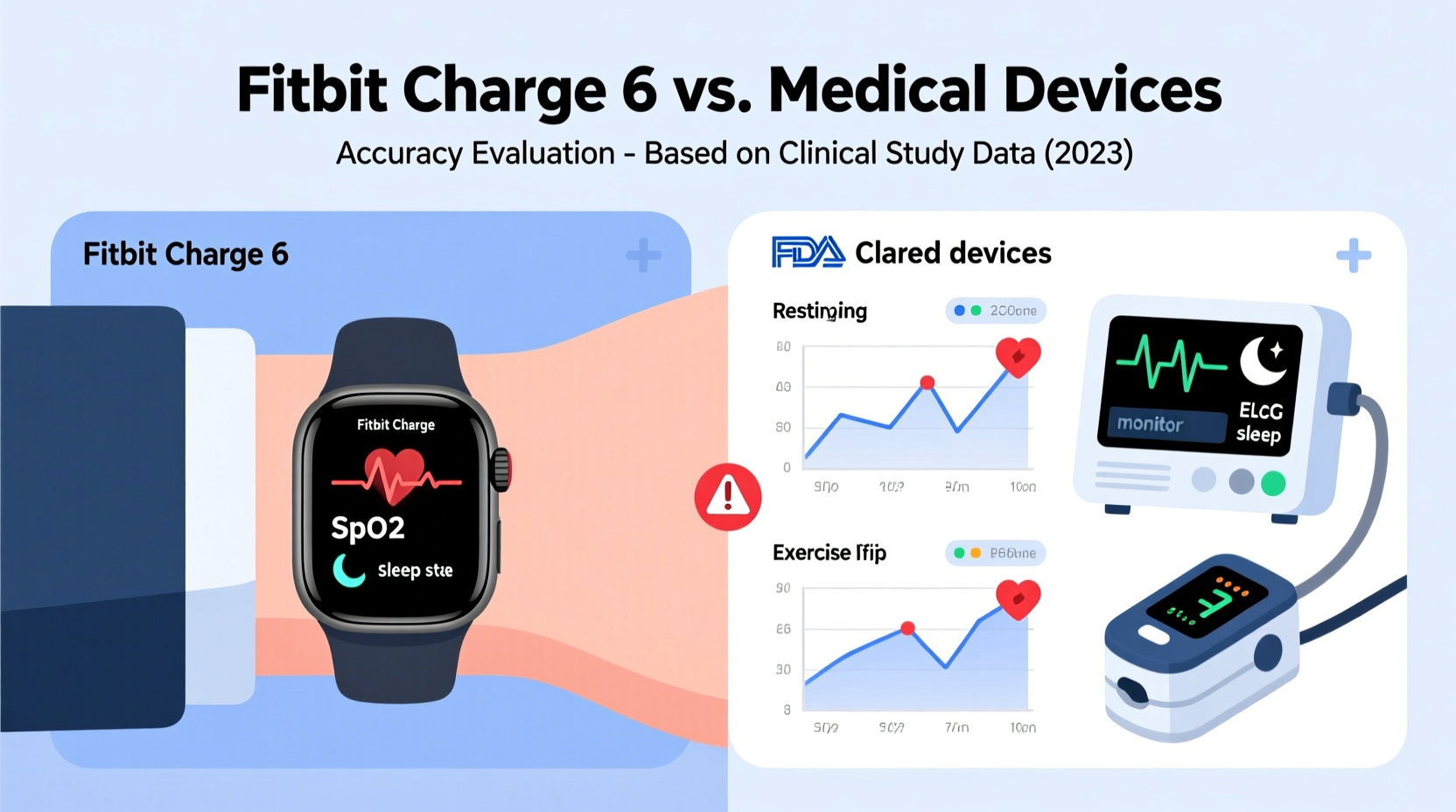
The Charge 6 builds on Fitbit’s legacy of accessible health tracking. It includes continuous heart rate monitoring using photoplethysmography (PPG), SpO2 (blood oxygen saturation) sensing during sleep, skin temperature variation tracking, and an electrodermal activity (EDA) sensor for stress response. These metrics offer users insight into trends over time, such as resting heart rate changes, irregular heartbeat notifications, and sleep quality patterns.
One of the most notable upgrades in the Charge 6 is the integration of Google’s AI-powered algorithms to enhance workout detection and heart rate accuracy. Additionally, it supports ECG readings via the Fitbit app — a feature cleared by the FDA for detecting signs of AFib. This capability allows users to take a single-lead electrocardiogram directly from their wrist, which can then be shared with a healthcare provider.
However, despite these advancements, the device operates under different standards than medical equipment. Clinical devices undergo rigorous validation across diverse populations and controlled environments. Consumer wearables, while increasingly sophisticated, are optimized for convenience and general trends rather than precision diagnostics.
Accuracy Compared to Medical-Grade Devices
To assess whether the Charge 6 could ever replace a medical device, it’s essential to compare its performance against clinically validated tools. Below is a comparison of key metrics tracked by the Charge 6 versus standard medical instruments.
| Metric | Fitbit Charge 6 Method | Medical Device Equivalent | Relative Accuracy |
|---|---|---|---|
| Heart Rate | PPG Optical Sensor | Electrocardiogram (ECG) | High during rest, moderate during intense exercise |
| Blood Oxygen (SpO2) | Reflectance Pulse Oximetry | Transmittance Pulse Oximeter (Finger Clip) | Moderate; prone to motion artifacts |
| Atrial Fibrillation Detection | User-initiated ECG + Irregular Rhythm Alerts | 12-Lead ECG, Holter Monitor | Screening-level only; not diagnostic |
| Sleep Stages | Heart rate variability, movement, SpO2 | Polysomnography (PSG) Lab Test | Good trend estimation; limited stage precision |
| Stress Levels | EDA + HRV Analysis | Clinical Biomarkers (Cortisol, etc.) | Indirect inference; not lab-validated |
Studies have shown that optical heart rate monitors like the one in the Charge 6 perform well under steady-state conditions but may lag during rapid heart rate changes, such as interval training. A 2023 review published in *npj Digital Medicine* found that Fitbit devices had a mean absolute error of 5–8 bpm during high-intensity activities compared to chest strap monitors.
Likewise, while the Charge 6’s SpO2 readings can flag potential issues like nocturnal desaturation, they are not intended for diagnosing conditions like sleep apnea. Unlike clinical pulse oximeters placed on fingertips with consistent blood flow, wrist-based sensors are more susceptible to signal interference from skin tone, tattoos, and movement.
“Wearables like the Fitbit Charge 6 are powerful tools for patient engagement and longitudinal monitoring, but they don’t eliminate the need for confirmatory testing in a clinical setting.” — Dr. Lena Patel, Cardiologist and Digital Health Researcher at Stanford University
Real-World Example: When the Charge 6 Helped Spot a Concern
Consider the case of Mark T., a 52-year-old software engineer with no prior history of heart issues. Over several weeks, his Charge 6 consistently flagged elevated resting heart rates — climbing from a baseline of 62 bpm to 78 bpm. He also received multiple “irregular heart rhythm” notifications. Though asymptomatic, he decided to consult his physician.
After a 24-hour Holter monitor test, Mark was diagnosed with paroxysmal atrial fibrillation. His doctor credited the early alert to the Charge 6’s persistent tracking, allowing intervention before complications arose. However, the diagnosis wasn’t made based on the Fitbit data alone — it required confirmation through medical-grade equipment.
This scenario illustrates the ideal use case: the wearable acts as a red flag system, prompting further investigation. It didn’t replace the medical device — it complemented it.
Limitations That Prevent Replacement of Medical Devices
No matter how advanced consumer wearables become, several inherent limitations prevent them from replacing regulated medical devices.
- Lack of regulatory approval for diagnosis: While certain Fitbit features are FDA-cleared, clearance does not equate to approval for standalone diagnosis. These tools are labeled for \"screening\" or \"notification,\" requiring follow-up with a clinician.
- Calibration and variability: PPG sensors can be affected by skin pigmentation, tattoo ink, wrist placement, and perfusion levels. Studies show reduced accuracy in individuals with darker skin tones due to light absorption differences.
- Data interpretation without context: The device lacks access to full medical histories, medication use, or environmental factors that influence vital signs. An elevated heart rate could signal illness, anxiety, dehydration, or caffeine intake — only a clinician can differentiate.
- No liability in emergencies: Unlike medical devices used in hospitals, consumer wearables carry no legal responsibility for missed diagnoses or false alarms.
Moreover, the algorithms behind features like AFib detection are trained on limited datasets and may not generalize across all demographics. In contrast, clinical ECG machines use standardized electrode placements and multi-lead analysis for higher sensitivity and specificity.
How to Use the Fitbit Charge 6 Responsibly for Health Monitoring
The Charge 6 shines when used as part of a proactive health strategy — not as a replacement for professional care. Here’s a practical checklist for maximizing its value while staying within safe boundaries:
✅ Wearable Health Monitoring Checklist
- Track daily resting heart rate and note sustained increases (>10 bpm over baseline).
- Review weekly sleep scores and look for consistent disruptions or low deep-sleep percentages.
- Use the ECG feature if you feel palpitations or receive an irregular rhythm alert.
- Sync data with your doctor before appointments, especially if managing chronic conditions.
- Ensure proper fit and wear the device snugly (but comfortably) on the non-dominant wrist for best sensor contact.
- Avoid making treatment decisions based solely on wearable data.
- Report persistent alerts to a healthcare provider — do not ignore them, but don’t self-diagnose either.
Frequently Asked Questions
Can the Fitbit Charge 6 detect a heart attack?
No. The Charge 6 cannot detect a heart attack. While it may record abnormal heart rate patterns or prolonged elevation in resting heart rate — which could be associated with cardiac events — it lacks the ability to identify ischemia or myocardial infarction. Chest pain, shortness of breath, and nausea require immediate emergency care, regardless of what the watch displays.
Is the ECG on the Charge 6 as good as a hospital ECG?
No. The Charge 6 uses a single-lead ECG, capturing electrical activity from one angle. Hospital-grade 12-lead ECGs provide a comprehensive view of the heart’s function from multiple vectors, enabling precise diagnosis of arrhythmias, ischemia, and structural abnormalities. The Fitbit ECG is useful for spotting possible AFib, but it cannot assess other critical conditions.
Should I rely on my Fitbit instead of going to the doctor?
Never. The Charge 6 is designed to encourage awareness and facilitate conversations with healthcare providers — not replace them. If you experience symptoms like dizziness, chest discomfort, or unexplained fatigue, seek medical attention immediately. Data from a smartwatch should support, not substitute, clinical evaluation.
Conclusion: A Powerful Companion, Not a Substitute
The Fitbit Charge 6 represents a significant leap in consumer health technology. Its ability to continuously monitor vital signs, detect potential arrhythmias, and deliver personalized insights makes it one of the most capable fitness trackers on the market. For individuals seeking to understand their bodies better, it offers unprecedented access to real-time physiological data.
Yet, it remains firmly in the category of wellness tools. No amount of AI refinement or sensor upgrades will allow it to meet the stringent accuracy, reliability, and regulatory requirements of medical devices. It cannot diagnose disease, replace lab tests, or guarantee safety in acute medical situations.
Used wisely, however, the Charge 6 empowers users to take ownership of their health journey. It encourages preventive habits, enables early detection of anomalies, and fosters more informed discussions with doctors. When integrated thoughtfully into a broader health strategy, it becomes a valuable ally — just not a replacement for medicine.




 浙公网安备
33010002000092号
浙公网安备
33010002000092号 浙B2-20120091-4
Comments
No comments yet. Why don't you start the discussion?