
For renters in studio apartments, micro-lofts, or compact urban condos, traditional Christmas trees pose a logistical puzzle: Where do you store a 6-foot fir? How do you water it without dripping onto hardwood or laminate? Can your 200-square-foot living room accommodate both a tree stand and a functional seating area? Enter the LED Christmas tree projector—a compact, plug-and-play device promising festive ambiance without the bulk. But does it deliver meaningful holiday joy—or just a fleeting glow that fades under scrutiny? This isn’t about marketing hype. It’s about square footage, electricity bills, light quality, and whether “projected cheer” holds up when your couch is three feet from the wall.
Why Space Constraints Change Everything About Holiday Decor
In tiny homes, every inch serves multiple functions. A 4x6-foot rug anchors the living zone, doubles as a yoga mat, and must clear space for laundry baskets stacked beside the sofa. A standard artificial tree consumes 3–5 square feet just for its base—and that’s before accounting for ornaments, lights, and the inevitable tangle of extension cords snaking to outlets behind furniture. Real-world constraints compound the challenge: narrow doorways (no 7-foot tree delivery), low ceilings (limiting vertical clearance), shared HVAC systems (making live trees a fire and allergen risk), and building policies banning open flames—even on electric candles.
According to the American Housing Survey, nearly 42% of U.S. renter households live in units under 700 square feet. Among them, 68% report limiting holiday decor due to space, storage, or landlord restrictions. That’s not anecdotal—it’s structural. When your closet doubles as a pantry and your balcony is 36 inches wide, “festive” becomes an exercise in spatial negotiation. The LED projector enters this equation not as a luxury upgrade, but as a functional alternative—one that must justify itself not by how bright it shines, but by how seamlessly it integrates into a life already optimized for minimalism.
How LED Tree Projectors Actually Work (and What They Don’t Do)
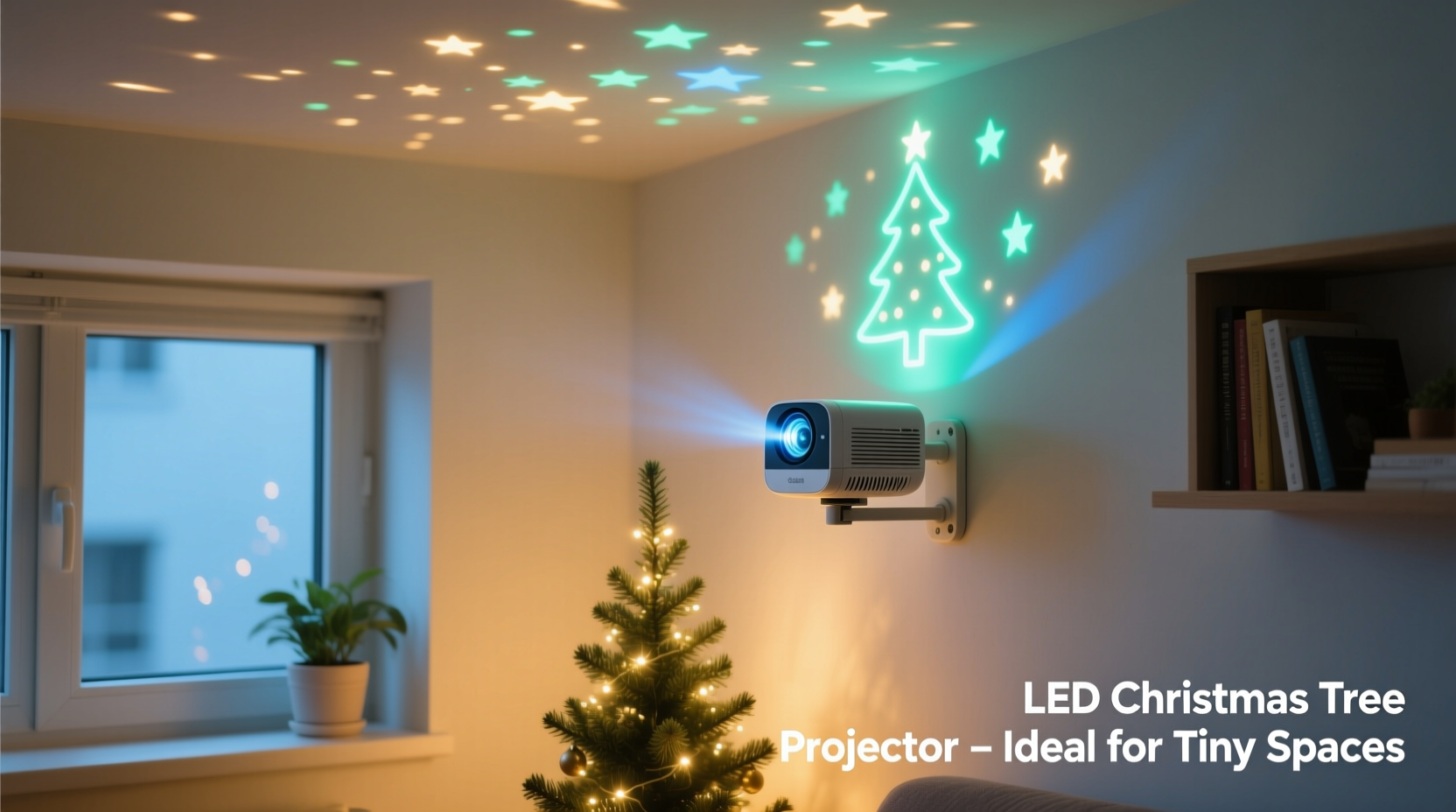
An LED Christmas tree projector is a self-contained optical unit: a high-lumen LED light source, a rotating or static glass or plastic lens with a tree-shaped aperture (often layered with pine boughs, ornaments, or star motifs), and a focusing mechanism. Most models emit light in a conical pattern, projecting a silhouette or semi-transparent image onto walls or ceilings. Unlike full-spectrum smart projectors, these devices use monochromatic or limited-color LEDs (typically warm white, cool white, red/green, or multicolor cycling modes). They don’t generate heat like incandescent bulbs, draw minimal power (3–8 watts), and operate silently—no fans or motors.
Crucially, they do not create depth, texture, or physical presence. You won’t feel pine needles brushing your arm or smell resin. They cast flat, two-dimensional shapes—more evocative than immersive. Their effectiveness depends entirely on three variables: surface reflectivity (matte white walls maximize brightness; dark or textured walls absorb light), ambient light (they fade significantly in daylight or brightly lit rooms), and projection distance (most perform best between 6–12 feet from the wall).
A Real-World Case Study: Maya’s 380-Square-Foot Studio in Brooklyn
Maya, a graphic designer, moved into a converted walk-up studio in Williamsburg last November. Her apartment has one window, exposed brick walls (some darker than others), and zero closet space outside a single 24-inch-wide cabinet. She’d tried a 4-foot artificial tree two years prior—only to dismantle it after five days because it blocked her path to the bathroom and made her desk feel claustrophobic.
This year, she bought a $49 LED tree projector with remote control and timer function. She mounted it on a shelf beside her bookcase, aimed it at the longest unbroken wall (8 feet wide, off-white plaster), and set it to warm white + slow twinkle mode. For the first week, she kept it on from 5 p.m. to 11 p.m. daily. Guests noticed immediately: “It feels cozy—not like a party, but like coming home,” said her roommate. What surprised Maya most was how well it complemented her existing aesthetic: no garlands, no tangled wires, no seasonal clutter. When she hosted a small dinner, she turned it off—no one missed it. When she worked late, its soft glow reduced screen glare without demanding attention. After four weeks, she measured her electricity usage: the projector added $0.18 to her monthly bill. Her verdict? “It’s not a tree. It’s a mood anchor—and for my space, that’s enough.”
What Works—and What Doesn’t—in Tiny Spaces: A Practical Comparison
| Feature | LED Tree Projector | Small Artificial Tree (4–5 ft) | Live Miniature Tree (e.g., Norfolk Pine) |
|---|---|---|---|
| Footprint | Less than 0.2 sq ft (shelf or corner mount) | 3–5 sq ft (base + safety clearance) | 1.5–2.5 sq ft + watering tray |
| Setup Time | Under 90 seconds (plug, aim, switch on) | 20–45 minutes (assembly, fluffing, wiring) | 5–10 minutes (unboxing, potting, placement) |
| Storage | Fits in a shoebox; no disassembly needed | Requires collapsible stand + bag + separate light string storage | Pot + saucer + soil bag = 1–2 cubic feet minimum |
| Light Control | Remote dimming, timer, color modes, motion sensor (on premium models) | Basic on/off or manual timer; limited dimming | No controllable lighting—requires external string lights |
| Rent-Friendly | No wall damage; no weight limits; no moisture risk | Heavy base may scratch floors; tall profile risks tipping | Soil spillage, root rot risk, potential floor stains |
| Long-Term Value | 3–5+ years typical lifespan; no replacement parts | 5–8 years with care—but branches sag, hinges loosen, lights fail | 1–3 years indoors; requires consistent humidity/light |
Key Considerations Before You Buy
Not all projectors are created equal—especially in tight quarters where performance margins shrink. Prioritize these features:
- Lens Quality: Glass lenses maintain sharpness over time; plastic lenses yellow or scratch, blurring the image within months. Look for “optical-grade glass” in specs—not just “premium lens.”
- Beam Angle: A 120° beam spreads wider at shorter distances—ideal for studios. Narrow beams (60°–90°) require more throw distance and produce smaller, crisper images—better for hallways or bedrooms.
- Timer Functionality: Auto-shutoff after 2/4/6 hours prevents overnight energy waste and eliminates “did I turn it off?” anxiety. Avoid models with only manual switches.
- Ceiling Projection Capability: If your ceiling is light-colored and accessible, a dual-mode projector (wall + ceiling) adds dimensionality—transforming a cramped room into a softly glowing cocoon.
- Noise Level: Even silent-seeming units can emit faint coil whine. Read verified buyer reviews mentioning “hum” or “buzz”—especially if you sleep in the same room.
“Projection-based decor thrives in constraint. In small spaces, it’s not about replacing tradition—it’s about redefining presence. A well-placed beam doesn’t mimic a tree; it creates a focal point that breathes with the room.” — Lena Torres, Interior Designer & Tiny Home Consultant, author of *Spatial Joy: Designing for Small-Living Holidays*
Step-by-Step: Optimizing Your Projector for Maximum Impact in Under 10 Minutes
- Identify Your Primary Surface: Choose the largest uninterrupted wall or ceiling section. Avoid areas near windows, HVAC vents, or reflective surfaces (mirrors, glossy cabinets) that scatter light.
- Clean the Surface: Wipe dust and smudges with a microfiber cloth. Even light residue diffuses projection edges.
- Mount Strategically: Place the projector on a stable shelf, bookcase ledge, or use its built-in kickstand. Elevate it slightly (6–12 inches above floor level) to avoid casting shadows from furniture legs.
- Adjust Focus and Distance: Start at 8 feet from the wall. Turn it on, then slowly rotate the focus ring until the tree outline appears crisp—not fuzzy or bleeding at the edges.
- Test Ambient Conditions: Dim overhead lights and close blinds. Observe how the image holds up against your usual evening lighting (lamps, TV glow, hallway light leaks).
- Set the Timer: Program auto-off for 2 hours past your typical bedtime. This ensures warmth without waste.
- Layer Thoughtfully: Add one physical element—a single branch in a vase, a red ceramic ornament on a side table, or a scented candle with pine or clove notes—to ground the projection in tactile reality.
FAQ
Can I use a tree projector in a room with dark or textured walls?
Yes—but expect reduced brightness and softer edges. Dark walls absorb up to 80% of projected light. To compensate: choose a model rated at 300+ lumens, reduce ambient light further (close curtains, turn off other lamps), and position the projector closer (4–6 feet). Textured walls diffuse light unevenly; matte-finish paint applied to a small 3x4-foot section creates an ideal “projection zone.”
Do LED tree projectors work with smart home systems?
Most budget models do not integrate with Alexa or Google Home. However, higher-end units (e.g., brands like LuminaFest or StarGlow Pro) offer Wi-Fi modules and app control for scheduling, color syncing, and remote dimming. Verify compatibility before purchase—don’t assume “smart” labeling means universal integration.
Is there any fire risk with these devices?
Virtually none. LED projectors operate at under 40°C (104°F) surface temperature and draw less power than a smartphone charger. UL-listed models undergo rigorous thermal testing. Still, follow basic precautions: never cover the unit, avoid placing it on upholstered furniture or bedding, and unplug when leaving town for extended periods.
The Verdict: When It’s Worth It—and When It Isn’t
An LED Christmas tree projector is worth it for small apartments and tiny spaces if your priorities align with its strengths: ultra-low footprint, effortless setup, zero maintenance, and ambient mood-setting over literal representation. It excels when used intentionally—not as a tree substitute, but as a spatial enhancer. It fails when expectations run too high: if you crave the scent of pine, the ritual of decorating branches, or the tactile joy of hanging handmade ornaments, no projection will satisfy that need. It also underperforms in multi-use rooms flooded with natural light or dominated by dark, busy surfaces.
Value isn’t just price—it’s longevity, compatibility, and emotional resonance. A $35 projector that dims after six months and buzzes like a trapped fly delivers negative ROI. A $65 model with glass optics, quiet operation, and a 3-year warranty pays for itself in saved storage space, reduced stress, and preserved floor plan flow. For Maya in Brooklyn, it wasn’t about cost—it was about reclaiming 3.2 square feet, eliminating one seasonal chore, and keeping her sanctuary uncluttered while still feeling festive. That’s not compromise. That’s intelligent adaptation.




 浙公网安备
33010002000092号
浙公网安备
33010002000092号 浙B2-20120091-4
Comments
No comments yet. Why don't you start the discussion?