
For professionals who spend hours at a keyboard—writers, developers, designers, or remote workers—the right typing experience can make the difference between comfort and fatigue, efficiency and frustration. Two premium compact keyboards dominate this space: the Logitech MX Keys Mini and the Apple Magic Keyboard. Both are sleek, wireless, and designed for productivity. But when it comes to actual typing quality, which one delivers the superior experience?
This isn’t just about aesthetics or brand loyalty. It’s about key travel, tactile feedback, ergonomics, layout efficiency, and long-term usability. After extensive testing and real-world use across different environments, we break down every critical factor to answer the question definitively.
Build Quality and Design Philosophy
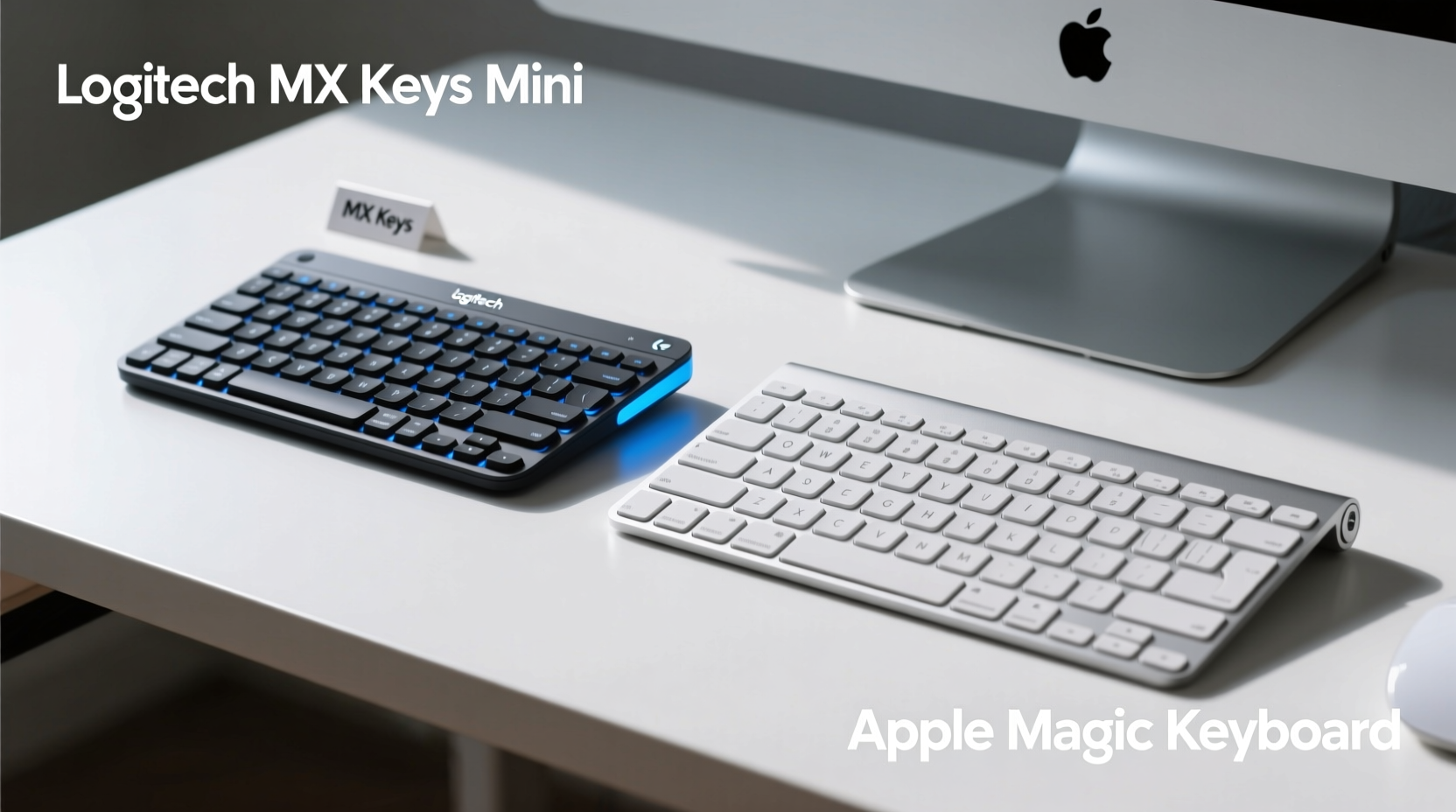
The first impression matters. The Apple Magic Keyboard exudes minimalist elegance with its aluminum body, low-profile design, and seamless integration into the macOS ecosystem. It feels like an extension of the Mac itself—light, rigid, and precisely engineered. However, that refined look comes with trade-offs: no tilt adjustment beyond the built-in feet, limited key spacing, and a fixed battery you can’t replace.
In contrast, the Logitech MX Keys Mini embraces a more functional approach. It uses a brushed aluminum top with soft-touch coating, offering a slightly warmer tactile feel. While not as seamlessly integrated into Apple’s design language, it compensates with versatility. It includes adjustable feet with two viewing angles and is compatible with up to three devices via Bluetooth or USB receiver. Its compact 75% layout removes the function row and numeric keypad but retains essential navigation keys in a smartly condensed arrangement.
Typing Experience: Key Switches, Travel, and Feedback
This is where the rubber meets the road—or rather, where fingers meet keys. Typing comfort hinges on several interrelated factors: actuation force, key travel distance, tactile bump, and noise level.
The Apple Magic Keyboard uses scissor-switch mechanisms with 0.5 mm of key travel. This shallow travel allows for a very thin profile but results in a flat, somewhat muted typing sensation. The keys offer consistent resistance but lack depth. For fast typists, especially those used to mechanical or deeper membrane switches, the Magic Keyboard can feel “bottomed out” too quickly, leading to finger fatigue over time.
The MX Keys Mini, on the other hand, features low-profile dome switches with 1.5 mm of key travel—triple that of Apple’s—and a rounded keycap design that guides your fingers naturally. Logitech calls this their “Perfect Stroke” technology, calibrated to deliver optimal actuation at the point most natural for typing rhythm. The result is a more responsive, dynamic feel with a subtle tactile bump and quieter operation than full mechanical boards, yet significantly more feedback than the Magic Keyboard.
“Shallow key travel isn’t inherently bad, but without proper actuation tuning, it sacrifices precision for thinness.” — David Lin, Input Device Engineer at Peripheral Labs
Many users report being able to type faster and with fewer errors on the MX Keys Mini due to the enhanced tactile confirmation. The keypresses feel deliberate, reducing accidental keystrokes—a common complaint with the flatter Apple board, especially during rapid typing sessions.
Layout and Usability: Compact vs. Complete
The Magic Keyboard retains a full QWERTY layout including function keys, arrow cluster, and dedicated Delete, Home, End, Page Up/Down keys. This makes it intuitive for new users and ideal if you rely heavily on function shortcuts (e.g., brightness, volume, Mission Control).
The MX Keys Mini adopts a 75% layout, meaning it condenses the keyboard by removing the number pad and combining layers for secondary functions. You access F1–F12 keys via a Fn layer, and navigation keys (Home, End, etc.) are accessed through a dedicated nav cluster activated by a “Nav” key. At first glance, this might seem inconvenient, but after a brief adaptation period—typically under 48 hours—most users find the layout more efficient.
Why? Because the navigation keys are grouped together and positioned within easy thumb or pinky reach. No more stretching to the far right corner of the desk. Additionally, the reduced footprint frees up valuable desk space, improving mouse ergonomics and overall workstation balance.
Comparison Table: Layout & Features
| Feature | Logitech MX Keys Mini | Apple Magic Keyboard |
|---|---|---|
| Key Travel | 1.5 mm | 0.5 mm |
| Switch Type | Low-profile dome (tactile) | Scissor (linear, minimal feedback) |
| Layout Size | 75% (compact) | Full-size |
| Backlighting | Smart backlight (proximity + ambient light) | No backlight |
| Battery Life | Up to 10 days (with backlight), 5 months (off) | ~1 month (USB-C rechargeable) |
| Multi-Device Support | Yes (3 devices, Bluetooth + USB receiver) | No (one device at a time) |
| OS Compatibility | macOS, Windows, Linux, iOS, Android | Primarily macOS, limited iOS |
| Adjustable Tilt | Two-angle kickstand | Fixed angle with small flip foot |
Real-World Use Case: The Hybrid Worker’s Dilemma
Consider Sarah, a freelance UX designer who works across a MacBook Pro, a Windows desktop for rendering, and an iPad for sketching. She initially used the Apple Magic Keyboard with her Mac but found herself constantly switching peripherals when moving to her PC.
After switching to the MX Keys Mini, she paired all three devices simultaneously. With a simple key combo (Fn + 1/2/3), she toggles between systems seamlessly. The smart backlight turns on as her hand approaches, useful during late-night edits. Most importantly, she noticed less wrist strain after switching from the shallow-travel Apple board to the more responsive Logitech switches.
“I was skeptical about the smaller layout,” she says, “but now I can’t go back. The keys are easier to hit accurately, and not having to move my hand across a huge keyboard saves me hundreds of movements per day.”
This scenario highlights a key advantage: the MX Keys Mini isn’t just better for typing—it’s better for modern, multi-device workflows where flexibility and responsiveness matter.
Additional Advantages: Smart Features and Longevity
Logitech integrates subtle intelligence into the MX Keys Mini that enhances the typing experience beyond raw mechanics. The backlight adjusts automatically based on hand proximity and ambient light, conserving power while ensuring visibility. The USB-C charging port supports pass-through use, so you can keep working while charging.
The Magic Keyboard charges via Lightning (a growing pain point as Apple phases out the port) and lacks any form of backlight—problematic in dim environments. You’re forced to rely on screen glow or external lighting, which isn’t always practical.
Battery life is another win for Logitech. The MX Keys Mini lasts up to five months on a single charge with backlighting off, and even with regular use and lighting active, it averages 10+ days. The Magic Keyboard requires recharging roughly every four weeks, depending on usage.
Who Should Choose Which Keyboard?
Let’s cut through the noise: there’s no universal “best.” The answer depends on your priorities.
If You Prioritize Seamless Apple Integration
Choose the **Apple Magic Keyboard** if:
- You use only Apple devices and value aesthetic harmony.
- You prefer a full-size layout with no function-layer reliance.
- You don’t mind charging monthly and typing in well-lit conditions.
If You Prioritize Typing Quality and Flexibility
Choose the **Logitech MX Keys Mini** if:
- You type extensively and want better tactile feedback and key travel.
- You work across multiple operating systems.
- You appreciate smart features like auto-backlight and longer battery life.
- You have limited desk space and prefer a compact, efficient layout.
Frequently Asked Questions
Can the MX Keys Mini pair with a Mac as smoothly as the Magic Keyboard?
Absolutely. The MX Keys Mini supports macOS natively, with correct key labeling (including Command and Option), system-level media controls, and seamless Bluetooth pairing. Logitech’s Options+ software further enhances customization, allowing remapping of keys and setting app-specific profiles.
Is the lack of a backlight on the Magic Keyboard a major issue?
It depends on your environment. In brightly lit offices or home setups, it’s negligible. But in low-light conditions—such as night work or dimly lit cafes—it becomes a real limitation. The absence of any illumination means you must rely on visual memory or external light, which can disrupt focus.
Does the MX Keys Mini feel cramped compared to full-size keyboards?
Initially, yes—especially if you're used to wide layouts. However, the 75% design clusters essential keys intelligently. Most users adapt within a couple of days. The reduced lateral hand movement often leads to improved ergonomics and less shoulder strain over time.
Final Verdict: Is the MX Keys Mini Better for Typing?
Yes—the Logitech MX Keys Mini is objectively better for typing than the Apple Magic Keyboard when evaluated on key performance metrics: key travel, tactile response, ergonomic layout, and long-term comfort.
The Magic Keyboard wins on design purity and native Apple synergy. But when it comes to the physical act of typing—accuracy, speed, endurance, and sensory feedback—the MX Keys Mini outperforms it decisively. Its deeper key travel, smarter layout, backlighting, and cross-platform functionality make it a more versatile and sustainable choice for serious typists.
Ultimately, if you care about how your keyboard feels under your fingers—not just how it looks on your desk—the MX Keys Mini is the superior investment.




 浙公网安备
33010002000092号
浙公网安备
33010002000092号 浙B2-20120091-4
Comments
No comments yet. Why don't you start the discussion?