
For casual virtual reality enthusiasts, the decision between the Meta Quest 2 and the newer Meta Quest 3 isn't always straightforward. While tech reviews often focus on specs and power, everyday users care more about comfort, ease of use, game availability, battery life, and value. The Quest 3 launched with bold claims—mixed reality support, improved visuals, and a slimmer design—but does it truly outshine the Quest 2 for someone who just wants to play fitness games, unwind with puzzles, or explore immersive experiences once or twice a week?
The answer depends on what \"better\" means to you. For hardcore developers or early adopters chasing cutting-edge features, the Quest 3 is clearly the upgrade. But for the average user who values simplicity, affordability, and a solid library of apps, the Quest 2 remains a compelling option. Let’s examine the differences in practical terms.
Performance and Visual Clarity: A Noticeable Step Up?
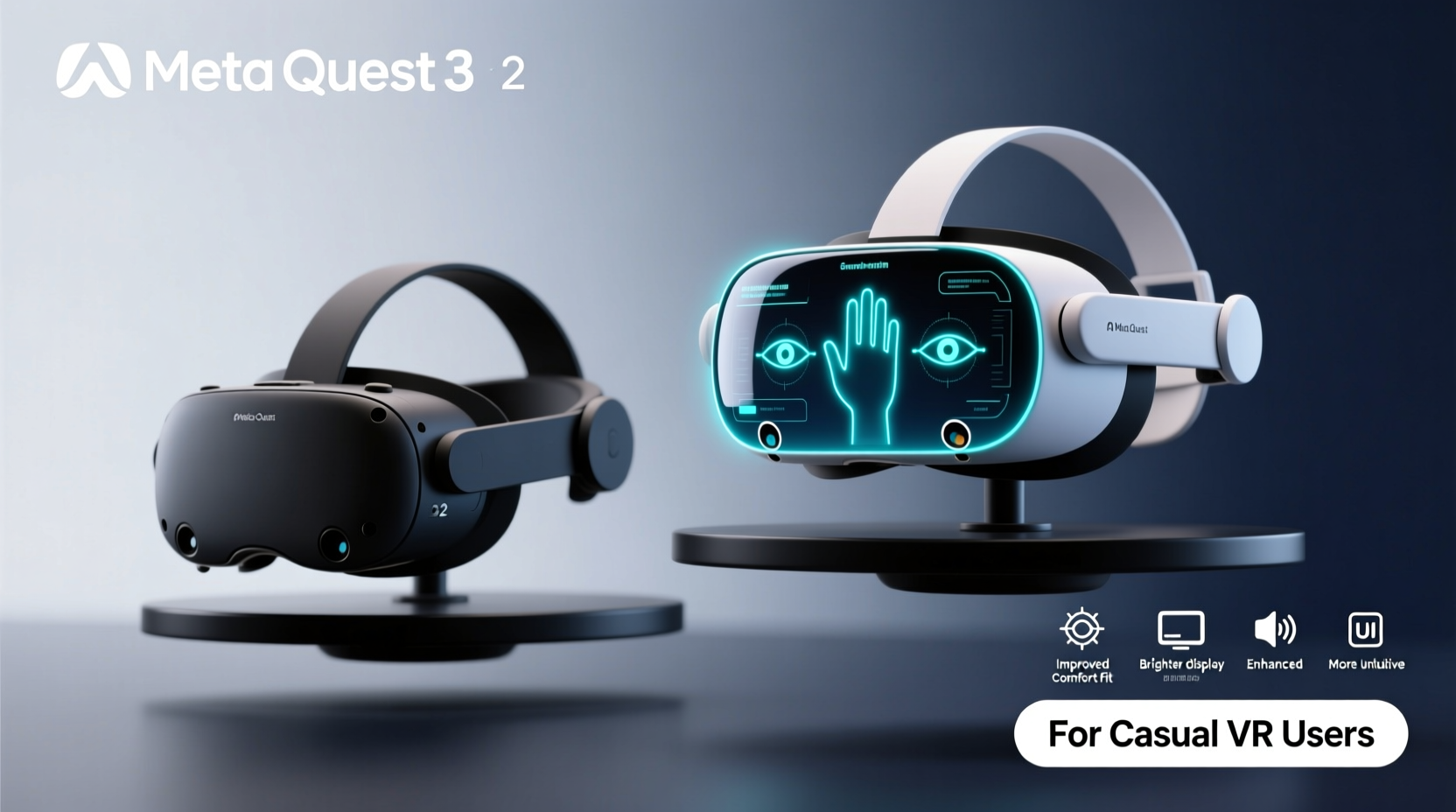
The Quest 3 features a new Snapdragon XR2 Gen 2 chip, which delivers nearly double the processing power of the Quest 2’s XR2 Gen 1. In real-world use, this translates to smoother gameplay in graphically demanding titles like *Resident Evil 4 VR* or *Lone Echo*, and faster app loading times. However, most casual users won’t notice a dramatic difference when playing lighter games such as *Beat Saber*, *Gorilla Tag*, or *Walkabout Mini Golf*—titles that run well even on the older hardware.
Visually, the Quest 3 offers higher resolution per eye (2064 x 2208 vs. 1832 x 1920) and a slightly wider field of view. This means sharper text in menus and crisper textures in environments. But unless you're sitting close to a virtual screen watching movies or diving into detailed simulations, the improvement may feel subtle rather than transformative.
One area where the Quest 3 pulls ahead decisively is mixed reality (MR). Its advanced passthrough cameras provide full-color, high-resolution views of your surroundings, allowing virtual objects to convincingly interact with real-world surfaces. Casual users might enjoy MR party games like *Pop Shop* or room-scale puzzle adventures where digital creatures appear to walk across their coffee table. Still, MR content remains limited, and many users may never fully utilize this feature.
Comfort and Design: Lighter Doesn’t Always Mean Better
Meta redesigned the Quest 3 with a thinner profile and a more balanced weight distribution. At 500 grams, it's 20% lighter than the Quest 2 (503g), but the real change is in how the weight feels. The front-heavy design of the Quest 2 could cause neck strain during long sessions. The Quest 3 shifts some mass toward the back strap, making it more comfortable for extended wear—even if only by 15 to 30 minutes.
The new IPD (inter-pupillary distance) adjustment slider allows for finer tuning between nose bridge positions, improving clarity for users with non-average eye spacing. Combined with softer facial interface materials, this makes the Quest 3 feel more personalized out of the box.
However, the Quest 3’s default head strap still lacks padding compared to third-party options. Many users—casual or otherwise—end up upgrading to a BOBOVR Z3 or similar cushioned strap for true comfort. So while the base design is improved, optimal comfort still requires an additional investment.
“Casual users prioritize comfort over specs. Even small ergonomic gains can make a big difference in whether someone reaches for their headset weekly or lets it collect dust.” — Dr. Lena Patel, Human-Computer Interaction Researcher, Stanford University
Price and Value: Is the Upgrade Worth It?
This is where the debate becomes most relevant for casual users. As of 2024, the Quest 2 is no longer sold new by Meta but remains widely available through retailers and secondhand markets. You can often find a used or refurbished Quest 2 for $200–$250, sometimes less. In contrast, the Quest 3 starts at $499 for the 128GB model.
That’s a $250+ difference—a significant amount for someone using VR occasionally. Consider what you’ll actually gain:
- Better graphics in select titles
- Faster load times
- Mixed reality capabilities
- Slightly better battery life (approx. 2 hours vs. 1.5–2 hours on Quest 2)
- Newer controllers with improved tracking
But consider what you won’t miss:
- Most popular VR games are cross-compatible
- Quest 2 will continue receiving software updates until at least 2026
- No exclusive content locked behind Quest 3 hardware
| Feature | Meta Quest 2 | Meta Quest 3 |
|---|---|---|
| Starting Price | $200–$250 (used/refurbished) | $499 (new) |
| Processor | Snapdragon XR2 Gen 1 | Snapdragon XR2 Gen 2 |
| Resolution (per eye) | 1832 x 1920 | 2064 x 2208 |
| Passthrough Quality | Grayscale, low-res | Full-color, high-res MR |
| Battery Life | ~1.5–2 hours | ~2–2.5 hours |
| Storage Options | 128GB (discontinued) | 128GB / 512GB |
| Weight | 503g | 500g (better balance) |
Real-World Example: Sarah’s Weekend VR Routine
Sarah, a 34-year-old graphic designer, bought a Quest 2 in 2022 primarily for relaxation and light exercise. She uses it about three times a week—Saturdays for 30 minutes of *Supernatural* workout, Sundays for exploring *Wander* or watching Netflix in virtual cinema mode, and occasional multiplayer fun with friends via *Rec Room*.
She considered upgrading to the Quest 3 after seeing ads showcasing mixed reality dinosaurs walking around her living room. Curious, she tested one at a friend’s house. While impressed by the color passthrough and sharper image, she realized none of her regular apps looked dramatically better. The new *Nature Treks VR* MR mode was fun for one session but didn’t replace her usual routine.
In the end, Sarah decided against the upgrade. Her Quest 2 works flawlessly, her games are updated, and she’d rather spend $500 on a vacation than a marginal improvement in VR quality. Her experience reflects a common pattern among casual users: familiarity, functionality, and cost-efficiency outweigh novelty.
What Should You Choose? A Practical Checklist
If you’re trying to decide between the two headsets, ask yourself these questions before purchasing:
- How often do I plan to use VR? Less than 2–3 times per week? Quest 2 likely suffices.
- Am I excited about mixed reality? If interacting with virtual objects in my real space sounds appealing, Quest 3 adds unique value.
- Do I watch movies or work in VR? Higher resolution and better color matter more here—Quest 3 wins.
- Is my budget under $300? Then Quest 2 is the only realistic option.
- Do I want future-proofing? Quest 3 will receive support longer and handle upcoming MR titles better.
- Do I already own Quest 2 accessories? Straps, cases, and lens cleaners can be reused—reducing upgrade costs.
Frequently Asked Questions
Can I play all the same games on Quest 3 as on Quest 2?
Yes. All Quest 2 games are compatible with Quest 3. There are no exclusives that lock Quest 2 users out. Some games offer enhanced graphics modes on Quest 3, but core gameplay remains identical.
Is the Quest 3 safer for kids or older adults?
Not inherently. Both headsets have similar safety warnings regarding motion sickness and spatial awareness. However, the Quest 3’s superior passthrough makes it easier to see obstacles during play, potentially reducing tripping hazards in shared spaces.
Will Meta stop supporting the Quest 2 soon?
No official end-of-life date has been announced, but Meta typically supports devices for 3–4 years post-discontinuation. Since Quest 2 was discontinued in 2023, expect support through at least 2026. Software updates may slow, but core functions will remain stable.
Final Verdict: Better Specs Don’t Always Mean Better Experience
The Meta Quest 3 is objectively superior in technical specifications—faster processor, sharper display, better passthrough, improved ergonomics. But for casual VR users, \"better\" must be measured in enjoyment, convenience, and value, not benchmarks.
If your primary activities include fitness apps, social VR hangouts, puzzle games, or passive media viewing, the Quest 2 delivers nearly the same experience at a fraction of the cost. Unless mixed reality excites you or you anticipate increasing your usage over time, the upgrade may feel underwhelming.
On the other hand, if you appreciate having the latest technology, plan to explore MR content as it grows, or simply prefer knowing your device will stay supported longer, the Quest 3 is a worthwhile investment—even for light use.
Ultimately, both headsets represent excellent entry points into standalone VR. The Quest 2 proves that good-enough technology, when paired with a rich ecosystem, can remain relevant years after release. The Quest 3 shows where VR is headed: more immersive, more integrated with reality, and increasingly capable.




 浙公网安备
33010002000092号
浙公网安备
33010002000092号 浙B2-20120091-4
Comments
No comments yet. Why don't you start the discussion?