
The foldable smartphone market has evolved rapidly, and two of the most compact clamshell-style devices—Motorola’s Razr 40 and Samsung’s Galaxy Z Flip 4—have been locked in a battle for attention. Both promise portability, style, and innovation. But after years of Samsung dominating the segment, does the 2023 Motorola Razr 40 finally close the gap—and even surpass its rival in value and usability?
This isn’t just about specs on paper. It’s about real-world performance, long-term durability, user experience, and whether paying less actually means getting more.
Design & Build: Compactness Meets Premium Feel
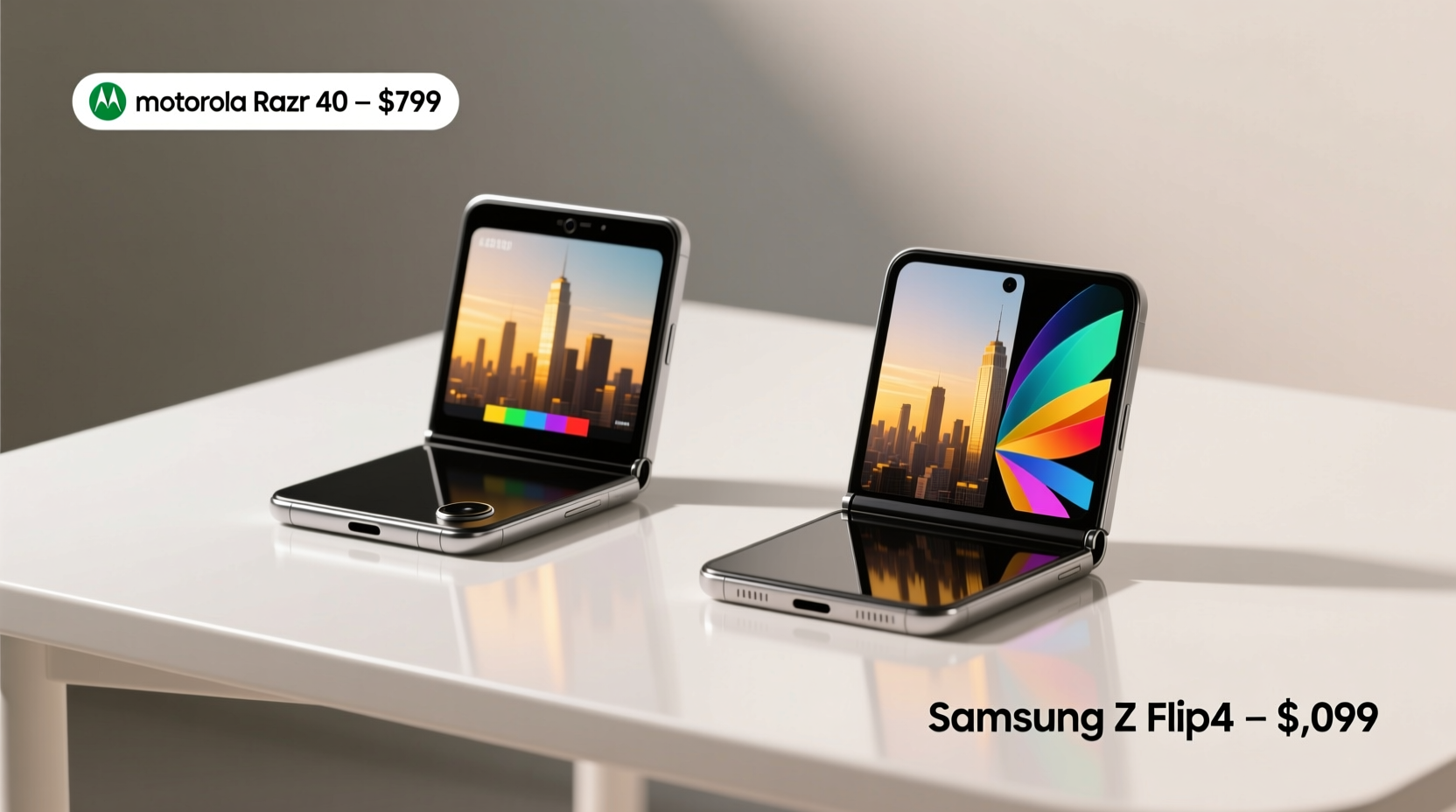
The Razr 40 and Z Flip 4 both embrace the vertical fold, prioritizing pocketability and one-handed use. But their design philosophies differ significantly.
The Motorola Razr 40 leans into minimalist elegance with a nearly bezel-less outer display and symmetrical folding mechanism. At just 6.9mm when unfolded and 15.1mm when folded, it's among the slimmest foldables ever made. Its IP52 rating offers basic splash resistance—modest but expected at this price point.
Samsung’s Z Flip 4, meanwhile, uses a sturdier hinge with dust-resistant IPX8 water protection and Gorilla Glass Victus on the main screen. While slightly thicker (7.2mm unfolded), it feels more robust in daily use. The external display is smaller proportionally but benefits from deeper software integration.
Display & Usability: Small Screens, Big Differences
Foldables live or die by their screens—both inside and out. The Razr 40 features a 6.9-inch pOLED main display with a 165Hz refresh rate, matching smoothness with top-tier flagships. Its outer display is a standout: 3.6 inches, occupying most of the front cover, allowing meaningful interactions without unfolding.
In contrast, the Z Flip 4’s inner 6.7-inch Dynamic AMOLED supports 120Hz, which is still fluid but not quite as responsive. Its 1.9-inch cover screen is functional but limited—best suited for notifications, quick replies, and music control.
Motorola’s near-stock Android skin makes navigating the outer display intuitive. You can reply to messages, check weather, launch apps, and even take selfies using the rear camera—all without opening the phone. Samsung has improved its Cover Screen UX over time, but it remains more restrictive.
“Motorola finally cracked the code on useful external displays. The Razr 40 turns what used to be a gimmick into a genuinely productive tool.” — Adrian Wong, Senior Mobile Analyst at TechInsider Weekly
Performance & Software: Raw Power vs. Longevity
Under the hood, the Razr 40 runs on Qualcomm’s Snapdragon 8+ Gen 1, a high-end chip that outperforms the Flip 4’s Snapdragon 8+ Gen 1 (yes, same name, slightly lower binning). In real-world tasks, both handle multitasking and gaming well, but the Razr shows faster app launches and cooler thermals thanks to Motorola’s lighter software layer.
Software updates are where Samsung shines. The Flip 4 launched with four generations of Android OS upgrades promised—meaning it will receive updates through Android 16. Motorola guarantees only two OS upgrades and three years of security patches for the Razr 40, raising concerns about long-term relevance.
Bloatware is minimal on both, though Samsung includes more Google-integrated services and proprietary tools like Good Lock. Motorola keeps things clean, closer to Pixel-like experience, which many users appreciate.
Update Support Comparison
| Device | OS Upgrades | Security Updates | Expected Support End |
|---|---|---|---|
| Motorola Razr 40 | 2 | 3 years | 2025–2026 |
| Samsung Galaxy Z Flip 4 | 4 | 5 years | 2027–2028 |
Camera Quality: Everyday Photography Showdown
Cameras remain a weak spot across most foldables, but improvements have been steady. The Razr 40 packs a dual system: a 50MP main sensor with OIS and a 13MP ultra-wide. This combination delivers sharp daylight shots and usable low-light performance, especially considering the form factor.
The Z Flip 4 uses a 12MP main + 12MP ultra-wide setup. While megapixels are lower, Samsung’s processing algorithms produce more natural color grading and better dynamic range. Night mode is noticeably superior, and video stabilization edges ahead.
Front cameras favor the Razr 40. Its 32MP selfie shooter takes clearer, more detailed images than the Flip 4’s 10MP unit. Combined with the large outer display, taking selfies with the primary lens is seamless—an advantage Motorola leverages well.
Real-World Example: Urban Commuter Use Case
Meet Lena, a freelance photographer who commutes daily via subway and values quick capture ability. She tested both phones during her morning transit. With the Razr 40, she could compose and shoot using the outer display with the main camera—ideal for discreet street photography. On the Flip 4, she had to unfold the device each time, missing fleeting moments. However, when editing photos later, she preferred the Flip 4’s smoother One UI workflow and longer update promise for her archive app compatibility.
Battery Life & Charging: Trade-offs in Thinness
Foldables struggle with battery capacity due to space constraints. The Razr 40 includes a 3,500mAh cell—just enough for moderate use. Heavy users report needing a top-up by late afternoon. It supports 30W fast charging, reaching 50% in about 25 minutes.
The Z Flip 4 houses a slightly larger 3,700mAh battery and benefits from more efficient power management. It consistently lasts a full day for average users. However, its charging speed caps at 15W, meaning a full recharge takes over an hour and a half.
Neither supports wireless charging—a notable omission at this price. If rapid top-ups matter more than all-day endurance, the Razr 40 wins. For consistent daily reliability, the Flip 4 holds the advantage.
Price & Value Proposition
The Motorola Razr 40 starts at $799, while the Z Flip 4 launched at $999 (now often found around $850 refurbished or discounted). This $150–$200 gap is significant.
For budget-conscious buyers, the Razr 40 offers compelling value: newer design language, larger outer display, faster charging, and stronger peak performance. But the trade-offs—shorter software support, thinner materials, and no water resistance—are real.
The Flip 4 costs more but delivers proven reliability, better resale value, and longer update cycles. It’s also widely available through carrier deals and trade-in programs.
Foldable Buying Checklist
- ✅ Assess how often you’ll unfold the phone daily
- ✅ Prioritize outer display utility if you want glanceable info
- ✅ Consider software update policy for long-term ownership
- ✅ Evaluate build quality if you’re rough on devices
- ✅ Compare total cost including carrier promotions
- ✅ Test ergonomics—some find wider foldables harder to grip
Frequently Asked Questions
Can the Razr 40 replace a traditional flagship?
For many users, yes—but with caveats. Battery life and app optimization aren’t quite on par with standard smartphones. If you rely on heavy multitasking or all-day usage without charging access, a conventional phone might still be safer.
Is the crease worse on the Razr 40?
No. Thanks to an advanced ultra-thin glass and tighter hinge clearance, the central crease is shallower than on the Z Flip 4. It’s barely noticeable during media consumption, though you can feel it when swiping slowly across the screen.
Which has better resale value?
Samsung currently leads in resale markets. After one year, Z Flip 4 units retain about 55–60% of their original price, compared to 45–50% for the Razr 40. Brand recognition and broader service network contribute to this difference.
Final Verdict: Who Should Buy Which?
The Motorola Razr 40 isn't just “better” or “worse”—it’s different. It represents a bold step forward for Motorola: refined design, innovative outer display, and strong performance at a competitive price. For tech-savvy users who prioritize aesthetics, responsiveness, and modern features, it’s arguably the smarter purchase today.
Yet, the Samsung Galaxy Z Flip 4 remains the safer long-term investment. Its update roadmap, proven durability, and ecosystem integration make it ideal for professionals or those planning to keep their phone beyond two years.
If your priority is cutting-edge design and immediate usability on a budget, the Razr 40 is finally a legitimate alternative—and in some ways, a superior choice. But if longevity, peace of mind, and brand trust matter more, Samsung still sets the standard.




 浙公网安备
33010002000092号
浙公网安备
33010002000092号 浙B2-20120091-4
Comments
No comments yet. Why don't you start the discussion?