
The handheld gaming market has exploded since Valve launched the Steam Deck in 2022. What started as a niche experiment is now a full-blown trend, with major PC hardware manufacturers jumping into the fray. Among the most prominent new entrants is the MSI Claw, a Windows-based handheld powered by Intel’s Lunar Lake processors and Arc graphics. Marketed as a high-performance portable gaming machine, the Claw promises desktop-level power in a compact form. But does it truly compete with the Steam Deck—or is it merely capitalizing on the hype without delivering real value?
To answer that, we need to go beyond marketing claims and examine real-world performance, ecosystem compatibility, ergonomics, battery life, and long-term usability. The Steam Deck isn’t perfect, but it’s evolved into a refined platform backed by a mature software environment. The MSI Claw, while technically impressive on paper, faces steep challenges in matching that holistic experience.
Performance: Raw Power vs Real-World Results
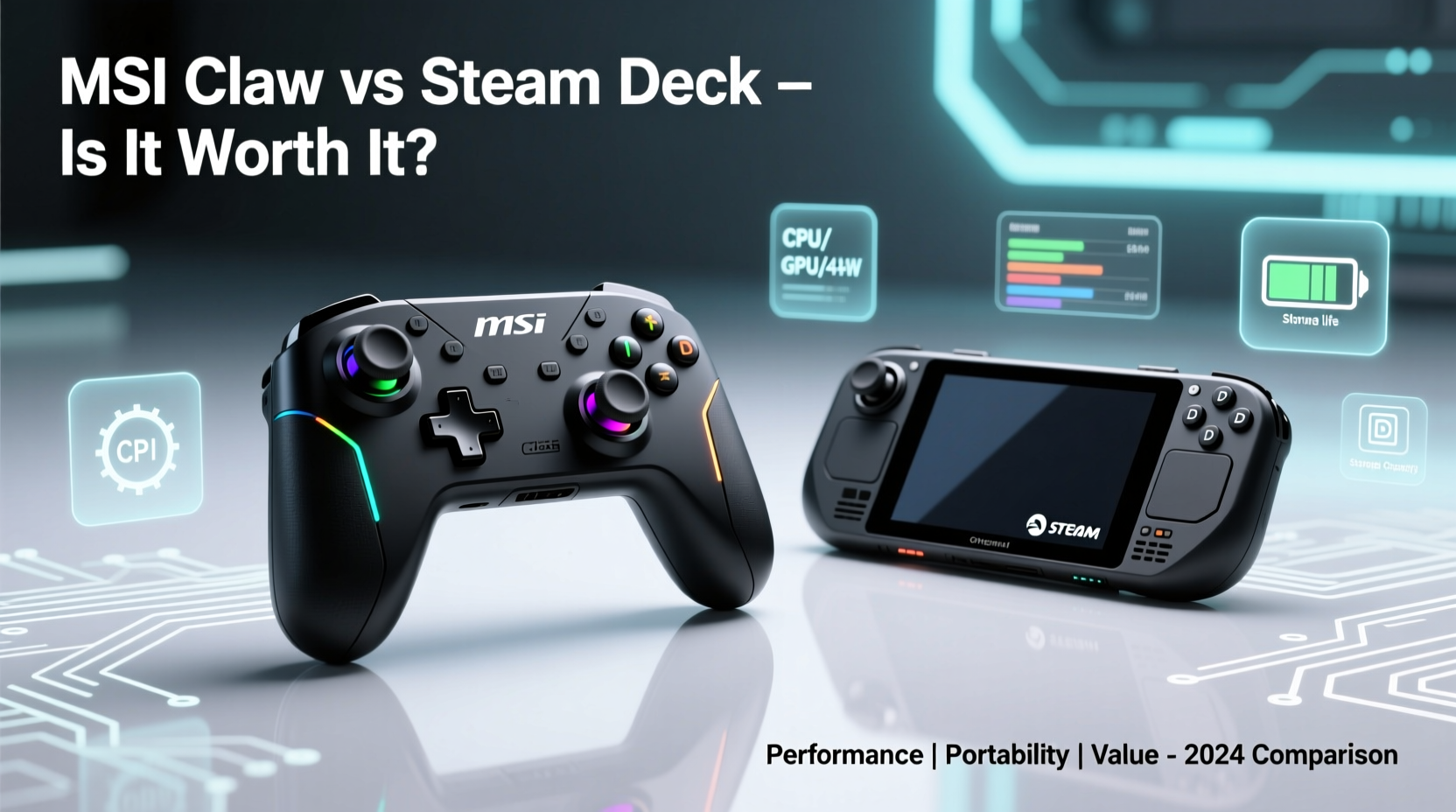
The MSI Claw runs on Intel’s Core Ultra processors—specifically the Core Ultra 7 155H—paired with Intel Arc graphics. This is a significant departure from the Steam Deck’s AMD APU architecture. On paper, the Claw boasts higher peak CPU and GPU clocks, better ray tracing support, and newer AI acceleration features. It also supports AV1 encoding, which improves streaming efficiency.
In benchmark tests, the Claw often outperforms the Steam Deck OLED in synthetic scores like 3DMark and even holds its own in native DirectX 12 titles at medium settings. Games like Horizon Zero Dawn, Baldur’s Gate 3, and Starfield run more smoothly on the Claw when using FSR upscaling and optimized drivers.
However, real-world gaming reveals limitations. Intel Arc drivers, while improving, still lag behind AMD and NVIDIA in consistency across older DX11 and Vulkan titles. Some games stutter or fail to launch without manual configuration. The Steam Deck, by contrast, benefits from Proton—a compatibility layer fine-tuned by Valve specifically for handheld gaming. This means thousands of Steam games “just work” with minimal user input.
“Raw specs don’t win handheld battles—it’s about optimization. The Steam Deck may have lower specs, but its software stack makes it punch above its weight.” — Lucas Tran, Senior Hardware Analyst at TechPulse Weekly
Ecosystem & Software: Open Flexibility vs Curated Simplicity
This is where the fundamental philosophies diverge. The Steam Deck runs SteamOS, a Linux-based system designed around one goal: playing Steam games as easily as possible. It boots directly into your game library, offers seamless suspend/resume, and integrates cloud saves, overlays, and remote play natively.
The MSI Claw runs full Windows 11 Home, giving users complete access to any application, storefront (Epic, GOG, Xbox), and modding tools. You can install Discord, OBS, or even do light productivity work. For power users who want maximum control, this is a huge advantage.
But with freedom comes complexity. Windows doesn’t optimize itself for handheld use. Background updates, telemetry, and resource-heavy services eat into battery life and performance. There’s no built-in game mode toggle, no standardized controller layout database, and no universal input remapping. You’ll spend more time tweaking than playing—unless you’re comfortable diving into settings.
Valve’s approach is intentionally restrictive. But that restriction translates into reliability. When a game works on the Deck, it stays working. Updates rarely break functionality. The MSI Claw, being a general-purpose Windows device, lacks this stability guarantee.
Build Quality & Ergonomics: Comfort Over Time
Physically, the MSI Claw feels premium. Its magnesium alloy chassis gives it a sturdy, almost industrial heft. The triggers and shoulder buttons are crisp, and the analog sticks use Hall-effect sensors, meaning they resist drift better over time. The 8.1-inch 1080p touchscreen has excellent color accuracy and touch responsiveness—superior to the Steam Deck’s original model, though comparable to the OLED version.
Yet ergonomics tell a different story. The Claw is slightly taller and less contoured than the Steam Deck. During extended sessions, especially with heavier AAA titles, users report hand fatigue setting in earlier. The button placement, while precise, feels cramped for those with larger hands. The Steam Deck’s wider body distributes weight more evenly across the palms.
Additionally, the Claw’s fan vents are located near the top edge, blowing hot air toward your wrists. In contrast, the Steam Deck channels heat away from contact points. After an hour of gameplay, the difference in thermal comfort becomes noticeable.
Battery Life: The Achilles’ Heel of High Performance
No discussion of handhelds is complete without addressing battery life. Here, the MSI Claw struggles to match expectations. Despite a 53Wh battery—slightly larger than the Steam Deck OLED’s 50Wh—the Claw lasts between 1.5 to 3 hours under typical gaming loads, depending on settings and title optimization.
Compare that to the Steam Deck OLED, which achieves 3–6 hours in similar scenarios, thanks to AMD’s superior power efficiency and aggressive dynamic clock scaling. Even when running native Windows via Steam Link or Cloud Gaming, the Deck’s longer idle life gives it an edge.
Intel’s Lunar Lake chip includes power-saving features, but Windows 11’s background processes undermine them. Disabling unnecessary services helps, but not enough to close the gap. If you plan to game away from outlets, the Claw demands a portable charger.
“I took my Claw on a cross-country flight hoping to play Diablo IV. Lasted 87 minutes. Switched to my Steam Deck for the rest of the trip.” — Sarah Kim, travel gamer and tech reviewer
Price & Value Proposition
The MSI Claw starts at $649 for the Core Ultra 5 model with 16GB RAM and 512GB SSD. The higher-end Ultra 7 variant costs $799. Meanwhile, the Steam Deck OLED ranges from $449 (512GB) to $649 (1TB). Used original models can be found under $300.
On price alone, the Steam Deck offers better entry-level value. But the Claw isn’t trying to be budget-friendly—it’s positioning itself as a premium Windows handheld. Still, paying $300 more than the base Deck for marginal performance gains and shorter battery life raises questions about ROI.
Moreover, upgradeability favors the Steam Deck. Both devices allow SSD expansion via M.2 slots, but the Deck’s modular design lets users replace sticks, batteries, and even screens with third-party kits. The Claw uses proprietary screws and adhesive-heavy construction, making repairs difficult and costly.
Comparison Table: MSI Claw vs Steam Deck OLED
| Feature | MSI Claw | Steam Deck OLED |
|---|---|---|
| Processor | Intel Core Ultra 7 155H | AMD Zen 2 (custom) |
| GPU | Intel Arc (8 Xe cores) | AMD RDNA 2 (16 CUs) |
| RAM | 16GB LPDDR5x | 16GB LPDDR5 |
| Storage | 512GB / 1TB NVMe | 512GB / 1TB NVMe |
| Display | 8.1\" 1080p IPS, 120Hz | 7.4\" 1080p OLED, 90Hz |
| OS | Windows 11 Home | SteamOS 3 (Linux) |
| Battery Life (Gaming) | 1.5 – 3 hrs | 3 – 6 hrs |
| Weight | 660g | 640g |
| Price (Starting) | $649 | $449 |
| Repairability | Low (proprietary design) | Moderate (modular parts) |
Who Is the MSI Claw Actually For?
The answer depends on your priorities. The MSI Claw isn’t a direct replacement for the Steam Deck—it’s a different kind of device altogether.
If you’re a hardcore PC gamer who wants full access to Windows, plays demanding titles, streams frequently, or uses mods and overlay tools, the Claw makes sense. It’s also ideal for users already invested in Intel/NVIDIA ecosystems or those who want to run non-gaming applications like photo editing or coding on the go.
But if you primarily play Steam games, value simplicity, long battery life, and consistent performance, the Steam Deck remains the smarter choice. It’s been battle-tested by millions, continuously updated, and supported by a thriving community of developers and modders.
Mini Case Study: Two Gamers, Two Paths
Alex and Jordan both wanted a handheld for gaming during commutes. Alex chose the MSI Claw, drawn by its 1080p screen and Windows flexibility. He installed several Epic Store exclusives and used ReShade to enhance visuals in older titles. However, he quickly grew frustrated with frequent driver crashes in The Witcher 3 and had to manually configure controller profiles for each launcher.
Jordan bought the Steam Deck OLED. She mostly plays indie titles and retro games via Proton and EmuDeck. Her device boots straight into her library, suspends instantly, and lasts through her two-hour train ride. When issues arise, she finds fixes in official forums or YouTube tutorials within minutes.
After six months, Jordan reports higher satisfaction despite lower specs. Alex acknowledges the Claw’s power but admits he spends more time maintaining it than enjoying it.
FAQ
Can the MSI Claw run all Steam games?
Technically yes, since it runs full Windows. But unlike the Steam Deck, there’s no automatic compatibility layer. Some games require manual tweaks, updated drivers, or may not perform well due to Intel Arc limitations.
Is the MSI Claw better than the Steam Deck for emulation?
For PS2, GameCube, or Wii games, both devices perform similarly. For Switch-level emulation (e.g., Yuzu, Ryujinx), the Claw has an edge due to stronger single-core CPU performance. However, battery life will suffer significantly during emulation.
Should I wait for future Windows handhelds?
Possibly. Companies like ASUS, Lenovo, and Samsung are developing next-gen handhelds with AMD Ryzen Hawk Point APUs, which promise better efficiency than current Intel options. If you can delay your purchase, waiting 6–9 months could yield more balanced alternatives.
Step-by-Step: Optimizing the MSI Claw for Gaming
- Disable Windows telemetry: Go to Settings > Privacy > Diagnostics & feedback and set it to \"Required diagnostic data.\"
- Enable HDR and adjust scaling: In Display settings, turn on HDR and set UI scaling to 150% for clarity.
- Install Intel Graphics Drivers: Download the latest DCH drivers directly from Intel’s website for best stability.
- Use Game Pass or GeForce Now: Stream AAA titles to conserve battery and avoid local rendering limits.
- Configure power plans: Set Windows Power Plan to “Best Performance” only when plugged in; use “Balanced” on battery.
- Map controls globally: Use Open Control Center (OCC) to create unified controller profiles across launchers.
Conclusion: A Niche Player, Not a True Rival—Yet
The MSI Claw is not overhyped because it fails—it’s overhyped because it’s being compared to the wrong standard. Judged purely as a portable Windows gaming machine, it delivers solid performance, excellent display quality, and robust build materials. It represents a meaningful step forward for Intel in the discrete graphics space.
But as a replacement for the Steam Deck? It falls short. Battery life, software polish, and ergonomic comfort still favor Valve’s offering. The Steam Deck succeeds not because of raw power, but because every element—from hardware to OS to community support—is engineered toward a singular purpose: seamless handheld gaming.
The MSI Claw tries to be everything: a gaming rig, a productivity tool, a media hub. In doing so, it sacrifices focus. For now, it remains a compelling option for a narrow audience—tech-savvy users willing to trade convenience for capability.




 浙公网安备
33010002000092号
浙公网安备
33010002000092号 浙B2-20120091-4
Comments
No comments yet. Why don't you start the discussion?