
The world of visual art is undergoing a profound transformation. With tablets, styluses, and powerful software like Procreate, Adobe Fresco, and Blender becoming accessible to artists at every level, digital art has surged in popularity. It offers speed, flexibility, undo buttons, infinite layers, and instant sharing—features that seem unmatched by pencil and paper. But does this mean traditional sketching is fading into irrelevance? While some fear that hand-drawn art may be on its way out, a closer look reveals a more nuanced reality: rather than replacing it, digital tools are reshaping how we value and use traditional techniques.
The Digital Surge: Why Artists Are Going Virtual
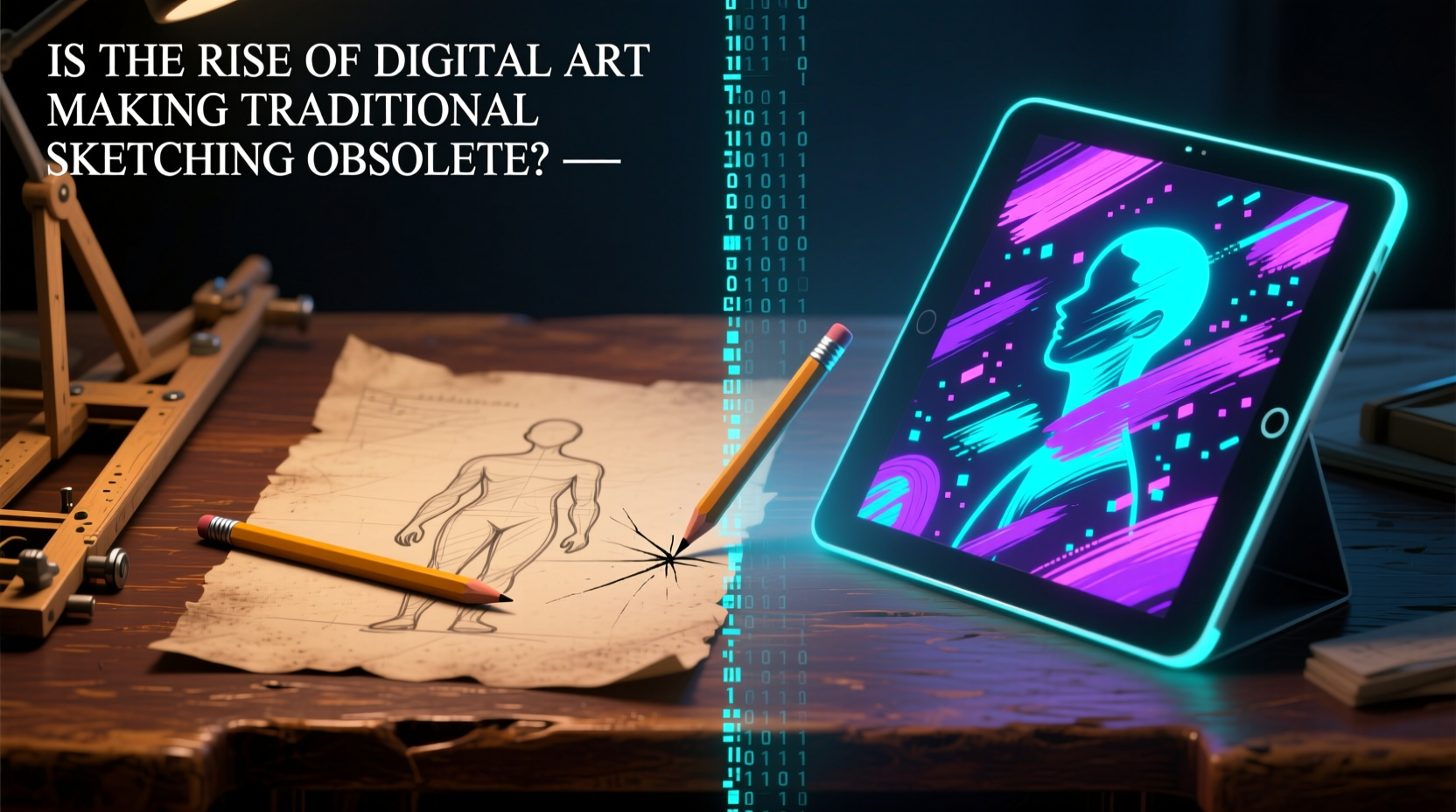
Digital art’s growth over the past decade has been exponential. From concept art for films and games to social media illustrations and NFTs, digital platforms have become dominant spaces for artistic expression. The accessibility of tools plays a major role—many artists can now create professional-grade work with just a tablet and free or low-cost software.
Speed and efficiency are key advantages. A digital artist can experiment with dozens of color palettes in minutes, adjust proportions with transformation tools, and export files instantly for clients or online portfolios. Collaboration is also streamlined; cloud-based projects allow teams across continents to co-create in real time. For commercial artists, these benefits are hard to ignore.
Moreover, digital art integrates seamlessly with other industries. Animation studios rely on digital workflows, fashion designers use 3D rendering to prototype garments, and architects visualize buildings through virtual models—all rooted in digital drawing foundations.
The Enduring Value of Traditional Sketching
Despite the allure of digital convenience, traditional sketching remains deeply embedded in artistic training and creative process. Many art schools still begin curricula with life drawing, perspective studies, and observational sketching using pencils, charcoal, and ink. Why? Because these methods build foundational skills that no software shortcut can replicate.
Sketching by hand develops hand-eye coordination, spatial reasoning, and an intuitive understanding of form and light. When an artist draws from life, they engage multiple senses—touch, pressure, movement—which contribute to a deeper connection with the subject. This embodied knowledge translates into stronger compositions, even when working digitally later.
Furthermore, traditional media offer unique textures and imperfections that many artists find irreplaceable. The grain of paper, the smudge of charcoal, the bleed of ink—these are not flaws but expressive qualities that give artwork soul. As painter and educator Maria Tenev notes:
“Drawing on paper forces you to commit. There’s no Ctrl+Z. That constraint breeds intentionality, focus, and authenticity.” — Maria Tenev, Fine Arts Instructor at Rhode Island School of Design
Comparing Strengths: Traditional vs. Digital Approaches
| Aspect | Traditional Sketching | Digital Art |
|---|---|---|
| Learning Curve | Moderate to high; requires repetition and physical control | Lower initial barrier with guides and tools |
| Cost Over Time | Low (basic materials), but ongoing supply costs | High upfront (tablet, software), minimal recurring cost |
| Portability | High (sketchbook fits in a bag) | Medium (requires device charging and protection) |
| Error Correction | Limited (erasing possible, but leaves marks) | Instant undo, non-destructive editing |
| Tactile Feedback | Rich sensory experience | Simulated only; lacks true texture |
| Sharing & Reproduction | Requires scanning or photography | Direct export and upload |
| Creative Constraints | Encourages discipline and focus | Risk of over-editing and indecision |
This comparison shows that neither medium is universally superior. Instead, each serves different purposes and stages of the creative journey. Traditional sketching excels in skill-building and conceptual exploration, while digital tools shine in refinement, iteration, and distribution.
Hybrid Workflows: Where Analog Meets Digital
Most contemporary artists don’t choose one over the other—they combine both. A common workflow begins with rough thumbnails and ideation on paper. These sketches capture raw ideas quickly, without the distraction of menus or settings. Once a concept solidifies, the artist scans the sketch and imports it into digital software for cleanup, coloring, and final detailing.
This hybrid method leverages the strengths of each medium. The spontaneity of hand-drawing fuels creativity, while digital precision ensures polish and scalability. Concept artist Lena Cho describes her process:
“I always start with a Moleskine. My best ideas come when I’m disconnected—on a train, in a café, nowhere near a screen. Then I bring those scribbles into Photoshop and let them evolve.” — Lena Cho, Lead Concept Artist, Blizzard Entertainment
Even in animation and game design, where digital pipelines dominate, studios often require artists to submit hand-drawn storyboards and character explorations before moving forward. Pixar, for example, maintains a strong tradition of hand-sketched story reels as part of its pre-production process.
Step-by-Step: Building a Hybrid Sketching Routine
- Carry a portable sketchbook – Dedicate 10–15 minutes daily to observational drawing: people, objects, landscapes.
- Use varied tools – Alternate between pencil, pen, charcoal, or watercolor to explore different mark-making styles.
- Select your strongest sketches – Once a week, review your pages and pick 2–3 promising concepts.
- Scan or photograph cleanly – Ensure good lighting and flat alignment to avoid distortion.
- Import into digital software – Place the image on a low-opacity layer and trace over it digitally.
- Refine and color – Use layers for line art, shading, and background to keep edits flexible.
- Export and archive – Save both the digital file and the original sketch for portfolio depth.
Real-World Example: The Journey of a Freelance Illustrator
Consider James Reed, a freelance illustrator based in Portland who transitioned from print design to full-time illustration during the pandemic. Initially skeptical of digital tools, he invested in an iPad and began experimenting. What surprised him was how much his old sketching habits helped.
“I hadn’t drawn seriously since college,” he recalls. “But when I started doing quick coffee-shop sketches again, my confidence came back fast. Those lines felt honest. When I brought them into Procreate, the digital stage became about enhancement, not invention.”
Today, James markets himself as an artist who blends “analog soul with digital precision.” His Instagram features side-by-side comparisons: a crumpled piece of notebook paper next to its vibrant digital counterpart. Followers respond strongly to this transparency, often commenting that it makes his work feel more personal and authentic.
His story illustrates a broader trend: audiences aren’t just interested in polished final products—they want to see the human behind the art. Traditional sketching provides that visible lineage of thought and effort.
Checklist: Maintaining Balance Between Digital and Traditional Practice
- ✅ Spend at least 20 minutes per week drawing without any digital device nearby
- ✅ Keep a dedicated sketchbook for idea generation (not just finished pieces)
- ✅ Limit screen time during brainstorming sessions to reduce cognitive overload
- ✅ Digitize select sketches monthly to build a hybrid portfolio
- ✅ Attend life drawing sessions or join local art groups to stay connected to analog practice
- ✅ Experiment with transferring digital prints back to paper—draw over them manually for mixed-media effects
Frequently Asked Questions
Can I become a successful artist without learning traditional sketching?
Yes, especially in niche areas like UI/UX design, 3D modeling, or algorithmic art. However, most professionals agree that foundational drawing skills significantly enhance composition, anatomy, and visual storytelling—even when applied digitally.
Do employers still value hand-drawn portfolios?
In competitive fields like animation, publishing, and fine arts, yes. Studios often request hand-drawn samples to assess an applicant’s fundamental abilities. A purely digital portfolio may raise questions about underlying technique.
Is traditional sketching dying among younger generations?
Not exactly. While fewer young artists start with pencil and paper, there’s been a resurgence of interest in analog methods through social media trends like #Inktober and #SketchbookChallenge. Many discover that stepping away from screens refreshes their creativity.
Conclusion: Evolution, Not Extinction
The rise of digital art isn’t making traditional sketching obsolete—it’s redefining its role. Just as photography didn’t kill painting, digital tools are not erasing the need for hand-drawn expression. Instead, they’re pushing artists to integrate both worlds more thoughtfully.
Traditional sketching remains vital as a tool for learning, ideation, and maintaining artistic integrity. It grounds creativity in physical experience, fostering mindfulness and presence often lost in fast-paced digital environments. At the same time, digital platforms expand reach, enable collaboration, and unlock new forms of expression.
The future belongs not to those who abandon one medium for another, but to those who master the dialogue between them. Whether you're a seasoned professional or just beginning your artistic journey, the most powerful habit you can cultivate is balance: the ability to move fluidly between the quiet intimacy of a sketchbook and the dynamic possibilities of the digital canvas.




 浙公网安备
33010002000092号
浙公网安备
33010002000092号 浙B2-20120091-4
Comments
No comments yet. Why don't you start the discussion?