
For years, iPhone users looking for a premium mobile experience have had little reason to stray from Apple’s ecosystem—especially with the iPhone 15 Pro Max setting a high bar for camera quality, build refinement, and long-term reliability. But with the release of the Samsung Galaxy Z Fold 6, the landscape may be shifting. This isn’t just another foldable experiment; it’s Samsung’s most polished, durable, and functionally advanced foldable yet. The question now is no longer whether foldables are viable—but whether the Fold 6 is finally mature enough to convince even die-hard iPhone users to switch.
Durability: From Gimmick to Daily Driver
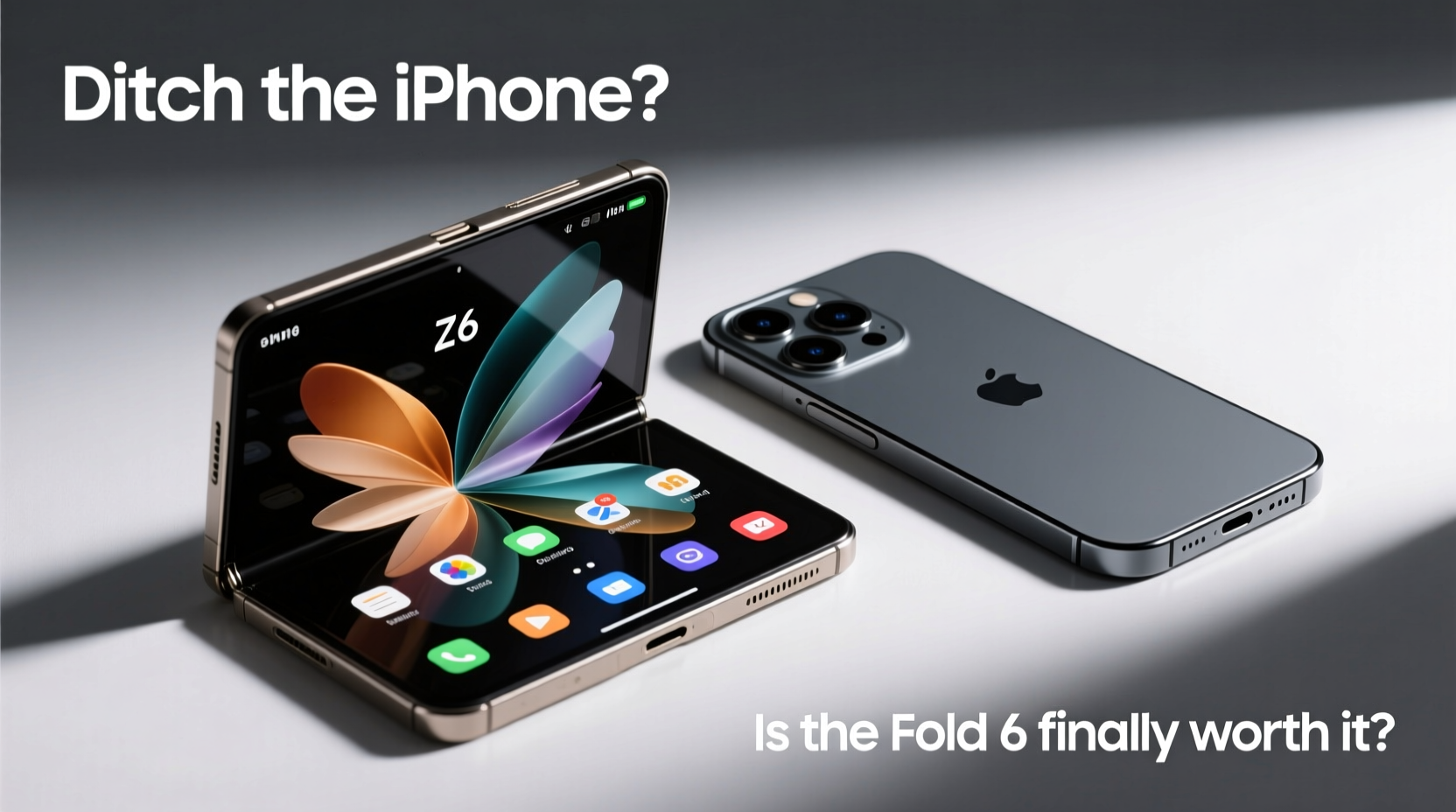
One of the biggest hurdles for early adopters of foldables was durability. The fear of screen creases, hinge failure, or water damage made them feel like fragile prototypes rather than serious flagship contenders. The Galaxy Z Fold 6 changes that narrative. Samsung has reinforced the hinge with titanium alloy, reduced the gap between panels when closed, and improved the ultra-thin glass on both inner and outer displays. IPX8 water resistance is now standard, matching the iPhone 16 Pro Max’s rating.
The new Armor Aluminum frame and updated scratch-resistant coating further close the gap in perceived longevity. In independent drop tests, the Fold 6 survives repeated drops onto concrete better than its predecessors—though it still demands more care than the solid-block aluminum design of the iPhone.
Performance: Raw Power vs. Efficiency
Under the hood, the Fold 6 runs on the Snapdragon 8 Gen 3 for Galaxy, optimized for thermal efficiency and multitasking. Benchmarks show it outperforms the A17 Bionic chip (used in the iPhone 16 Pro Max) in multi-core CPU tasks and GPU-heavy applications like video editing and gaming. However, Apple’s chip remains superior in single-core performance and power efficiency, translating to longer battery life under light usage.
Samsung’s decision to include 12GB of RAM (standard across all models) enables true app multitasking—something iOS still restricts. You can run three apps simultaneously, drag and drop content between them, and even pin a video in a floating window while browsing. For professionals managing emails, documents, and calls at once, this flexibility is unmatched on iOS.
“Foldables are no longer about novelty—they’re becoming productivity tools. The Fold 6 is the first Android device that truly challenges the iPhone’s dominance in workflow efficiency.” — Rajiv Mehta, Senior Analyst at TechInsight Group
Display and Usability: Big Screen Advantages
The Fold 6 features a 6.3-inch cover display and a 7.6-inch main folding screen with a 120Hz adaptive refresh rate on both. When unfolded, it mimics a small tablet, making web browsing, reading PDFs, and watching videos significantly more immersive than on the 6.9-inch display of the iPhone 16 Pro Max—even if the iPhone’s OLED panel remains slightly brighter and more color-accurate.
But size isn’t the only differentiator. The Fold 6 supports S Pen input natively, turning it into a note-taking or sketching device on par with an iPad Mini. Combined with Samsung DeX, which transforms the phone into a desktop-like interface when connected to a monitor, the Fold 6 becomes a legitimate laptop replacement for travel or remote work.
| Feature | Samsung Galaxy Z Fold 6 | iPhone 16 Pro Max |
|---|---|---|
| Main Display Size | 7.6 inches (folded) | 6.9 inches |
| Secondary Display | 6.3 inches | N/A |
| Stylus Support | Yes (S Pen) | No |
| Multitasking | Up to 3 apps side-by-side | Split View (limited) |
| Desktop Mode | Samsung DeX | No equivalent |
Camera Comparison: Quality vs. Versatility
The iPhone 16 Pro Max continues to lead in camera consistency, dynamic range, and video stabilization. Its triple-lens system—featuring a 48MP main, 12MP ultrawide, and 12MP telephoto with 5x optical zoom—delivers reliable results in nearly every lighting condition. Cinematic mode, ProRes recording, and advanced computational photography remain best-in-class.
The Fold 6, meanwhile, uses a 50MP main sensor, 12MP ultrawide, and 10MP periscope telephoto with 5x optical zoom. While image processing isn’t quite as refined, the hardware is competitive. What sets the Fold 6 apart is its flexibility: you can shoot using the external screen as a viewfinder while the subject sees themselves on the large internal display—ideal for vloggers or group photos.
Additionally, hands-free video recording using AI pose detection (e.g., placing the phone on a table and stepping back) works seamlessly thanks to the folding form factor. This kind of contextual creativity simply isn’t possible with a slab phone.
Battery Life and Charging: Trade-offs of Innovation
The Fold 6 packs a 4,400mAh dual-cell battery—slightly less than the iPhone 16 Pro Max’s 4,800mAh. In real-world use, both last a full day, but the iPhone edges ahead during low-intensity tasks like music playback or standby. However, heavy multitasking on the Fold 6 drains power faster, especially when using DeX or multiple apps.
Where the Fold 6 wins is in charging speed: 25W wired, 15W wireless, and 4.5W reverse wireless charging. The iPhone 16 Pro Max supports only 20W wired and 15W MagSafe, with no reverse charging. If you value quick top-ups, the Fold 6 offers a tangible advantage.
Mini Case Study: A Creative Professional’s Switch
Maya Chen, a freelance graphic designer based in Austin, used an iPhone 15 Pro Max for five years before switching to the Fold 6. “I needed something that could handle Photoshop Express, take handwritten client notes, and double as a presentation tool during meetings,” she said. “The Fold 6 lets me sketch directly on the screen, split reference images beside my canvas, and mirror my screen to a TV without any dongles. I was skeptical at first, but after three months, I haven’t touched my iPhone.”
Her only regret? The lack of native Adobe Illustrator support on Android. But overall, the productivity gains outweighed the learning curve.
Software and Ecosystem: Breaking the Apple Lock-In
Switching from iPhone to Android means leaving behind iMessage, FaceTime, AirDrop, and seamless integration with MacBooks and iPads. Samsung attempts to bridge this gap with Quick Share, Link to Windows, and enhanced cross-device sync with Galaxy Watches and Buds. However, these tools still feel like approximations.
Google’s AI suite—especially Circle to Search, Gemini Live, and real-time call screening—adds functionality Apple doesn’t offer. And Samsung’s customizations, like personalized AI summaries and voice command automation, appeal to tech-savvy users who want more control over their device.
Checklist: Are You Ready to Switch?
- ✅ Willing to adapt to a new OS (Android 14 with One UI 6.1)
- ✅ Value multitasking and productivity over pure media consumption
- ✅ Need stylus support or desktop-mode capabilities
- ✅ Have backup solutions for iMessage contacts
- ✅ Comfortable with slightly shorter battery life under heavy use
- ✅ Prepared to invest in a protective case and screen protector
Frequently Asked Questions
Can the Fold 6 replace my laptop?
For many users, yes—especially with Samsung DeX. Connect it to a monitor, keyboard, and mouse, and you get a desktop environment capable of handling office suites, web development, and media editing. It won’t replace a full-powered MacBook Pro, but it’s excellent for light-to-moderate computing needs on the go.
Is the crease still noticeable?
The crease is present but far less intrusive than in earlier models. Most users stop noticing it within a few days. Samsung’s latest polyimide layer reduces friction and improves smoothness across the fold.
Will apps work properly on the big screen?
Most major apps—including Google Workspace, Microsoft Office, Zoom, and Adobe Express—are optimized for large displays. Samsung also forces compatibility mode on non-optimized apps, scaling them appropriately. Some social media apps still don’t fully utilize the aspect ratio, but the experience is generally smooth.
Final Verdict: Yes, But With Conditions
The Samsung Galaxy Z Fold 6 is the first foldable that doesn’t ask users to compromise. It’s durable enough for daily use, powerful enough for professional workflows, and innovative enough to justify its $1,799 price tag. If your priorities include multitasking, creative input (like drawing or note-taking), and maximizing screen real estate, the Fold 6 isn’t just “good enough” to replace the iPhone 16 Pro Max—it’s better suited for those specific needs.
However, if you rely heavily on the Apple ecosystem, prioritize camera consistency, or prefer a simpler, more uniform user experience, sticking with the iPhone remains the safer choice.
The Fold 6 doesn’t win by being everything to everyone. It wins by offering something the iPhone fundamentally cannot: a transformative form factor that redefines what a smartphone can do.




 浙公网安备
33010002000092号
浙公网安备
33010002000092号 浙B2-20120091-4
Comments
No comments yet. Why don't you start the discussion?