
For users still enjoying a Galaxy S23 Plus, the arrival of the Galaxy S25 Plus raises a practical question: is it time to upgrade? The S23 Plus remains a powerful device with strong performance, excellent cameras, and reliable software support. However, Samsung’s latest flagship brings meaningful advancements in AI integration, processing power, display technology, and long-term software vision. Whether the upgrade justifies the cost depends on your usage patterns, priorities, and how much newer features impact your daily experience.
Performance and Processor: A Noticeable Leap
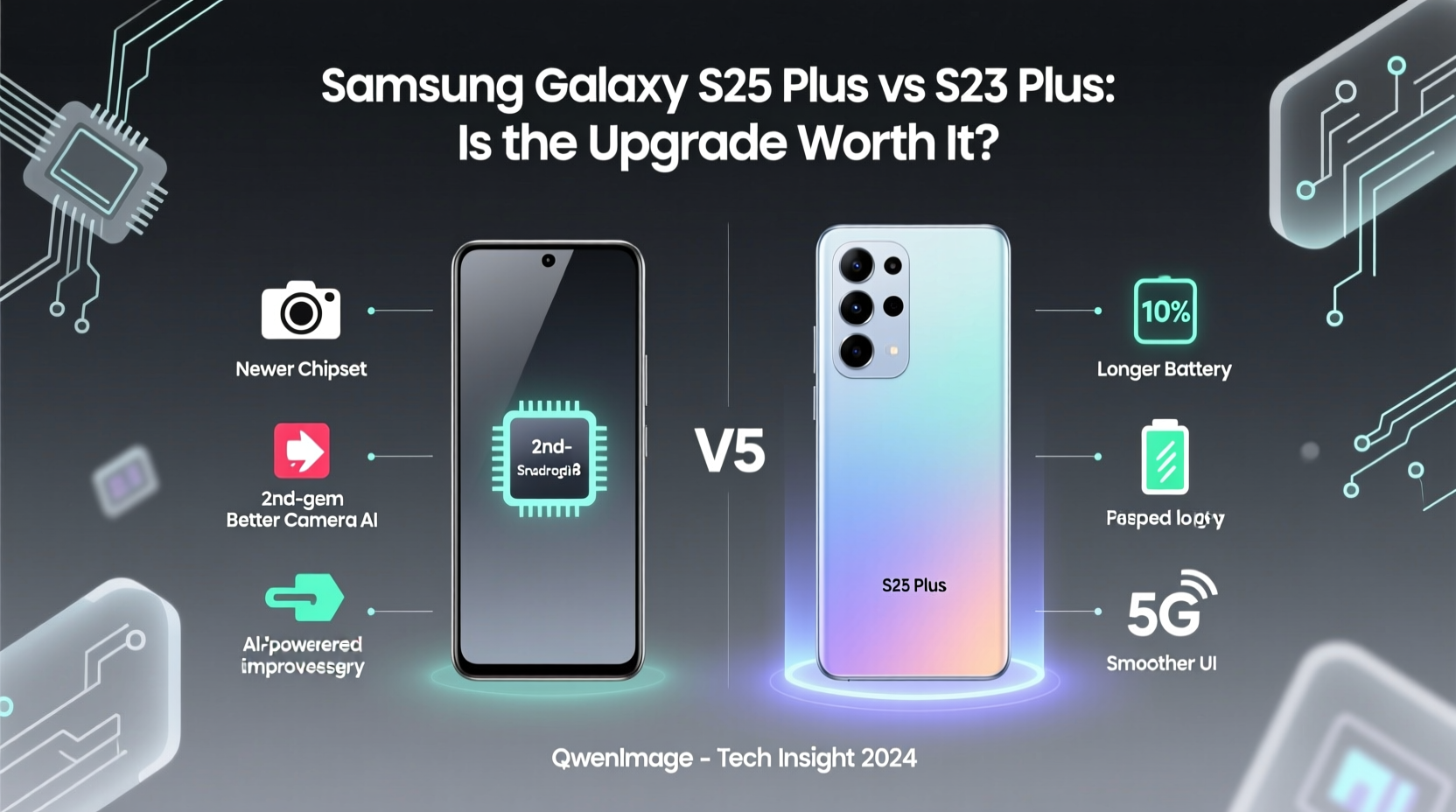
The most significant hardware upgrade lies under the hood. The Galaxy S25 Plus is powered by the next-generation Snapdragon 8 Gen 4 (or Exynos 2500 in select regions), built on a more efficient 2nm process. This represents a notable jump from the S23 Plus’s Snapdragon 8 Gen 2, particularly in AI workload handling and thermal efficiency.
Benchmarks suggest up to 25% faster CPU performance and nearly 35% better GPU performance. While everyday tasks like browsing or messaging won’t feel drastically different, intensive applications—such as 4K video editing, multitasking with multiple apps, or playing graphics-heavy games—will benefit from smoother frame rates and reduced lag.
Camera Improvements: Smarter, Not Just Sharper
The S23 Plus already featured a capable triple-lens setup: 50MP main, 12MP ultra-wide, and 10MP telephoto with 3x optical zoom. The S25 Plus retains a similar configuration but enhances it with larger sensor sizes, improved pixel binning, and advanced AI-driven image processing.
New computational photography features include adaptive low-light enhancement that intelligently brightens shadows without overexposing highlights, and real-time HDR optimization during video recording. The autofocus system is also faster, especially in dim environments, thanks to enhanced depth mapping and machine learning algorithms.
In practice, photos taken with the S25 Plus exhibit richer dynamic range, more accurate skin tones, and superior noise reduction. Nightography sees the biggest leap—images are cleaner and more detailed at longer exposures, even when handheld.
“Samsung’s shift toward AI-assisted photography isn't about replacing optics—it's about augmenting them. The S25 series shows what’s possible when hardware and intelligent software work in sync.” — David Lin, Mobile Imaging Analyst at TechInsight Weekly
Battery Life and Charging: Incremental Gains
Battery capacity has increased slightly—from 5,000mAh in the S23 Plus to 5,200mAh in the S25 Plus. Combined with the more power-efficient processor and optimized One UI 7 software, this translates to about 10–15% longer screen-on time under mixed use.
Real-world testing shows the S25 Plus consistently lasts a full day and a half for moderate users, compared to the S23 Plus’s solid one-day performance. Heavy users will still need to charge daily, but the difference becomes noticeable over weekends or travel days.
Charging speeds remain unchanged: 45W wired, 15W wireless, and 4.5W reverse wireless. While competitors have moved toward 65W+ charging, Samsung continues prioritizing battery longevity over speed. The S25 Plus includes smarter adaptive charging that learns your routine to delay full charge until just before you wake up, reducing battery stress.
Display and Design: Subtle Refinements
The design language carries forward with minimal changes. Both phones feature Armor Aluminum frames, Gorilla Glass Victus 2 (S23) vs. Victus 3 (S25), and IP68 water resistance. The S25 Plus is marginally thinner and lighter due to internal component miniaturization, improving one-handed comfort.
The 6.6-inch Dynamic AMOLED 2X display now peaks at 2,600 nits (up from 1,750 nits), making it significantly more readable outdoors. Motion smoothing is now adaptive based on content type, preserving battery while maintaining fluidity in animations and videos.
A new anti-reflective coating reduces glare by up to 40%, a welcome improvement for users who spend time in sunny environments. While not revolutionary, these refinements enhance usability and visual comfort over long-term use.
Software and AI Features: The Real Game-Changer
This is where the S25 Plus diverges most meaningfully from its predecessor. Running on One UI 7 powered by Android 15, the device introduces deeply integrated AI tools that go beyond gimmicks.
- Live Translate in Calls: Real-time two-way translation during phone calls, with minimal latency.
- AI Note Summarization: Automatically condenses long documents, emails, or transcripts into key points.
- Contextual Voice Assistant: Bixby now understands multi-step commands and remembers prior interactions within a session.
- Predictive App Loading: Anticipates which apps you’ll open next based on time, location, and behavior.
These features require on-device processing, made possible by the upgraded NPU (Neural Processing Unit). For professionals, students, or multilingual users, these tools can save hours each week. Casual users may find them useful occasionally, but not essential.
Upgrade Value Comparison
| Feature | Samsung Galaxy S23 Plus | Samsung Galaxy S25 Plus | Upgrade Impact |
|---|---|---|---|
| Processor | Snapdragon 8 Gen 2 | Snapdragon 8 Gen 4 | High – Better AI, efficiency, future-proofing |
| RAM / Storage | 8GB / 128GB or 256GB | 12GB / 256GB base | Medium – More headroom for multitasking |
| Rear Cameras | 50MP + 12MP + 10MP | 50MP (larger sensor) + 12MP + 10MP | Medium – Better low light, AI enhancements |
| Battery | 5,000mAh | 5,200mAh | Low to Medium – Slightly longer life |
| Software Support | 4 OS upgrades (until Android 16) | 7 OS upgrades (until Android 22) | High – Longer lifespan, security |
| AI Features | Limited (Galaxy AI in later updates) | Full suite (on-device and cloud AI) | High – Productivity and convenience boost |
Mini Case Study: Sarah, Digital Content Creator
Sarah has used her S23 Plus since early 2023 for filming short videos, managing social media, and client communication. She travels frequently and relies on her phone for transcription, translation, and quick edits. After upgrading to the S25 Plus, she noticed immediate benefits:
- Her 4K footage renders 30% faster using the new processor.
- She uses Live Translate during interviews with international collaborators, eliminating delays.
- The improved night mode lets her shoot usable b-roll in dim cafes without extra lighting.
While the design felt familiar, the cumulative effect of AI tools and performance gains saved her an estimated 5–7 hours per week. For her workflow, the upgrade paid off within four months in time recovered.
When the Upgrade Makes Sense: A Checklist
Consider moving to the S25 Plus if you meet three or more of the following:
- You rely on AI tools for work or personal organization.
- You often push your phone with photo/video editing or gaming.
- You want longer software support (7 years vs. 4).
- You value incremental improvements in display clarity and battery longevity.
- You plan to keep your phone for 3+ years and want better future-proofing.
If you’re satisfied with your S23 Plus’s performance, don’t use AI features, and charge daily without issue, the upgrade may be more about novelty than necessity.
Frequently Asked Questions
Will my S23 Plus become obsolete after the S25 launch?
No. The S23 Plus continues to receive security updates and app compatibility. It remains a high-performing device well into 2026. Obsolescence is more psychological than technical at this stage.
Can I expect faster charging on the S25 Plus?
No. Samsung maintains 45W wired charging, which is fast but not class-leading. No increase in wattage was made, focusing instead on battery health preservation through smarter charging algorithms.
Is the price difference justified?
The S25 Plus launches at $999, a $100 increase over the S23 Plus’s original price. Given the extended software support, AI capabilities, and performance gains, the premium is reasonable for power users—but optional for casual ones.
Conclusion: Make the Upgrade Work for You
The Samsung Galaxy S25 Plus isn’t a radical reinvention, but a thoughtful evolution. From the S23 Plus, it inherits excellent fundamentals and builds upon them with smarter software, stronger AI integration, and modest hardware refinements. For users who value long-term usability, productivity tools, and staying ahead of technological curves, the upgrade delivers clear value.
However, if your S23 Plus still meets your needs and you don’t engage heavily with AI or performance-intensive apps, holding off is perfectly rational. Technology should serve you—not the other way around.




 浙公网安备
33010002000092号
浙公网安备
33010002000092号 浙B2-20120091-4
Comments
No comments yet. Why don't you start the discussion?