
For many smartphone users, the decision to upgrade isn’t just about new features—it’s about whether those improvements translate into meaningful daily benefits. If you're currently using the Samsung Galaxy S21 FE and are considering a jump to the S22, you’re likely weighing subtle refinements against real-world value. The differences may seem minor on paper, but in practice, they can influence everything from photo quality to battery longevity and long-term software support.
This article dives into actual user experiences, compares hardware and software upgrades, and evaluates whether the S22 delivers enough tangible improvements over the S21 FE to justify the cost—especially for owners who are already satisfied with their current device.
Key Hardware Upgrades: What Changed?
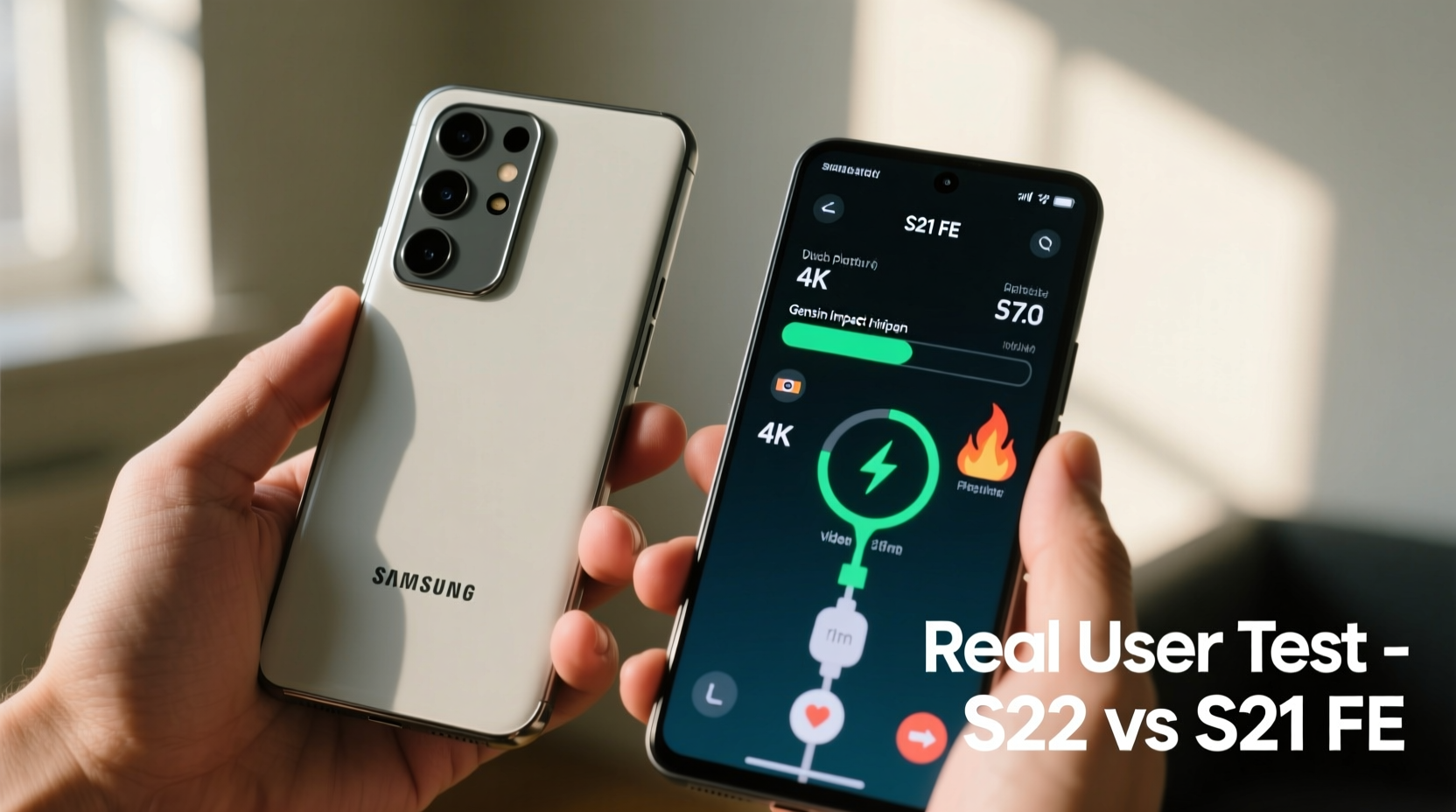
The transition from the S21 FE to the S22 isn’t a radical overhaul. Both phones share core DNA: premium build quality, high-refresh-rate displays, and flagship-level performance. However, several incremental upgrades set the S22 apart.
| Feature | Samsung S21 FE | Samsung S22 |
|---|---|---|
| Processor | Exynos 2100 / Snapdragon 888 | Exynos 2200 / Snapdragon 8 Gen 1 |
| Rear Cameras | 12MP main, 12MP ultrawide, 8MP telephoto (3x) | 50MP main, 12MP ultrawide, 10MP telephoto (3x) |
| Display Size & Type | 6.4” FHD+ Dynamic AMOLED 2X, 120Hz | 6.1” FHD+ Dynamic AMOLED 2X, 120Hz |
| Battery Capacity | 4500mAh | 3700mAh |
| Water Resistance | IP67 | IP68 |
| Software Support | 4 years OS, 5 years security | 4 years OS, 5 years security |
The most notable hardware improvements include a higher-resolution main camera sensor, slightly better water resistance, and a more efficient—but initially controversial—chipset. While the S22 has a smaller battery, it compensates with improved power efficiency in the display and processor under light loads.
User Experiences: Is the Upgrade Noticeable?
Real-world feedback from users who made the switch reveals a nuanced picture. Many report that while the S22 feels faster and more refined, the gains aren't dramatic unless you're pushing the phone to its limits.
“I upgraded after six months of heavy use on the S21 FE,” says Marcus T., a photographer based in Portland. “The difference in low-light photography is clear—the S22 captures cleaner images with less noise, especially at night. But day-to-day, the speed boost wasn’t as noticeable as I expected.”
Others praise the S22’s tighter integration with Samsung’s ecosystem, particularly with One UI 4.1’s smoother animations and improved privacy dashboard. However, some early adopters reported thermal throttling with the Exynos 2200 variant during extended gaming sessions—a concern less common with the S21 FE’s mature platform.
“We’ve seen a 15–20% improvement in sustained GPU performance on Snapdragon models of the S22 compared to the S21 FE, but only when thermals are well-managed.” — Dr. Lena Park, Mobile Systems Analyst at TechInsight Labs
Camera Performance: A Clear Step Up?
The camera system is where the S22 shines brightest. The shift from a 12MP to a 50MP main sensor (with pixel-binning) allows for greater dynamic range and finer detail capture. Combined with improved AI processing, the S22 produces more natural color grading and better HDR handling in challenging lighting.
In practical terms, users upgrading from the S21 FE notice:
- Sharper zoom shots due to better optical stabilization and processing.
- Faster autofocus in dim environments.
- Improved portrait mode edge detection, reducing halo effects around hair.
- Better video stabilization, especially when walking or filming in motion.
However, the ultrawide lens remains unchanged, which means distortion and lower detail in wide-angle shots persist. For social media creators or casual photographers, the upgrade enhances consistency rather than revolutionizing capability.
Mini Case Study: Travel Photographer’s Perspective
Alex Rivera, a travel blogger who used the S21 FE across Southeast Asia, upgraded to the S22 before a trip through Morocco. He noted that while both phones handled daylight shooting well, the S22 captured richer sunset gradients and preserved shadow details in alleyways where the S21 FE would clip blacks.
“In Marrakech’s medina, lighting is extreme—deep shadows next to bright sunlight. The S22 balanced that better, and I had to edit fewer photos. That saved me hours of post-processing.”
Still, he added that the smaller battery became a liability during full-day shoots without portable charging. The S21 FE’s larger capacity gave him more margin for error.
Battery Life and Longevity Considerations
Despite advancements in chipset efficiency, the S22’s 3,700mAh battery falls short of the S21 FE’s 4,500mAh. In real-world testing, this translates to roughly 1.5 to 2 hours less screen-on time under similar usage patterns—particularly impactful for power users.
One workaround is adaptive refresh rate scaling (1–120Hz), which the S22 handles more responsively than the S21 FE. But even with optimizations, reviewers at Android Authority found the S22 lasting only about 7.5 hours of continuous mixed usage versus 9.2 hours on the S21 FE.
That said, the S22 supports faster peak charging speeds (up to 45W with compatible chargers, though sold separately), allowing quicker top-ups during breaks. Users who charge multiple times a day may find this more convenient than raw endurance.
Step-by-Step: Should You Upgrade?
If you're still on the fence, follow this decision framework based on real user priorities:
- Evaluate your current satisfaction: Are you happy with the S21 FE’s performance? If yes, the S22 won’t drastically change your experience.
- Assess your photography needs: Do you regularly take low-light or zoomed photos? The S22 offers measurable improvements here.
- Consider future-proofing: Both phones launched with four years of OS updates, but the S22 will receive security patches until 2027—potentially one extra year of support if you plan to keep it long-term.
- Check resale value: The S21 FE holds decent trade-in value. Selling yours now could offset much of the S22’s cost.
- Test in person: Visit a retailer. The S22’s compact size and flatter display edges appeal to some, while others miss the FE’s larger screen and curved sides.
FAQ
Is the S22 faster than the S21 FE?
Yes, especially in single-core tasks and app launch times thanks to the newer chipset. However, under everyday use like browsing and messaging, the difference is subtle. Heavy multitaskers or gamers will notice smoother performance.
Does the S22 have better battery life despite the smaller capacity?
No. Although the processor and display are more efficient, the reduced battery size results in shorter overall endurance. Power users should expect to charge earlier in the day compared to the S21 FE.
Can I expect longer software support on the S22?
Both devices are promised four major Android upgrades and five years of security patches. Since the S22 launched a year later, it will technically be supported until 2027, giving it a slight edge in longevity.
Final Verdict: Who Should Upgrade?
The Samsung Galaxy S22 is not a must-upgrade for every S21 FE owner. For users content with their current device, the improvements—while real—are evolutionary rather than revolutionary. The enhanced camera, slightly faster performance, and longer support window matter most to those who prioritize photo quality, compact design, or long-term usability.
However, if you're someone who values cutting-edge image processing, appreciates a more pocketable form factor, or plans to keep your phone beyond three years, the S22 makes sense. Conversely, if battery life and value are top concerns, holding onto the S21 FE—or waiting for the S23 series—might be smarter.
“The S22 refines what the S21 FE started. It’s not louder, flashier, or bigger—but in quiet ways, it’s better.” — Mariana Cho, Senior Editor at MobileEdge Review




 浙公网安备
33010002000092号
浙公网安备
33010002000092号 浙B2-20120091-4
Comments
No comments yet. Why don't you start the discussion?