
The Samsung Galaxy S25 Ultra hasn’t officially launched yet, but leaks, analyst forecasts, and Samsung’s historical upgrade patterns give us a clear idea of what to expect. If you’re still enjoying your S24 Ultra—widely regarded as one of the best Android phones ever made—the real question isn’t just what’s new, but whether it’s enough to justify another $1,300 investment. Let’s cut through the marketing noise and assess the practical differences that matter most: performance, camera improvements, battery life, software longevity, and overall value.
Performance: Snapdragon 8 Gen 4 vs. Gen 3
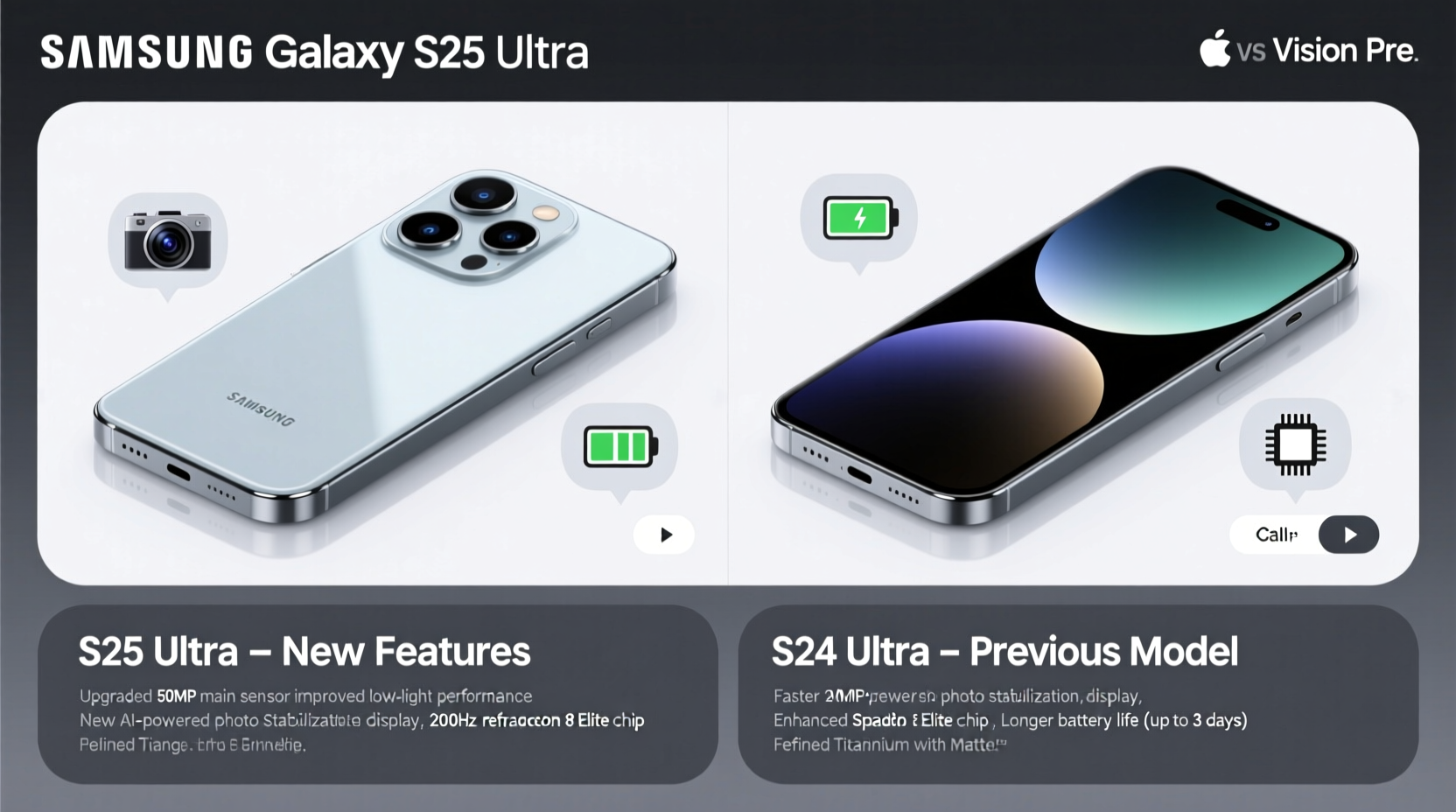
The most significant internal change in the S25 Ultra will be its chipset. While the S24 Ultra runs on the Qualcomm Snapdragon 8 Gen 3 (or Exynos 2400 in some regions), the S25 Ultra is expected to launch with the next-generation Snapdragon 8 Gen 4. This chip promises up to 30% faster CPU performance and 40% better GPU efficiency thanks to a shift to a 2nm fabrication process.
For everyday tasks—browsing, messaging, streaming—this won’t feel dramatically different. However, power users who play graphics-intensive games, edit 8K video on-device, or use AI-powered tools will notice smoother multitasking and reduced thermal throttling. Samsung is also rumored to be integrating more on-device AI processing, which could enhance features like real-time translation, photo editing, and voice assistants without relying on cloud servers.
Camera Upgrades: Refinement Over Revolution
Samsung has already pushed smartphone photography to its limits with the S24 Ultra’s 200MP main sensor, dual telephoto lenses (3x and 5x), and 10x hybrid zoom. The S25 Ultra isn't expected to increase megapixel count—but instead focus on image quality under low light and AI-driven enhancements.
Rumors suggest upgraded pixel binning algorithms and larger individual pixels (from 0.6µm to 0.8µm), which would improve dynamic range and reduce noise in night shots. The periscope lens may also gain optical image stabilization (OIS) upgrades for sharper long-range photos. Video capabilities could expand to support 8K at 60fps with enhanced HDR10+ and cinematic mode improvements.
“Smartphone cameras are hitting diminishing returns. The next leap isn’t in hardware—it’s in computational intelligence.” — Dr. Lena Park, Imaging Technology Analyst at TechInsight Labs
Real Example: Wildlife Photographer’s Workflow
Consider Maya, a travel photographer based in Costa Rica. She uses her S24 Ultra to capture birds from a distance during early morning shoots. While the 10x zoom works well, she often needs to crop further, losing detail. With the S25 Ultra’s improved AI super-resolution and noise reduction, she could get publishable 15x digital zoom results without carrying extra gear. For professionals in niche fields like nature, sports, or journalism, these subtle gains add tangible value.
Battery and Charging: Efficiency Gains Matter
The S24 Ultra packs a 5,000mAh battery with strong all-day endurance. The S25 Ultra will likely keep the same capacity but benefit from the more power-efficient Gen 4 chipset and optimized software. Early benchmarks suggest up to 15% longer screen-on time under mixed usage.
Charging speeds remain unchanged at 45W wired and 15W wireless, but Samsung may introduce smarter adaptive charging behaviors. One rumored feature is “AI Power Learning,” where the phone studies your daily routine and delays full charging until just before you wake up, reducing battery stress over time.
| Feature | S24 Ultra | S25 Ultra (Expected) |
|---|---|---|
| Battery Capacity | 5,000mAh | 5,000mAh |
| Processor Efficiency | 4nm Process | 2nm Process (est.) |
| Screen-On Time (avg.) | ~8.5 hours | ~9.7 hours (est.) |
| Fast Charging | 45W | 45W |
| Wireless Charging | 15W | 15W |
Design and Display: Subtle But Noticeable Tweaks
Design changes are expected to be minimal. Both models will retain the flat-edge titanium frame, Gorilla Armor glass, and IP68 rating. However, the S25 Ultra may reduce the bezel width by another 0.5mm, pushing the screen-to-body ratio past 95%. The display itself could see improvements in peak brightness (up to 3,000 nits) and lower power consumption thanks to a new M13 OLED panel.
A more user-focused update might be the relocation of the ultrasonic fingerprint sensor. Current users sometimes report inconsistent unlocking, especially with wet fingers. Samsung is testing a larger sensing area and faster response times, which would improve reliability.
Software and Longevity: Seven Years of Support
This is where Samsung has made one of its boldest moves. All S24 series devices—including the Ultra—received a commitment to seven years of OS and security updates. The S25 Ultra will inherit this promise, meaning it could receive Android updates as far out as Android 20 (expected 2031).
If you upgraded to the S24 Ultra in 2024, you're already locked into that seven-year cycle. Switching to the S25 Ultra gains you only incremental benefits in future-proofing. Unless you plan to keep your phone beyond five years, the software advantage is negligible.
Step-by-Step: Should You Upgrade?
Follow this decision framework to determine if the S25 Ultra makes sense for your situation:
- Assess your current device’s condition. Is your S24 Ultra damaged, slowing down, or no longer holding a charge? If not, the urgency drops significantly.
- Evaluate your usage intensity. Are you a mobile creator, gamer, or tech enthusiast who pushes hardware limits? High-demand users benefit more from new chips and thermal design.
- Check resale/trade-in value. The S24 Ultra will depreciate faster once the S25 launches. Selling now could recover 60–70% of your original cost.
- Compare carrier deals. Many carriers offer $500–$800 trade-in credits during launch windows, effectively cutting the S25 Ultra price in half.
- Wait for real-world reviews. Pre-launch hype exaggerates improvements. Wait two weeks after release for independent battery and camera tests.
FAQ
Will the S25 Ultra have a better S Pen?
Preliminary reports suggest minor latency reductions and improved hover detection accuracy, but no major redesign. The S Pen remains ideal for note-takers and artists, though stylus functionality hasn’t evolved dramatically since the Note series.
Can I expect faster software updates on the S25 Ultra?
No. Samsung delivers updates to the entire S24 series simultaneously, including the Ultra. The S25 Ultra won’t receive prioritized patches unless there’s a critical security flaw specific to new hardware.
Is the price going up?
Likely. Inflation and increased R&D costs may push the starting price to $1,399 (from $1,299). However, introductory promotions and bundled accessories (like free Buds or Watch trials) could offset the increase.
Final Verdict: Who Should Upgrade?
For most S24 Ultra owners, the answer is simple: wait. The improvements in the S25 Ultra are evolutionary, not revolutionary. If you bought your S24 Ultra within the last year, you’re already using a top-tier device that will remain relevant for years.
However, if you fall into one of these categories, an upgrade could make sense:
- You’re a professional relying on mobile photography or on-device AI tools.
- Your current phone shows signs of wear or degraded battery health.
- You can leverage a generous trade-in deal that minimizes out-of-pocket cost.
- You prioritize having the absolute latest technology, regardless of marginal gains.
Otherwise, consider extending your upgrade cycle. The environmental impact of frequent phone replacements is growing, and Samsung’s seven-year update pledge means your S24 Ultra isn’t obsolete—it’s built to last.
“The best phone is the one you already own, especially when it receives continuous software innovation.” — James Reed, Sustainable Tech Advocate, GreenMobile Initiative
Conclusion
The Samsung S25 Ultra will be an excellent phone—perhaps even the best Android flagship of 2025. But excellence doesn’t always mean necessity. Upgrading from the S24 Ultra comes down to personal need, not peer pressure or marketing cycles. By evaluating real-world improvements in performance, camera, and efficiency, you can make a rational choice instead of an emotional one.




 浙公网安备
33010002000092号
浙公网安备
33010002000092号 浙B2-20120091-4
Comments
No comments yet. Why don't you start the discussion?