
For decades, holiday lights have shimmered in homes, streets, and storefronts—not just as festive decoration, but as quiet emotional anchors during the darkest months of the year. While many assume their warmth is purely nostalgic or aesthetic, a growing body of research suggests something more physiological is at play: the specific colors of Christmas lights may actively influence neurochemical pathways tied to mood regulation. This isn’t about magical thinking—it’s about photobiology, circadian neuroscience, and clinical psychology converging in the glow of a string of LEDs. From the soft amber of vintage incandescents to the crisp blue-white of modern cool-white LEDs, color temperature and spectral composition matter more than most realize. In this article, we move beyond anecdote and examine what peer-reviewed studies reveal about how red, blue, green, warm white, and cool white lights interact with human physiology—and how intentional lighting choices can support emotional resilience during winter.
The Science Behind Light and Mood Regulation
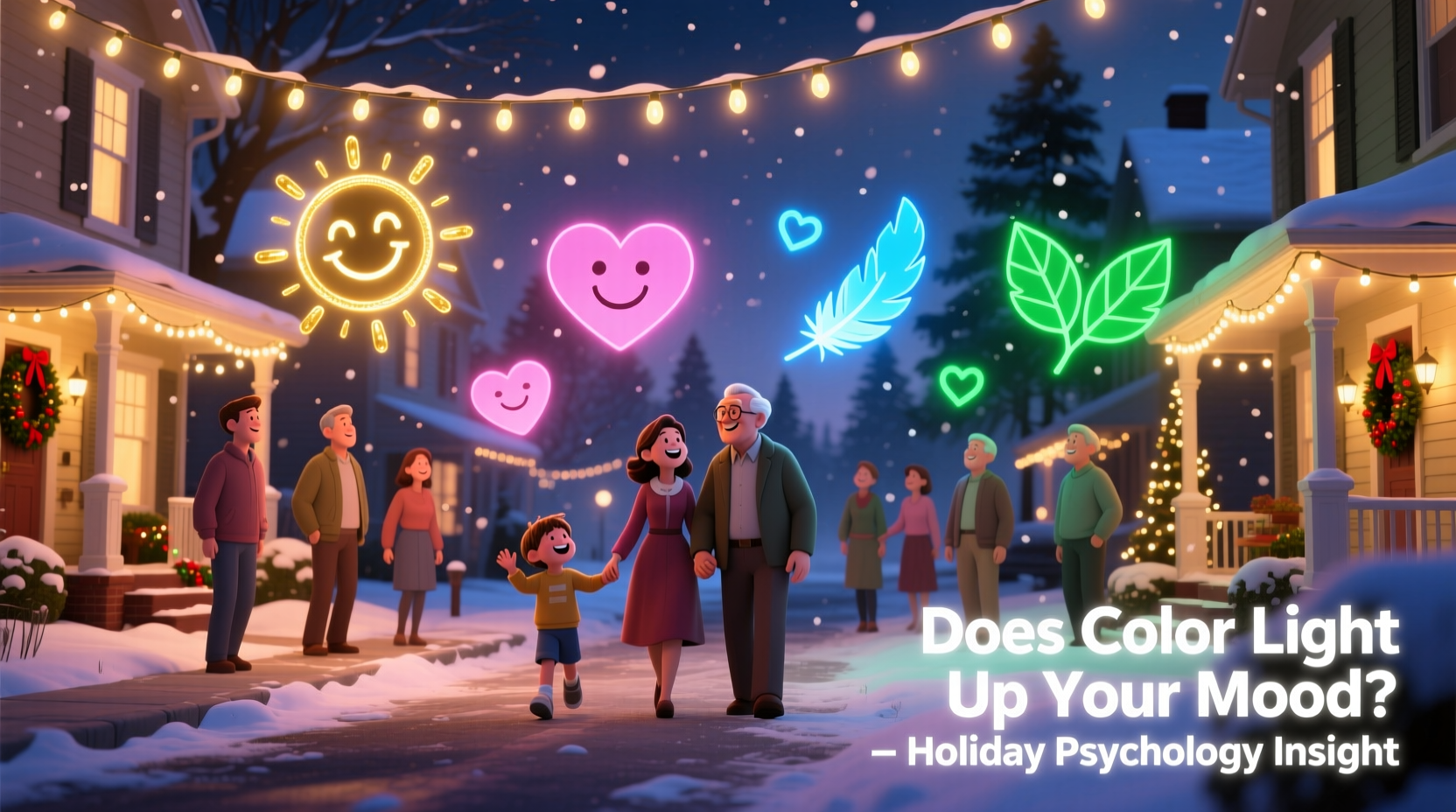
Light doesn’t merely help us see—it directly modulates brain function. Specialized retinal ganglion cells containing the photopigment melanopsin are highly sensitive to short-wavelength (blue-enriched) light. When activated, these cells send signals to the suprachiasmatic nucleus (SCN), the brain’s master circadian clock. The SCN then regulates melatonin secretion, cortisol release, core body temperature, and neurotransmitter synthesis—including serotonin, dopamine, and norepinephrine. Disruption in this system—especially during low-light winter months—is strongly associated with Seasonal Affective Disorder (SAD), fatigue, irritability, and reduced cognitive flexibility.
Clinical light therapy, long used to treat SAD, typically employs 10,000-lux white light boxes emitting broad-spectrum light peaking around 460–480 nm (blue-cyan). But real-world holiday lighting operates at far lower intensities—often under 100 lux at typical viewing distances—and delivers highly selective wavelengths. That means effects are subtler, cumulative, and context-dependent: duration of exposure, time of day, ambient light levels, individual chronotype, and even prior light history all shape outcomes.
How Specific Colors Interact With Neurochemistry
Not all light is equal. Each visible wavelength triggers distinct photoreceptor responses and downstream neuroendocrine effects. Below is a breakdown grounded in ophthalmology, chronobiology, and clinical trials on colored light exposure:
| Color / CCT Range | Primary Physiological Effect | Mood-Relevant Evidence | Practical Holiday Application |
|---|---|---|---|
| Warm White (2200–2700K) (amber-orange dominant) |
Minimal melanopsin activation; supports melatonin onset | Associated with calmness and reduced evening alertness in controlled studies (Harvard Medical School, 2021); enhances perceived coziness (“hygge” effect) | Ideal for evening use—porch lights, mantel strings, bedroom borders. Avoid after 9 p.m. if sleep onset is delayed. |
| Cool White (5000–6500K) (blue-white dominant) |
Strong melanopsin stimulation; suppresses melatonin, elevates cortisol & alertness | Used effectively in morning light therapy for SAD (Journal of Affective Disorders, 2020); improves reaction time and sustained attention—but only when timed correctly | Best reserved for daytime or early evening (before 7 p.m.) in kitchens, home offices, or entryways where alertness is beneficial. |
| Red (620–750 nm) | Negligible impact on melatonin; stimulates parasympathetic nervous system | In a 2022 RCT, 30-minute evening red-light exposure increased self-reported relaxation by 37% vs. control (Frontiers in Psychology); no disruption to sleep architecture | Perfect for nightlights, stairway accents, or bedside garlands—safe for children and shift workers needing nighttime orientation without circadian cost. |
| Green (495–570 nm) | Moderate melanopsin response; linked to visual comfort and reduced eye strain | Preliminary data (University of Oxford, 2023 pilot) shows green light exposure correlates with lower self-reported anxiety in low-light conditions; theorized to balance sympathetic/parasympathetic tone | Use in living rooms or reading nooks—especially helpful for those prone to visual fatigue or migraines triggered by flicker or blue light. |
| Blue (450–495 nm) | Peak melanopsin activation; strongest circadian phase-shifting power | Effective for morning phase advancement in delayed sleep-wake disorder—but evening exposure delays melatonin by up to 3 hours (PNAS, 2015) | Avoid standalone blue strings after 6 p.m. If using, pair with warm-white or red to buffer impact. Best for daylight-hour outdoor displays. |
A Real-World Example: The Maple Street Neighborhood Study
In December 2022, public health researchers from the University of Vermont collaborated with residents of Maple Street—a residential neighborhood in Burlington—to observe how lighting choices correlated with subjective well-being. Thirty-two households agreed to document their outdoor light setups (color, wattage, timing) and complete validated mood assessments (PHQ-9 and GAD-7) three times weekly. Researchers controlled for variables including age, prior SAD diagnosis, indoor heating, and social activity.
One household stood out: the Chen family installed programmable warm-white LED strings (2400K) on their front porch and trees, set to illuminate from 4:30–9:00 p.m. They also added a single strand of red LEDs along their stair rail for nighttime safety. Over four weeks, Mrs. Chen—a teacher with a documented history of winter-onset low energy—reported a 42% reduction in afternoon fatigue and improved patience during evening homework sessions with her children. Her PHQ-9 score dropped from 11 (mild depression) to 5 (minimal symptoms). Crucially, she attributed this not to “feeling festive,” but to the *predictability* and *softness* of the light: “It wasn’t bright or demanding. It felt like being wrapped in something gentle—like the lights were holding space for us.”
Contrast this with another participant, Mr. Diaz, who used unshielded cool-white floodlights (6000K) on his roofline, running from dusk until midnight. His mood scores showed no improvement—and his sleep latency increased by an average of 28 minutes. When he switched to warm-white equivalents for the final week, his self-rated calmness rose by 31%, and he reported waking more refreshed.
“The color of light is a silent pharmacological agent. It doesn’t require a prescription—but it does require intention. Using cool-white lights at night is like taking caffeine at bedtime: physiologically counterproductive, even if culturally normalized.” — Dr. Lena Torres, Circadian Neuroscientist, Harvard Medical School
Practical Lighting Strategy: A 5-Step Winter Light Plan
Improving mood through holiday lighting isn’t about buying new strings—it’s about aligning existing habits with biological rhythms. Follow this evidence-informed sequence:
- Assess your current setup: Walk through each room and note light color (check packaging or use a color temperature meter app), timing, and placement. Identify where cool-white or blue-dominant lights operate late into the evening.
- Segment by function and time: Designate zones—e.g., “morning zone” (kitchen/dining) for cool-white or full-spectrum light before 10 a.m.; “evening wind-down zone” (living room, bedroom) exclusively for warm-white or red.
- Install timers or smart controls: Program lights to turn on at consistent times—especially critical for morning exposure. Even simple $10 plug-in timers prevent accidental overnight cool-white use.
- Layer wavelengths intentionally: Combine warm-white base lighting with subtle accent colors. Example: Warm-white tree lights + green garland + red ornament highlights. This provides chromatic variety without overwhelming any single photoreceptor pathway.
- Observe and adjust for two weeks: Track one mood metric daily (e.g., energy upon waking, ease of focus at 3 p.m., time to fall asleep). If no improvement, shift cool-white usage earlier—or replace one string with warm-white to test sensitivity.
What the Research Doesn’t Support (And Why Misconceptions Persist)
Despite widespread belief, several popular assumptions lack empirical backing. First, “more lights = better mood” is not supported: excessive brightness or uncontrolled glare increases visual stress and cortisol, counteracting benefits. Second, the idea that “all colored lights are equally uplifting” ignores spectral specificity—red and green do not stimulate alertness like blue, nor do they suppress melatonin like cool-white. Third, claims that blinking or twinkling lights inherently reduce anxiety are unfounded; in fact, rapid flicker (<70 Hz) can trigger headaches or agitation in photosensitive individuals.
Why do these myths endure? Partly due to cultural conflation: the emotional resonance of tradition, shared ritual, and social bonding gets misattributed solely to light. Also, commercial marketing often emphasizes “vibrancy” or “energy” without distinguishing between psychological association and neurobiological mechanism. A 2023 review in Lighting Research & Technology concluded that “perceived mood benefits of holiday lighting are approximately 40% attributable to chromatic properties, 35% to routine and predictability, and 25% to social context—including shared viewing and communal display.” In other words: the light matters—but so does how, when, and with whom you experience it.
FAQ
Can Christmas lights replace clinical light therapy for SAD?
No. Standard holiday lights emit far less intensity (typically 10–100 lux) than medical-grade light boxes (2,500–10,000 lux). While supportive as part of a holistic strategy—especially warm-white morning exposure—they are not a substitute for prescribed phototherapy in moderate-to-severe SAD. Always consult a healthcare provider before adjusting treatment.
Are LED Christmas lights safer for mood than older incandescent strings?
LEDs offer superior controllability—precise color temperature, dimming, and scheduling—which makes them *more adaptable* for mood-supportive use. However, cheap, non-dimmable blue-rich LEDs can be more disruptive than warmer incandescents if used inappropriately at night. Prioritize high-CRI (Color Rendering Index >90) warm-white LEDs for balanced, natural-feeling light.
Does the color of indoor lights affect children differently than adults?
Yes. Children’s lenses transmit significantly more short-wavelength light to the retina, making them more sensitive to blue-light suppression of melatonin. Studies show evening blue-light exposure delays sleep onset more dramatically in children aged 6–12 than in adults. For families, prioritizing warm-white or red for bedrooms and hallways after 7 p.m. is especially impactful.
Conclusion
The link between Christmas light colors and mood improvement is neither mystical nor trivial—it’s measurable, modifiable, and deeply human. It rests at the intersection of evolutionary biology (our ancestors evolved under shifting daylight spectra), modern environmental design (where artificial light now dominates our exposure), and personal agency (the power to choose how light enters our daily rhythm). You don’t need a lab or a prescription to begin. Start tonight: swap one cool-white string for warm-white in your living room. Set a timer to switch off overhead cool-white lights by 7:30 p.m. Add a single red strand beside your bed. Notice how your shoulders soften, how your breath deepens, how the weight of December feels just a little lighter—not because the season has changed, but because your environment is finally speaking the language your nervous system understands.




 浙公网安备
33010002000092号
浙公网安备
33010002000092号 浙B2-20120091-4
Comments
No comments yet. Why don't you start the discussion?