
In just a few years, TikTok has transformed from a niche social app into a global cultural force. With over a billion active users, its algorithm-driven short-form videos dominate daily screen time for millions. But as endless scrolling becomes routine, a growing concern echoes across homes, offices, and classrooms: is TikTok making us less productive? Cognitive scientists, neurologists, and behavioral researchers are now sounding the alarm. Evidence suggests that the platform’s design—optimized for rapid dopamine hits and infinite novelty—may be reshaping our brains in ways that undermine sustained focus, deep work, and long-term goal achievement.
This isn’t about blaming a single app. It’s about understanding how the architecture of digital entertainment intersects with human cognition. The science is clear: frequent exposure to ultra-short, high-reward stimuli can recalibrate attention systems, reduce tolerance for slower-paced tasks, and fragment concentration. For students trying to study, professionals aiming to write reports, or anyone striving to complete meaningful work, this shift has real consequences.
The Neuroscience of Attention in the Age of TikTok
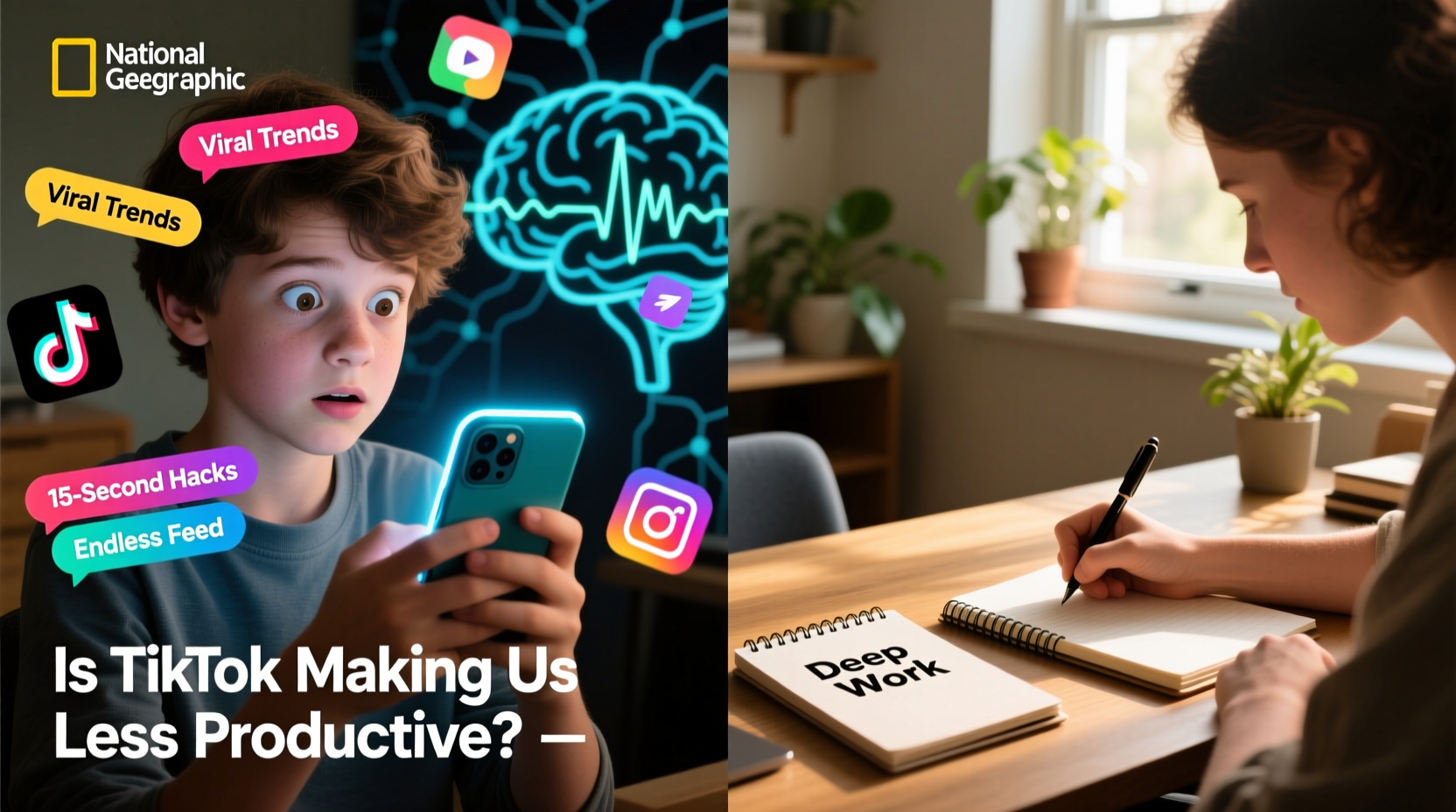
Human attention operates through two primary systems: top-down (goal-directed) and bottom-up (stimulus-driven). Top-down attention allows us to concentrate on a task despite distractions—like reading a book in a noisy café. Bottom-up attention, on the other hand, responds automatically to salient stimuli—bright colors, sudden movements, emotional cues. TikTok exploits the latter with precision.
Each video on the platform averages between 15 and 60 seconds and is packed with visual effects, music shifts, jump cuts, and emotional triggers. This constant stream of novel stimuli keeps the brain’s reward circuitry—particularly the release of dopamine—on high alert. Over time, repeated activation of this system conditions the brain to expect rapid rewards. As Dr. Adam Gazzaley, a neuroscientist at the University of California, San Francisco, explains:
“Every time you swipe to a new TikTok, your brain gets a micro-dose of dopamine. That’s not inherently bad, but when it happens hundreds of times a day, it trains your brain to crave constant novelty. You start losing the ability to engage in sustained, effortful thinking.”
Studies using EEG and fMRI have shown measurable changes in attention networks among heavy users of short-form video platforms. One 2023 study published in *Nature Human Behaviour* found that individuals who consumed more than 90 minutes of TikTok-style content daily showed reduced activation in the prefrontal cortex—the region responsible for planning, decision-making, and impulse control—during cognitive tasks requiring focus.
Attention Spans Are Shrinking—But Not for the Reasons You Think
Headlines often claim that the average human attention span has dropped from 12 seconds in 2000 to 8 seconds today—shorter than a goldfish’s. While this specific statistic is widely misquoted and lacks robust scientific backing, the underlying trend is valid: people report greater difficulty maintaining focus on long-form content.
A 2022 Microsoft study tracking media consumption habits found that 73% of respondents admitted they could only concentrate on a task for up to 30 minutes before feeling distracted. More telling, 44% said they now struggle to read books or watch full-length films without checking their phones.
The issue isn’t a biological decline in attention capacity. Instead, it’s a phenomenon known as “attention residue”—a term coined by organizational psychologist Sophie Leroy. When we switch tasks rapidly, part of our mind remains engaged with the previous activity, reducing cognitive bandwidth for the new one. TikTok, with its endless scroll and algorithmic unpredictability, creates a perfect storm for attention residue. Every swipe pulls you deeper into a cycle of partial engagement, leaving little mental space for deep work.
Productivity in the Shadow of Infinite Scroll
Modern productivity relies on what Cal Newport calls “deep work”—the ability to focus without distraction on cognitively demanding tasks. Writing a report, coding software, studying for exams, or even having a thoughtful conversation all require uninterrupted attention. TikTok’s design directly opposes these conditions.
A longitudinal study conducted by the University of Pennsylvania in 2023 tracked 300 college students over six months. Researchers divided participants into three groups: low TikTok use (under 30 minutes/day), moderate use (30–90 minutes), and high use (over 90 minutes). The results were striking:
| Usage Level | Average Daily Deep Work Time | Self-Reported Focus Difficulty | Academic Performance (GPA) |
|---|---|---|---|
| Low | 2.8 hours | 28% | 3.6 |
| Moderate | 1.5 hours | 54% | 3.2 |
| High | 0.7 hours | 79% | 2.8 |
The data shows a strong inverse correlation between TikTok usage and both focus capacity and academic outcomes. But the impact isn’t limited to students. Knowledge workers report similar challenges. A 2024 survey by RescueTime, a productivity analytics firm, found that employees who used TikTok during work hours took 23 minutes on average to regain focus after each session.
Mini Case Study: From A-Student to Academic Probation
Take the case of Maya, a 20-year-old university sophomore majoring in psychology. In her first year, she maintained a 3.7 GPA, studied consistently, and participated actively in class. Then, during winter break, she downloaded TikTok. What began as 10-minute breaks between lectures grew into hour-long sessions late at night. By mid-spring semester, Maya noticed she couldn’t read textbook chapters without checking her phone every few minutes. Her essays took twice as long to write, and she frequently missed deadlines. By finals, her GPA had dropped to 2.9, and she was placed on academic probation.
After consulting a campus counselor, Maya underwent a digital detox experiment. She deleted TikTok for 30 days and replaced it with audiobooks and scheduled social media use. Within two weeks, her ability to concentrate improved significantly. She reported being able to read for 45 minutes straight without distraction—a feat she hadn’t accomplished in months.
Strategies to Reclaim Your Attention
Abstaining from TikTok entirely may not be realistic or necessary. The goal isn’t elimination but intentionality. The brain remains neuroplastic well into adulthood, meaning it can adapt back to deeper focus with deliberate practice. Below is a step-by-step guide to retrain your attention and mitigate TikTok’s impact on productivity.
Step-by-Step Guide to Digital Attention Recovery
- Track Your Usage: Use built-in screen time tools (iOS Screen Time or Android Digital Wellbeing) to log daily TikTok use for one week. Awareness is the first step.
- Set Hard Limits: Allocate no more than 20 minutes per day for TikTok. Use app timers to enforce this limit.
- Create Buffer Zones: Designate the first 60 minutes after waking and the last 60 minutes before bed as TikTok-free. These periods are critical for setting focus tone and sleep quality.
- Replace Passive Scrolling with Active Consumption: Swap 15 minutes of TikTok with reading, journaling, or listening to a podcast. This strengthens top-down attention.
- Practice Monotasking: Choose one task per day—writing an email, organizing files, studying—and complete it without switching apps. Use a physical timer to stay accountable.
- Engage in Attention-Strengthening Activities: Regularly read long-form articles, solve puzzles, or learn a musical instrument. These activities reinforce neural pathways for sustained focus.
Checklist: Building a Focus-Friendly Environment
- ✅ Delete TikTok from your home screen or place it in a folder
- ✅ Enable grayscale mode during work/study hours to reduce visual appeal
- ✅ Use website blockers (e.g., Freedom, Cold Turkey) if you access TikTok via browser
- ✅ Schedule “distraction windows” instead of random scrolling
- ✅ Replace bedtime scrolling with a non-digital wind-down routine
Expert Perspectives on Digital Habits and Cognition
Dr. Maggie Jackson, author of *Distracted: The Erosion of Attention and the Coming Dark Age*, argues that society is facing an “attention crisis” not due to individual weakness, but systemic design:
“We’ve outsourced our attention to algorithms optimized for engagement, not enlightenment. The cost is a loss of depth—in thought, in relationships, in work. Reclaiming attention isn’t just personal; it’s a form of resistance.”
Likewise, Tristan Harris, co-founder of the Center for Humane Technology, emphasizes that TikTok’s interface is engineered to bypass rational choice:
“The ‘swipe’ mechanic is like a slot machine for the brain. You don’t decide when to stop; the algorithm decides when to deliver the next hit. That’s not user freedom—that’s behavioral manipulation.”
These insights underscore a crucial point: the challenge isn’t willpower alone. It’s about redesigning our relationship with technology to align with human needs, not corporate metrics.
Frequently Asked Questions
Can occasional TikTok use still affect my productivity?
Yes. Even brief, frequent sessions can create attention fragmentation. The key factor is not total time, but frequency of interruption. Checking TikTok five times for five minutes each can be more disruptive than one 25-minute session, as each check resets your cognitive load.
Are there any benefits to using TikTok?
Certainly. TikTok can be a source of creativity, community, and learning—especially in niches like DIY, fitness, or language education. The issue arises when passive consumption replaces intentional use. The goal is balance, not total avoidance.
How long does it take to recover attention span after quitting TikTok?
Research suggests noticeable improvements within 2–3 weeks of reduced use. Full recovery of deep focus capacity may take 4–8 weeks, depending on prior usage levels and engagement in restorative practices like reading, meditation, or focused work.
Conclusion: Taking Back Control of Your Mental Space
TikTok isn’t inherently evil—but its design prioritizes retention over reflection, speed over substance. The science is consistent: unchecked use erodes attention, diminishes productivity, and fragments our cognitive lives. Yet, awareness and small, consistent actions can reverse the trend. By setting boundaries, restructuring digital habits, and reintroducing activities that demand sustained focus, it’s possible to rebuild attention resilience.
The goal isn’t to reject modern technology, but to master it. In a world of infinite distractions, the ability to focus deeply is becoming one of the most valuable skills—and one of the rarest. Start today. Put down the phone, pick up a book, and give your brain the quiet it needs to think, create, and thrive.




 浙公网安备
33010002000092号
浙公网安备
33010002000092号 浙B2-20120091-4
Comments
No comments yet. Why don't you start the discussion?