
If you're still using a Samsung Galaxy S7—once a flagship powerhouse—it’s likely showing its age. Released in 2016, the S7 was a marvel of its time: water-resistant, with a brilliant display and excellent battery life. But nearly a decade later, technology has advanced dramatically. The Galaxy S21, launched in 2021, represents a generational leap. So, is making the jump from the S7 to the S21 truly worthwhile today? For most users, the answer isn’t just yes—it’s emphatic.
The decision hinges on more than raw specs. It's about usability, security, app compatibility, and daily experience. This article breaks down every critical factor to help you determine whether the upgrade makes sense for your lifestyle, budget, and expectations in 2024.
Performance: A Quantum Leap in Speed and Efficiency
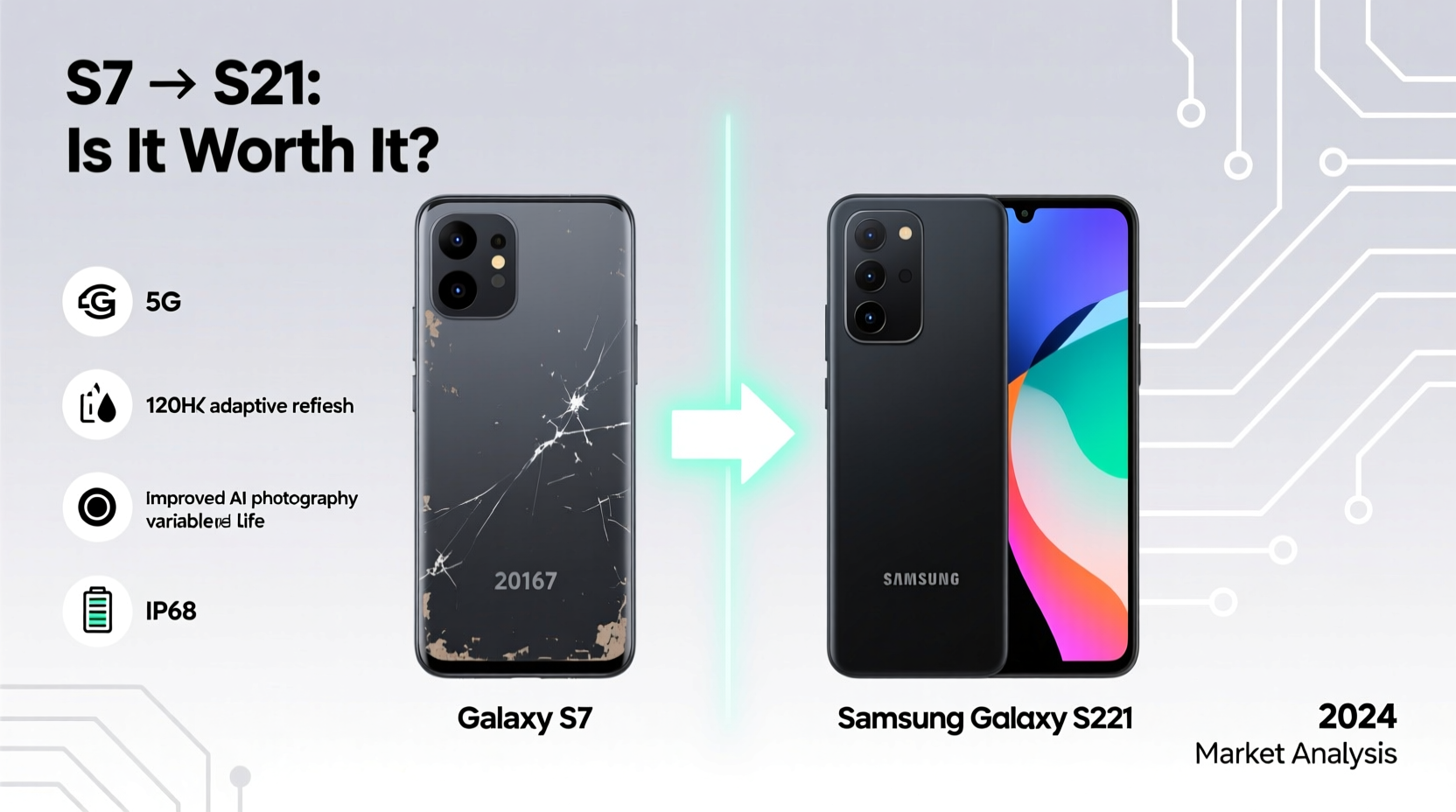
The Galaxy S7 ran on either the Snapdragon 820 or Exynos 8890, depending on region—both solid chips for their era. In contrast, the S21 uses the Snapdragon 888 (or Exynos 2100), a processor that’s not only faster but also far more power-efficient and capable of handling modern multitasking, gaming, and AI-driven apps with ease.
Real-world differences are stark:
- The S21 boots apps up to 3x faster.
- It handles 4K video editing, AR filters, and high-refresh-rate gaming smoothly—tasks that would stutter or fail on the S7.
- Background processes like photo scanning, voice assistants, and cloud syncing happen almost instantly.
But beyond speed, there’s longevity. The S7 stopped receiving major Android updates after 2019 and security patches have long since ended. The S21, while no longer getting major OS upgrades, still receives quarterly security updates as of 2024—critical for protecting your data against emerging threats.
Display and Design: From Good to Exceptional
The S7 featured a 5.1-inch Quad HD Super AMOLED display—a top-tier screen in 2016. The S21, however, ups the ante with a 6.2-inch Dynamic AMOLED 2X panel with a 120Hz refresh rate. Scrolling is noticeably smoother, animations are crisper, and outdoor visibility is vastly improved due to higher peak brightness.
Design-wise, the S21 adopts a minimalist aesthetic with a flush camera module and slimmer bezels. While the S7 had a glass back and metal frame (and IP68 rating), the S21 improves ergonomics with a lighter build and better grip. However, it swaps the beloved microSD card slot and headphone jack—trade-offs that may matter to some users.
“Modern displays aren't just sharper—they're more responsive and easier on the eyes during extended use.” — David Lin, Mobile UX Analyst at TechInsight Group
Camera Comparison: Night Shots, Zoom, and Intelligence
Photography is where the S21 outshines the S7 most dramatically. The S7 had a capable 12MP rear sensor with Dual Pixel autofocus, producing strong low-light shots for its time. The S21, meanwhile, features a triple-camera system:
- 12MP main wide lens (improved low-light via larger pixels)
- 64MP telephoto with 3x hybrid zoom
- 12MP ultra-wide for landscapes and group shots
The difference is evident in real usage:
| Feature | Galaxy S7 | Galaxy S21 |
|---|---|---|
| Low-Light Performance | Good for 2016 | Excellent with Night Mode |
| Zoom Capability | Digital only (blurry beyond 2x) | Up to 30x digital with stabilization |
| Video Recording | 4K at 30fps | 8K at 24fps, 4K at 60fps with HDR10+ |
| AI Enhancements | None | Scene optimizer, single-take mode, AI noise reduction |
A user upgrading from the S7 will notice immediate improvements in dynamic range, color accuracy, and detail retention—especially in challenging lighting. The S21’s AI-powered processing enhances photos automatically, reducing the need for manual editing.
Total Upgrade Value in 2024: Is It Still Relevant?
While the S21 is three years old, it remains a competitive mid-to-high-tier device in 2024. Used models are widely available for $200–$300, making the upgrade financially accessible. At that price point, it offers far more value than similarly priced older flagships or budget new phones.
Consider this real-life scenario:
Mini Case Study: Maria’s Upgrade Journey
Maria held onto her Galaxy S7 for seven years, relying on it for work emails, family photos, and mobile banking. By 2023, she noticed constant app crashes, slow loading times, and inability to install newer versions of WhatsApp and Google Maps. After upgrading to a refurbished S21 for $240, she found:
- Emails loaded instantly instead of lagging.
- Google Photos recognized faces and locations accurately.
- Her kids’ school app, previously incompatible, now worked flawlessly.
- Battery lasted all day despite heavier usage.
“I didn’t realize how much I was missing until I used a modern phone,” she said. “It’s not just faster—it feels secure and future-ready.”
What You Should Consider Before Upgrading
Despite the advantages, the S21 isn’t perfect. Here’s a checklist to evaluate if it’s right for you:
Upgrade Checklist
- ✅ Are you experiencing frequent app crashes or slowdowns on your S7?
- ✅ Do you want better photo quality, especially in low light?
- ✅ Is security important? (S7 no longer receives patches.)
- ✅ Can you live without a headphone jack or microSD expansion?
- ✅ Are you buying the S21 at a fair price (under $300)?
- ✅ Do you plan to keep the phone for 2+ years?
If you answered yes to most of these, the upgrade makes strong sense. However, if you’re deeply attached to expandable storage or wired audio, consider pairing the S21 with wireless earbuds and cloud storage—a small adjustment for massive gains.
Frequently Asked Questions
Can the Galaxy S21 still run modern apps smoothly?
Yes. The S21 handles all mainstream apps—including Instagram, TikTok, Zoom, and mobile games like Genshin Impact—without issue. Even with Android 13 (its final OS), it supports the latest app frameworks and APIs.
Is the battery life better than the S7?
Despite a similar 4000mAh capacity, the S21 lasts significantly longer due to more efficient hardware and software optimization. With moderate use, it easily reaches end-of-day battery, whereas the aging S7 likely needs midday charging.
Should I wait for a newer model instead?
If budget allows, the S23 or S24 offer incremental improvements—but at double the price. For most former S7 users, the S21 delivers 90% of the modern smartphone experience at half the cost.
Final Verdict: Yes, It’s Worth It
Upgrading from a Galaxy S7 to an S21 in 2024 isn’t just about newer tech—it’s about reclaiming reliability, security, and usability. The S7 served millions well, but it’s no longer viable as a primary device in a world driven by fast apps, cloud services, and digital identity.
The S21 bridges the gap between legacy and modernity. It brings high-end features like 5G, advanced cameras, and smooth 120Hz scrolling into an affordable package. For less than the cost of a new pair of premium headphones, you gain years of dependable performance, peace of mind from ongoing security updates, and access to the full ecosystem of modern mobile experiences.




 浙公网安备
33010002000092号
浙公网安备
33010002000092号 浙B2-20120091-4
Comments
No comments yet. Why don't you start the discussion?