
For many long-time Samsung Galaxy S7 owners, the question isn't whether they *can* upgrade—but whether they *should*. The leap from the S7 to the S9 may seem modest on paper, but in daily use, the differences can be transformative. This article dives into real-world experiences, performance benchmarks, camera improvements, and longevity considerations to help you decide if making the switch is truly worthwhile.
Performance: A Noticeable Leap in Speed and Efficiency
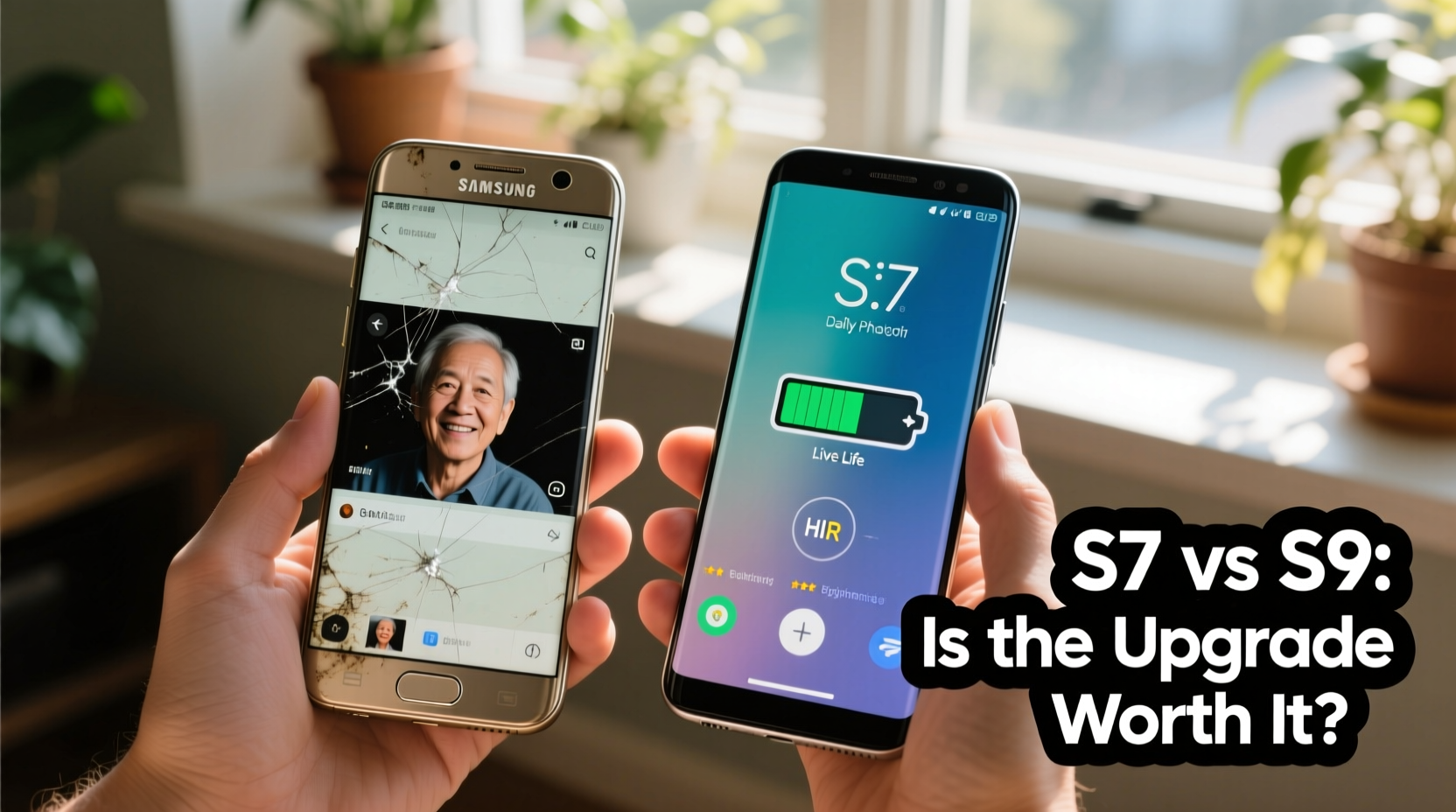
The Galaxy S7, released in 2016, was a powerhouse in its time, featuring either the Exynos 8890 or Snapdragon 820 processor depending on region. By 2018 standards, however, those chips began showing their age. The Galaxy S9, equipped with the Snapdragon 845 (or Exynos 9810), brought significant upgrades in CPU and GPU performance—roughly 25–30% faster in multitasking and gaming workloads.
Users who upgraded consistently reported smoother app launches, quicker transitions between screens, and noticeably better performance when running memory-intensive apps like photo editors or video streaming platforms at high resolution.
Camera Improvements That Deliver in Real Use
One of the most compelling reasons users cited for upgrading was the camera. While the S7 already had a solid 12MP rear sensor with Dual Pixel autofocus, the S9 introduced variable aperture technology—f/1.5 and f/2.4—allowing better low-light photography without overexposing bright scenes.
In practical terms, S7 users upgrading to the S9 noticed dramatic improvements in night shots. Indoor photos taken in dim lighting were sharper, with less noise and more accurate color reproduction. The S9’s improved image processing also reduced shutter lag, making it easier to capture fast-moving subjects.
“After switching from my S7 to S9, I stopped carrying a compact camera. The low-light performance alone made the upgrade worth it.” — Daniel M., photography enthusiast and mobile content creator
The front-facing camera also saw an upgrade, moving from 5MP on the S7 to 8MP on the S9, with better face detection and beautification algorithms. For users who frequently take selfies or use video calling, this change was immediately apparent.
Display and Design: Subtle but Meaningful Refinements
Both phones feature 5.8-inch Quad HD Super AMOLED displays, so pixel density and color accuracy remain excellent on both. However, the S9’s screen is slightly brighter—up to 1000 nits peak brightness compared to the S7’s 600–700 nits. This makes outdoor visibility significantly better, especially under direct sunlight.
Design-wise, the S9 adopted a more refined aesthetic. The curved glass back feels more ergonomic, and the speaker grille below the display was replaced with stereo speakers tuned by AKG—a first for Samsung flagships. Users noted richer audio quality during media playback and clearer speakerphone calls.
| Feature | Samsung Galaxy S7 | Samsung Galaxy S9 |
|---|---|---|
| Processor | Snapdragon 820 / Exynos 8890 | Snapdragon 845 / Exynos 9810 |
| Rear Camera | 12MP f/1.7, Dual Pixel AF | 12MP f/1.5–f/2.4, Dual Aperture |
| Front Camera | 5MP f/1.7 | 8MP f/1.7 |
| Display Brightness | ~600–700 nits | Up to 1000 nits |
| Speakers | Single bottom-firing | Stereo, AKG-tuned |
| Water Resistance | IP68 | IP68 |
| Battery Capacity | 3000 mAh | 3000 mAh |
| Android Support | Ended after Android 8.0 | Extended to Android 10 + security updates |
User Experience Over Time: Longevity and Software Support
Perhaps the most underrated factor in the upgrade decision is software support. The S7 received major OS updates up to Android 8.0 Oreo, with final security patches ending in 2019. In contrast, the S9 launched with Android 8.0 but was updated to Android 10, with monthly security patches continuing into 2021.
This extended support means S9 users could safely use modern banking apps, messaging platforms, and productivity tools longer than S7 owners. Several users reported that after 2020, their S7 devices struggled to run newer versions of Google Play Services or even basic apps like Gmail due to compatibility issues.
Battery degradation is another critical point. After three to four years of use, many S7 batteries had degraded to 70–80% capacity. While the S9 has the same 3000 mAh battery, its more efficient processor and optimized software meant better real-world battery life—even with aging hardware.
Mini Case Study: Maria’s Upgrade Journey
Maria had used her Galaxy S7 since launch day in March 2016. By early 2019, she noticed frequent app crashes, slow boot times, and difficulty uploading photos due to sluggish gallery performance. She hesitated to upgrade, thinking “it still turns on,” but decided to test an S9 at a local store.
Within minutes of using the demo unit, she felt the difference: apps opened instantly, videos played smoothly, and the camera focused in near-darkness. She purchased the S9 the same day. Six months later, she reported that her daily frustration with her phone had vanished. “It’s not just faster—it feels like a new category of device,” she said.
Checklist: Is It Time to Upgrade from S7 to S9?
Use this checklist to evaluate your current situation:
- ✅ Do apps frequently freeze or crash?
- ✅ Is charging speed slower than before?
- ✅ Have you stopped receiving system or security updates?
- ✅ Is the camera struggling in low light?
- ✅ Do newer apps fail to install or run poorly?
- ✅ Are you relying on third-party launchers or lightweight apps to keep the phone usable?
If you answered yes to three or more of these, upgrading to the S9—or a similar modern mid-range device—will likely improve your experience significantly.
Frequently Asked Questions
Can the Galaxy S7 still be used in 2024?
Technically, yes—but with major limitations. Without security updates or app support, using the S7 for online banking, social media, or email poses risks. Basic calling and texting are still functional, but overall usability is severely hampered.
Is the S9 still supported today?
No. Official software support for the S9 ended in 2021. However, it runs Android 10 reliably and remains compatible with most current apps as of 2024. Custom ROMs like LineageOS extend its life further for tech-savvy users.
Was the price jump from S7 to S9 justified?
At launch, the S9 retailed for around $720, while the S7 started at $650. For most users, the $70 difference was justified by tangible gains in camera quality, audio, display brightness, and future-proofing through longer software support.
Conclusion: Making the Smart Move
Upgrading from the Galaxy S7 to the S9 isn’t about chasing the latest trend—it’s about reclaiming reliability, speed, and security in your daily digital life. Real users consistently report that the upgrade felt like stepping into a new generation of smartphones, even though the design changes were subtle.
If you’re clinging to an aging S7 out of loyalty or hesitation, consider how much time you lose each day waiting for apps to load or photos to save. That time adds up. The S9, even today, offers a smoother, safer, and more enjoyable experience.




 浙公网安备
33010002000092号
浙公网安备
33010002000092号 浙B2-20120091-4
Comments
No comments yet. Why don't you start the discussion?