
In 2025, 5G networks are no longer a futuristic promise—they’re a mainstream reality. Carriers have expanded coverage, device support is nearly universal, and marketing campaigns continue to push 5G as the essential upgrade. But for the average smartphone user—someone who streams music, checks email, browses social media, and occasionally watches videos—the question remains: is switching to or staying on 5G actually worth it? The answer isn’t a simple yes or no. It depends on where you live, how you use your phone, and what you're willing to pay for marginal improvements.
This article examines the state of 5G in 2025 through real-world performance, cost implications, battery trade-offs, and future-proofing considerations. By the end, you’ll have a clear picture of whether upgrading—or maintaining—a 5G plan makes sense for your lifestyle.
Understanding 5G: What’s Changed Since 2020
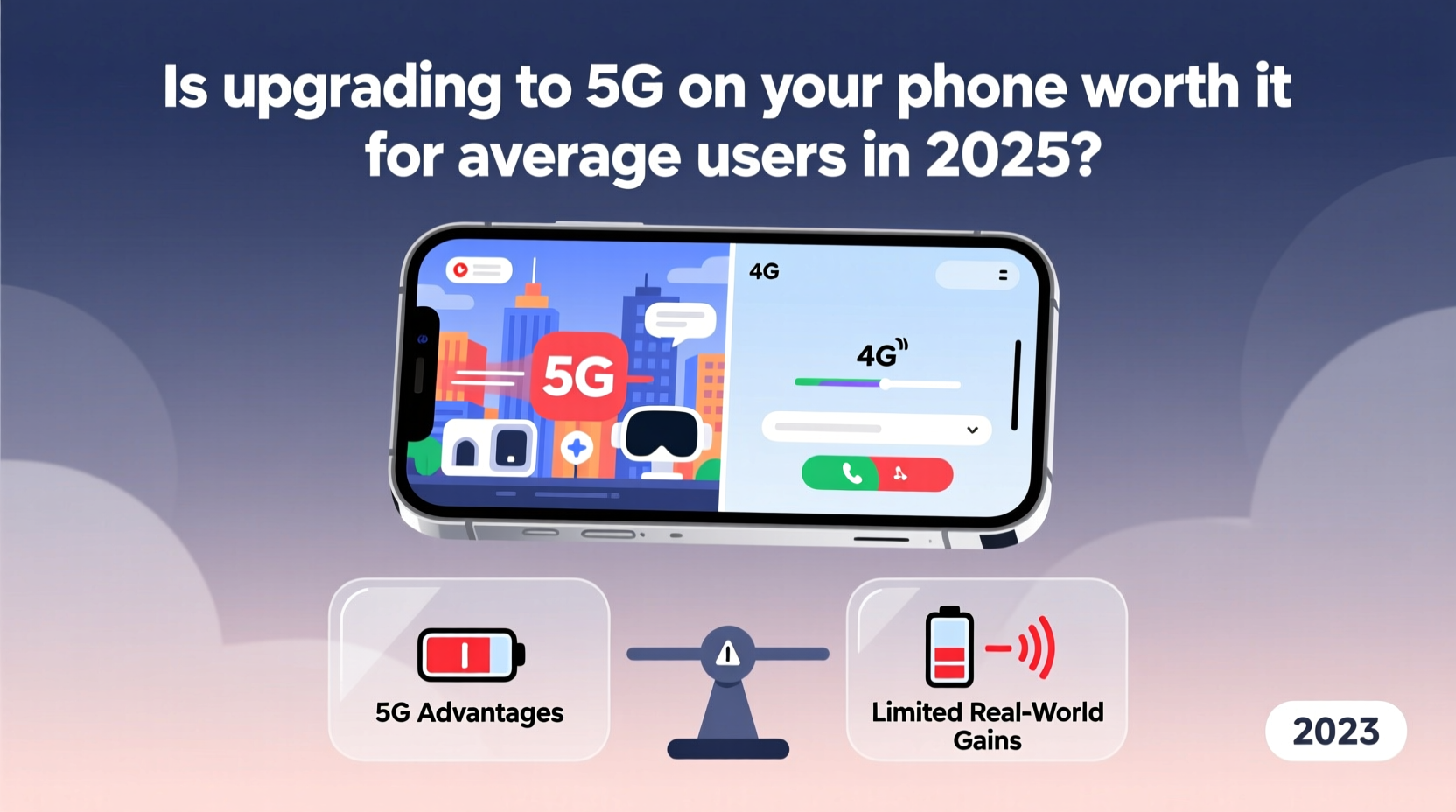
When 5G launched, it was marketed as a revolutionary leap over 4G LTE. Promises included download speeds up to 100 times faster, near-zero latency, and seamless streaming. In practice, early adoption was rocky. Coverage was spotty, mmWave signals were easily blocked by walls, and many phones struggled with battery drain due to inefficient modems.
By 2025, the landscape has matured significantly. Most carriers now rely on a mix of frequency bands:
- Low-band 5G: Offers wide coverage and better wall penetration but speeds often match or only slightly exceed 4G LTE (50–150 Mbps).
- Mid-band 5G (C-band): Delivers a balance of speed and coverage, averaging 150–500 Mbps—ideal for urban and suburban areas.
- mmWave (high-band): Provides gigabit-level speeds (>1 Gbps) but only in dense city centers and specific venues like stadiums. Easily disrupted by obstacles.
According to data from OpenSignal’s 2025 Mobile Network Experience Report, mid-band 5G now covers over 65% of major metropolitan areas in the U.S., while low-band reaches over 90% of the population. However, real-world speeds vary dramatically based on location and network congestion.
“5G today is more reliable than ever, but its benefits are still unevenly distributed. For most users, the gains are incremental rather than transformative.” — Dr. Lena Patel, Senior Analyst at TechConnect Research
Real-World Benefits for Average Users
For power users—gamers, remote workers with large file needs, or those uploading 4K video daily—5G can offer tangible advantages. But the average user’s digital habits don’t always require such bandwidth. Let’s examine common activities and whether 5G meaningfully improves them:
| Activity | 4G LTE Performance | 5G Performance | Perceived Benefit |
|---|---|---|---|
| Streaming HD Video | Smooth at 5–8 Mbps | No noticeable improvement | Minimal |
| Downloading Apps/Updates | 3–5 minutes for 1GB | Under 1 minute with mid-band | Moderate |
| Video Calls (Zoom, FaceTime) | Stable at 3 Mbps | Slightly more stable, less buffering | Minor |
| Online Gaming | Lag spikes possible | Lower latency (10–20ms vs. 30–50ms) | Noticeable |
| Cloud Backups | Slow for large photo libraries | Faster upload times | Useful |
The table shows that while 5G improves download and upload speeds, most everyday tasks don’t bottleneck on current 4G performance. If your primary uses are social media, messaging, and occasional streaming, the difference may be imperceptible. However, if you frequently transfer large files, work remotely with cloud tools, or dislike waiting for app updates, 5G offers measurable convenience.
Battery Life and Device Efficiency
One of the biggest concerns with early 5G phones was battery drain. Constantly searching for 5G signals—even when unnecessary—led to 10–20% shorter battery life compared to 4G-only usage.
By 2025, modem efficiency has improved significantly. Modern chipsets like Qualcomm’s Snapdragon X75 and Apple’s custom 5G modems include adaptive technologies that dynamically switch between 5G and LTE based on signal strength and task demand. This means your phone isn’t always “on” 5G, helping preserve battery.
Still, real-world testing by Consumer Reports found that phones using 5G continuously last about 1.5 hours less per day than those on LTE alone. For users with long commutes or limited charging access, this could be a meaningful drawback.
Cost Implications: Is 5G Priced Fairly?
Most carriers now include 5G access in their standard plans, but premium tiers often charge extra for “Ultra Wideband” or “DSS+” access. Here’s a breakdown of major U.S. carriers’ 2025 offerings:
| Carrier | Base Plan (with 5G) | Premium Tier (Enhanced 5G) | Price Difference |
|---|---|---|---|
| Verizon | $70/month (Start Unlimited) | $90/month (Ultimate) | $20/month |
| AT&T | $75/month (Unlimited Extra) | $95/month (Premium) | $20/month |
| T-Mobile | $60/month (Go5G Next) | $85/month (Go5G Pro) | $25/month |
That’s an additional $240–$300 per year for enhanced 5G features. For most users, this premium buys access to mmWave and priority network lanes during congestion—but only if you’re in an area that supports it. If you’re mostly on Wi-Fi or in rural zones, the added cost delivers little return.
“We’ve seen a trend toward ‘5G inflation’—where carriers bundle fast networks with other perks to justify higher prices. Consumers need to ask: am I paying for speed I can’t use?” — Mark Tran, Telecom Policy Advisor at NetEquity Initiative
Mini Case Study: Sarah’s Upgrade Dilemma
Sarah, a 34-year-old teacher in Columbus, Ohio, upgraded her iPhone 12 to an iPhone 15 in early 2025. Her old plan used AT&T’s 4G network, and she paid $65/month. The sales rep encouraged her to switch to the $85/month Premium plan for “faster 5G.”
At first, she noticed quicker app downloads and smoother video calls with her parents. But after a few weeks, she realized most of her internet use happened on school Wi-Fi or at home. Her apartment building had weak mmWave penetration, so she rarely accessed the fastest 5G tier. After tracking her data usage, she found only 18% of her monthly 15GB was consumed outside Wi-Fi—and even then, mid-band speeds averaged just 120 Mbps, not the promised gigabit rates.
She downgraded back to the mid-tier plan, saving $240 annually without losing functionality. Her experience reflects a growing trend: many users overpay for 5G capabilities they don’t fully utilize.
Step-by-Step Guide: Should You Upgrade to 5G in 2025?
Before deciding, follow this practical checklist to assess your needs:
- Evaluate Your Current Usage: Check your phone’s data settings to see how much you use monthly and whether you regularly exceed 10–15GB.
- Test Your Location: Use apps like Speedtest or Carrier Benchmark to measure actual 5G speeds at home, work, and commute routes.
- Review Your Carrier Plan: Determine if 5G is included or requires a premium. Ask if you’re getting mmWave or just low/mid-band.
- Assess Battery Needs: If you struggle with all-day battery, test 5G impact by enabling it for one day and monitoring drain.
- Consider Future Use: Will you start working remotely, streaming more, or using AR/VR apps? These may benefit from 5G later.
- Compare Alternatives: Could a Wi-Fi 6 router or hotspot meet your speed needs more affordably?
- Make a Decision: Upgrade only if the benefits outweigh cost and battery trade-offs.
Checklist: Is 5G Right for You?
Answer these questions to determine if 5G is worth it:
- ✅ Do you live or work in a city with strong mid-band or mmWave coverage?
- ✅ Do you regularly download large files or stream 4K content on mobile?
- ✅ Are you frustrated by slow app updates or cloud backups?
- ✅ Can your budget handle a $20–$25 monthly increase?
- ❌ Do you spend most of your time on Wi-Fi?
- ❌ Is battery life a top concern?
- ❌ Do you live in a rural area with limited 5G infrastructure?
If you answered “yes” to most of the top three and “no” to the bottom three, 5G likely adds value. Otherwise, sticking with 4G or basic 5G may be smarter.
FAQ
Will 4G be phased out soon?
No. Major carriers have committed to supporting 4G LTE through at least 2030. Even as 5G expands, 4G will remain the fallback network for years, especially in rural areas.
Can I turn off 5G to save battery?
Yes. All modern smartphones allow you to limit network mode to LTE or 4G. On iPhones, go to Settings > Cellular > Cellular Data Options > Voice & Data and select LTE. On Android, navigate to Network Settings and choose “LTE” or “Preferred network type.”
Does 5G improve call quality?
Only indirectly. 5G enables VoNR (Voice over New Radio), which can offer clearer calls with less background noise. However, most carriers still rely on VoLTE (4G voice), so the difference is minimal for now.
Conclusion: A Calculated Upgrade, Not a Mandatory One
In 2025, 5G is no longer a gamble—it’s a functional, widely available technology. But widespread availability doesn’t mean universal necessity. For average users, the decision to upgrade should be based on real usage patterns, not marketing hype.
If you’re in a well-covered urban area, frequently use data-intensive apps, and can absorb the extra cost, 5G offers legitimate convenience. But if you’re mostly on Wi-Fi, live in a coverage gap, or prioritize battery life, holding back on full 5G adoption is not only reasonable—it’s financially and practically sound.
Technology should serve your life, not dictate it. Before upgrading, measure your needs against the actual benefits. In many cases, 4G LTE remains more than enough for the way most people use their phones today.




 浙公网安备
33010002000092号
浙公网安备
33010002000092号 浙B2-20120091-4
Comments
No comments yet. Why don't you start the discussion?