
Foldable phones have moved from futuristic prototypes to mainstream shelves in under five years. Samsung, Google, and Motorola now offer compelling models with refined designs, improved durability, and software that adapts to folding screens. Yet, despite their growing presence, many consumers remain skeptical: Is investing in a foldable phone truly practical, or is it still more of a tech flex than a functional upgrade?
The answer isn’t binary. For some users, a foldable offers transformative multitasking and portability. For others, it’s an overpriced novelty with trade-offs in battery life, camera quality, and long-term reliability. To help you decide whether this technology fits your lifestyle, we’ll examine its current state—balancing innovation against real-world usability.
The Evolution of Foldable Phones: From Novelty to Near-Maturity
When Samsung unveiled the Galaxy Fold in 2019, it was met with both excitement and skepticism. Early units failed within days due to screen creases, dust ingress, and fragile hinges. Critics dismissed the device as a prototype sold too soon. But behind the scenes, engineers were solving core issues: improving hinge mechanisms, strengthening ultra-thin glass, and developing water-resistant seals.
By 2023, the third-generation Samsung Galaxy Z Fold and Flip models had achieved remarkable durability. The latest devices feature IPX8 water resistance, Gorilla Glass Victus on outer displays, and redesigned hinges that minimize the \"dust problem\" that plagued earlier versions. Google’s Pixel Fold brought tighter software integration with Android, while Motorola’s Razr+ offered a near-seamless crease and nostalgic flip design.
According to Carolina Milanesi, tech analyst at Creative Strategies, “Foldables are no longer science experiments. They’ve crossed into viable consumer products—but they’re still niche because of cost and compromises.”
“Foldables are no longer science experiments. They’ve crossed into viable consumer products—but they’re still niche because of cost and compromises.” — Carolina Milanesi, Tech Analyst, Creative Strategies
Practical Advantages: Where Foldables Shine
Despite higher prices and lingering concerns, foldable phones deliver unique benefits that traditional slabs can’t match:
- Enhanced multitasking: With screen real estate approaching small tablets, foldables allow true split-screen workflows. You can browse, reply to emails, and watch video tutorials simultaneously.
- Better portability (flip models): Devices like the Galaxy Z Flip6 or Razr+ fold vertically, slipping easily into pockets while offering a full-sized display when opened.
- Flexible form factors: Some users appreciate the ability to prop the phone in tent mode for hands-free video calls or cooking recipes.
- Innovative UX features: Apps like Samsung Notes or Google Keep auto-adjust when folding/unfolding, creating fluid transitions between modes.
Real-World Example: A Digital Marketer’s Workflow
Take Sarah, a freelance digital marketer based in Austin. She upgraded from a Pixel 7 Pro to the Samsung Galaxy Z Fold5 for client work. Her typical day involves managing social media calendars, editing copy, and joining Zoom calls. On her old phone, switching between apps disrupted focus. With the Fold, she runs Trello on one side, Google Docs on the other, and keeps Slack open in a pop-up window. “It’s not quite a laptop,” she says, “but it cuts my tablet dependency by 70%.”
For professionals who juggle multiple apps or travel frequently, the foldable’s hybrid nature bridges the gap between smartphone convenience and productivity tools.
The Hidden Trade-Offs: Why Foldables Aren’t for Everyone
Despite progress, foldables come with compromises that may outweigh their benefits for average users.
Battery Life and Hardware Constraints
To accommodate the folding mechanism, manufacturers split the battery across two compartments. This reduces total capacity compared to flagship smartphones. Most foldables last a full day under moderate use but struggle under heavy multitasking or gaming.
Additionally, cameras often lag behind standard flagships. Due to space constraints in the hinge area, lens modules are smaller. While Samsung has narrowed the gap, the Pixel 8 Pro or iPhone 15 Pro still outperform most foldables in low-light photography.
Durability Concerns and Repair Costs
Even with improved build quality, foldables remain more vulnerable than rigid phones. The crease in the display, though less noticeable, is still a structural weak point. Dropping a foldable on its edge can damage the hinge or inner screen—a repair that often costs $300–$600, sometimes exceeding half the phone’s value.
Third-party insurance options are limited, and manufacturer warranties typically don’t cover accidental damage. This makes protection a critical consideration.
Premium Pricing Without Premium Value for All
Foldables start around $999 (Motorola Razr+) and go up to $1,799 (Samsung Galaxy Z Fold5). At those prices, buyers expect flawless performance. But for someone who primarily uses social media, streaming, and messaging, the added functionality may feel underutilized.
As one Reddit user put it: “I loved showing off my Fold, but after six months, I realized I only unfolded it 20% of the time. I switched back to my iPhone—it just worked better for how I actually use my phone.”
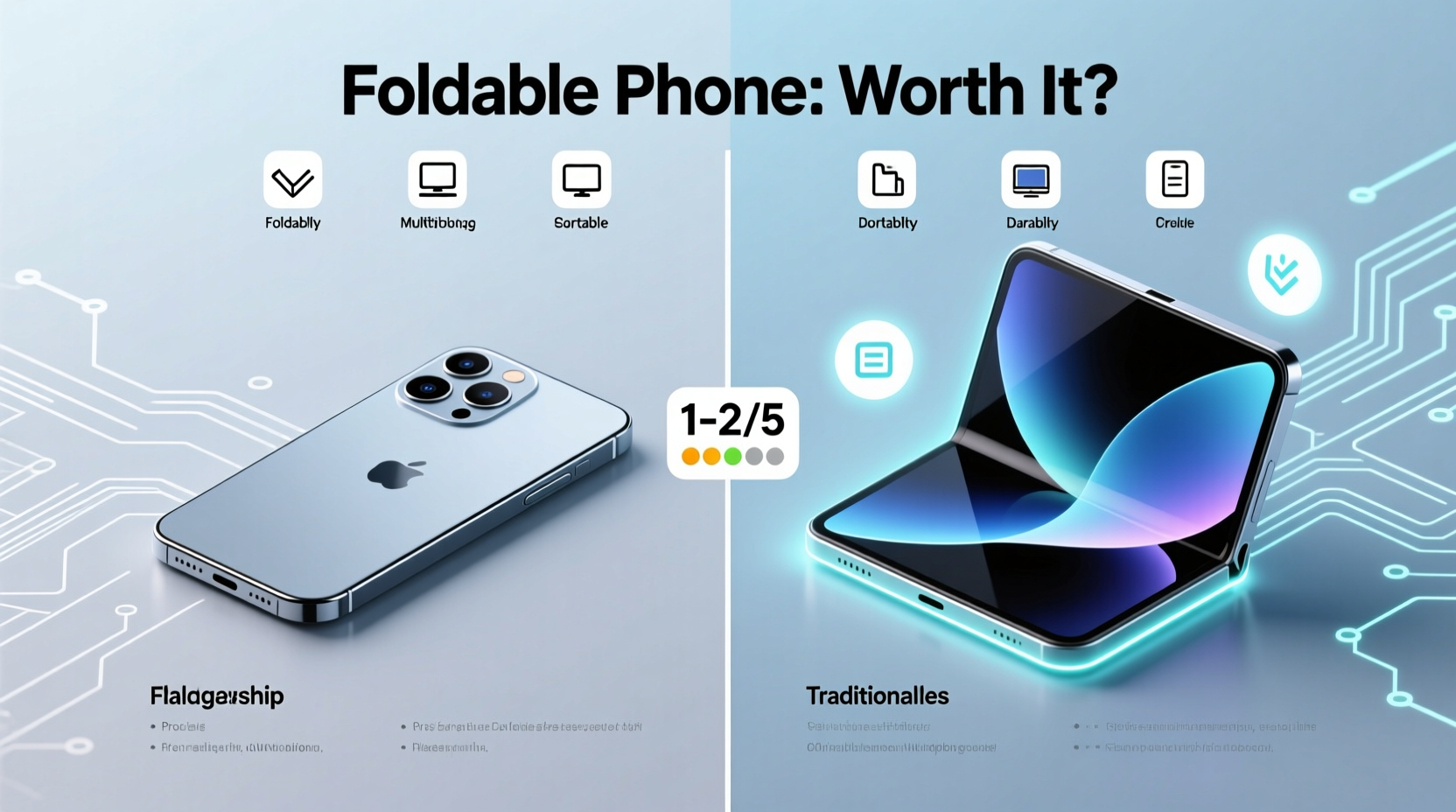
Comparison Table: Foldable vs. Traditional Flagship (2024)
| Feature | Foldable (e.g., Galaxy Z Fold5) | Traditional Flagship (e.g., iPhone 15 Pro) |
|---|---|---|
| Starting Price | $1,799 | $999 |
| Battery Life (typical use) | 10–12 hours | 14–16 hours |
| Main Camera Quality | Very Good | Excellent |
| Durability (drop risk) | Moderate (hinge/crease vulnerability) | High (solid frame) |
| Repair Cost (screen) | $450–$600 | $279–$399 |
| Multitasking Capability | Excellent (multi-active windows) | Limited (split-screen restrictions) |
| Pocketability | Folded: Good / Open: Bulky | Consistently Compact |
Who Should Upgrade—and Who Should Wait
The decision to adopt a foldable shouldn’t be driven by hype, but by how closely the device aligns with your daily habits.
Upgrade If You:
- Regularly use multiple apps at once (e.g., email + calendar + browser).
- Travel often and want a single device that replaces a phone and mini-tablet.
- Value compactness in a flip design (Z Flip, Razr+) for easy pocket carry.
- Work in creative fields where screen space helps with editing or design previews.
Wait If You:
- Primarily consume content (streaming, scrolling, gaming).
- Are sensitive to price and want the best value per dollar.
- Have a history of dropping phones or dislike using cases.
- Prefer long battery life without needing midday charging.
Action Checklist: Evaluating a Foldable Purchase
Before committing, walk through this checklist:
- Assess your usage patterns: Do you multitask heavily or mostly use one app at a time?
- Test the weight and feel: Foldables are heavier and unevenly balanced when open.
- Check software optimization: Are your frequently used apps compatible with large screens?
- Factor in protection: Budget for a case and consider extended warranty or insurance.
- Compare total cost of ownership: Include potential repair costs over 2–3 years.
- Review return policies: Ensure you can return the device if the form factor doesn’t suit you.
What the Future Holds: Beyond the Gimmick Phase
Foldables are transitioning from experimental gadgets to mature tools. Industry trends suggest continued refinement:
- Thinner creases: Samsung and BOE are developing “zero-gap” hinges that eliminate visible folds.
- Better batteries: Solid-state and dual-cell advancements could extend life without adding bulk.
- Lower prices: As production scales, analysts predict sub-$800 foldables by 2026.
- New form factors: Rollable displays (like Oppo’s concept phones) may offer screen expansion without folding.
Apple’s potential entry into the foldable market could accelerate adoption. While rumors remain unconfirmed, a well-integrated iOS foldable could push the category into the mainstream.
FAQ: Common Questions About Foldable Phones
Can you feel the crease when swiping across the screen?
Yes, there’s a slight tactile bump, but it’s far less pronounced than in early models. Most users report getting used to it within a few days. It doesn’t interfere with typing or scrolling.
Do foldable phones last as long as regular smartphones?
Manufacturers now rate hinges for 200,000 folds—equivalent to five years of average use. However, long-term reliability data is still limited. Real-world longevity depends heavily on handling, exposure to dust, and use of protective cases.
Are apps optimized for foldable screens?
Major apps like Gmail, YouTube, Microsoft Office, and Instagram support multi-window and adaptive layouts. However, smaller developers often haven’t updated their apps, leading to stretched or poorly formatted displays on the inner screen.
Final Verdict: Worth It for Some, Not a Must-Have for All
Foldable phones are past the gimmick phase—but they’re not yet universal upgrades. For power users, mobile professionals, and tech enthusiasts who value versatility, the investment can pay off in productivity and convenience. The ability to replace a phone and tablet with one device is no longer science fiction.
However, for the average user, the drawbacks—higher cost, shorter battery life, delicate hardware—often outweigh the benefits. If your phone use revolves around communication, media, and light browsing, a traditional flagship delivers better value and peace of mind.
The key is honest self-assessment. Don’t buy a foldable because it’s new. Buy it because it solves a real problem in your digital life.




 浙公网安备
33010002000092号
浙公网安备
33010002000092号 浙B2-20120091-4
Comments
No comments yet. Why don't you start the discussion?