
Every holiday season, millions of homes glow with strings of lights—icicle strands on eaves, net lights on shrubs, C7 bulbs outlining windows, and LED mini-lights weaving through mantels and stair rails. To power them all, many reach for the familiar black plastic power strip: a convenient, affordable, seemingly harmless solution. But behind that convenience lies a quiet, escalating risk. According to the U.S. Consumer Product Safety Commission (CPSC), decorative lighting accounts for an average of 700 home fires annually—and over 60% of those involve improper use of extension cords or power strips. What most people don’t realize is that a standard 15-amp power strip isn’t designed to handle the cumulative draw of five, eight, or twelve light strands—even if they’re labeled “LED.” Voltage drop, heat buildup, internal wiring degradation, and counterfeit certifications turn routine decoration into a latent ignition source. This isn’t theoretical. It’s measurable, preventable, and urgent.
Why Power Strips Were Never Meant for Light-String Stacking
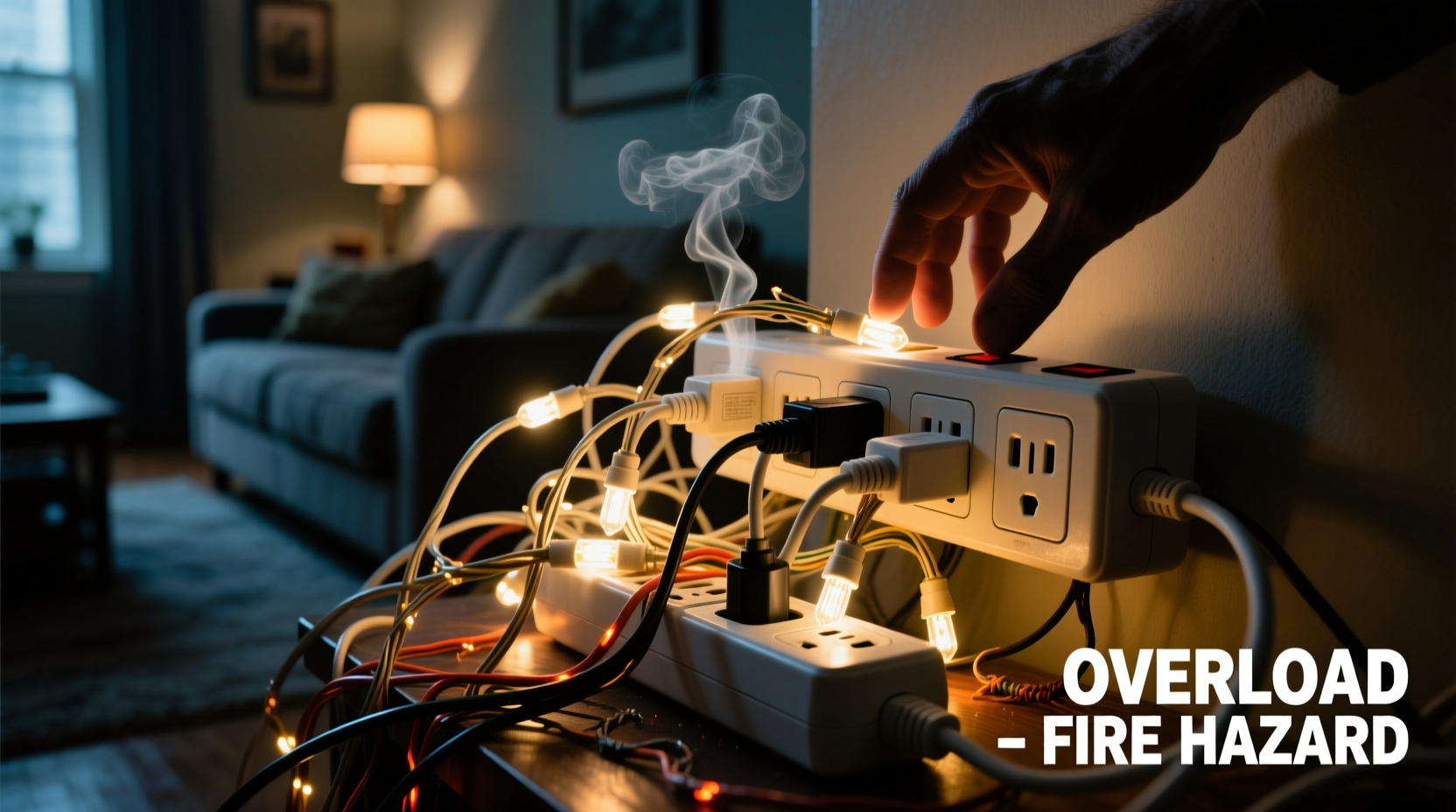
Power strips are engineered for low-duty-cycle, intermittent-use devices: desktop computers, monitors, printers, and phone chargers. Their internal copper bus bars, thermal cutoffs, and circuitry assume brief surges—not sustained 8–12 hour daily loads across dozens of outlets. When you plug three 50-foot LED light strands into one strip, you’re not just adding outlets—you’re concentrating resistive load in a compact enclosure where heat has nowhere to dissipate. Unlike a properly rated outdoor-rated extension cord with 14-gauge wire and robust insulation, most indoor power strips use 16- or 18-gauge internal conductors. Under continuous load, those thin wires heat up. That heat softens PVC housing, degrades solder joints, and accelerates oxidation at plug contacts—raising resistance further, creating a feedback loop toward thermal runaway.
The problem worsens with age. A 2022 NFPA analysis found that power strips older than four years showed a 3.7× higher failure rate under sustained load than new units—yet 68% of households reuse the same strip for five or more seasons. And while LED lights draw less than incandescents, their driver circuits introduce harmonic distortion and inrush current spikes—especially during startup—that cheap surge protectors don’t filter. That stress compounds over time, silently compromising integrity long before visible melting occurs.
How to Calculate Real Load—Not Just “It Says LED”
Manufacturers often list only “watts per 100 ft” or “max string length”—but those figures assume ideal lab conditions, not your attic’s 90°F summer storage or your porch’s -5°F winter operation. Actual wattage depends on ambient temperature, voltage consistency, and driver efficiency. Here’s how to calculate true load:
- Find the label on each light strand. Look for “W,” “VA,” or “A” (amps)—not just “LED.” If only volts and amps appear (e.g., “120V ~ 0.04A”), multiply: 120 × 0.04 = 4.8 watts.
- Add all strands’ wattages. Don’t assume “low-power” means negligible. Ten 4.8W strands = 48W—but that’s just the steady state. Add 20% for inrush and driver inefficiency: 57.6W.
- Convert to amps at 120V: Amps = Watts ÷ Volts → 57.6 ÷ 120 = 0.48A. Sounds safe? Yes—until you factor in the strip’s rating.
- Check the power strip’s amp rating. Most basic strips are rated for 15A continuous—but that’s for *all outlets combined*. UL 1363 requires derating to 80% for continuous loads (>3 hours). So 15A × 0.8 = 12A max continuous. That’s 1,440W at 120V.
Here’s where assumptions collapse. A single 50-foot incandescent C9 strand draws ~175W (1.46A). Four of those = 5.84A—still under 12A. But add a 200W projector, a 30W speaker system, and a 60W LED tree light base, and you’ve hit 7.7A. Now throw in a space heater “just for 10 minutes” (1,500W = 12.5A)—and the thermal cutoff fails before the breaker trips. That’s how fires start: not from one overloaded device, but from layered, normalized overuse.
Safety-Critical Checklist: Before You Plug In Any Strand
Follow this verified checklist every single time—no exceptions, no “just this once.” It takes 90 seconds and prevents catastrophic failure.
- ✅ Verify UL/ETL Listing: Look for the full mark—“UL 1363” or “ETL Listed” with file number—not just “UL Recognized” or “Meets UL Standards.” Counterfeit labels are rampant; verify online via UL’s Product iQ database.
- ✅ Confirm Outdoor Rating: Indoor strips lack moisture-resistant housings and UV-stabilized plastics. Even covered porches experience condensation. Use only strips explicitly rated “Outdoor Use” or “Wet Location” (look for IP66 or NEMA 3R).
- ✅ Inspect Every Plug & Housing: No discoloration, warping, or brittle plastic. No loose prongs or warm-to-touch outlets after 10 minutes of operation. Replace immediately if any issue appears—even if it “still works.”
- ✅ Measure Cord Length & Gauge: Input cord must be ≥6 feet and 14-gauge (or thicker) for loads >1,000W. Avoid coiled cords—they trap heat. Unspool fully during use.
- ✅ Test Ground Fault Protection: Press the “TEST” button monthly. It should cut power instantly. If it doesn’t trip—or the “RESET” button won’t engage—the unit is compromised and must be discarded.
Real-World Failure: The Portland Porch Fire (2023)
In December 2023, a two-story craftsman in Portland, Oregon, suffered $220,000 in fire damage. Investigators found no faulty bulbs or damaged wiring in the light strands themselves. Instead, the origin was traced to a $12 power strip mounted beneath the front porch eave—out of sight, out of mind. The homeowner had used it for four consecutive seasons: three LED net lights (total 42W), one animated reindeer (65W), and a programmable controller (18W). On Christmas Eve, ambient temps dropped to 28°F. Condensation formed inside the non-rated strip’s housing. Overnight, micro-corrosion increased contact resistance at one outlet. By noon, that outlet reached 187°F—well above the 140°F threshold where PVC insulation begins auto-igniting. The fire started silently in the strip’s housing, then spread upward through dry cedar shingles.
What made this avoidable? The strip lacked outdoor certification. Its ground-fault protection hadn’t been tested since installation. And critically—it was mounted directly against wood framing, with zero airflow. Fire Marshal Lena Torres stated in her report: “This wasn’t an equipment defect. It was a cascade of normal, everyday decisions that ignored cumulative risk. Every element worked as designed—until the environment changed, and the design limits were exceeded.”
“The biggest misconception is that ‘if it’s not smoking, it’s safe.’ Thermal degradation is invisible until it’s irreversible. A power strip operating at 90% capacity for 10 hours generates 3–4x more internal heat than one at 50%. That heat doesn’t vanish—it migrates, oxidizes contacts, and lowers the ignition threshold of surrounding materials.” — Dr. Arjun Mehta, Electrical Safety Engineer, National Fire Protection Association
Do’s and Don’ts: Power Strip Use for Holiday Lighting
| Action | Do | Don’t |
|---|---|---|
| Load Management | Use no more than 80% of the strip’s rated amperage for continuous lighting loads. For a 15A strip, cap at 12A (1,440W). | Assume “LED = safe to overload.” Some commercial LED displays draw 500W+ per 100 ft due to high-density chips and active cooling fans. |
| Placement | Mount vertically in open air, 6+ inches from combustibles. Use metal mounting brackets—not tape or staples. | Hide strips behind drapes, under furniture, or inside insulated walls. Enclosure traps heat and blocks ventilation. |
| Maintenance | Replace strips every 3 years, even if unused. UV exposure and thermal cycling degrade internal components silently. | Reuse strips with cracked housings, discolored outlets, or inconsistent “click” when plugging in. |
| Monitoring | Install a plug-in energy monitor (e.g., Kill A Watt) to track real-time amps and detect creeping load increases. | Rely solely on circuit breakers. Breakers protect wiring—not power strips. A strip can ignite before the 15A breaker trips. |
| Alternative Solutions | Use dedicated GFCI-protected outdoor outlets. For complex displays, install a weatherproof junction box with individual 15A circuits per zone. | Plug multiple strips into one outlet via a “power cube” adapter. These lack thermal protection and exceed outlet contact ratings. |
FAQ: Critical Questions Answered
Can I plug a light strand into a power strip *if* it’s the only thing plugged in?
Yes—but only if the strip is UL 1363-listed, outdoor-rated (if used outside), and the strand’s total wattage stays below 1,440W. Still, avoid this as a long-term practice. Power strips aren’t optimized for constant resistive loads like lighting; dedicated outlets or properly sized extension cords are safer and more reliable.
Are “smart” power strips with timers and apps safer?
Not inherently. While remote shutoff adds convenience, most smart strips use the same internal wiring and thermal management as basic models. Their Wi-Fi modules add another heat source and potential point of failure. Prioritize physical safety specs (gauge, rating, certification) over connectivity features.
My power strip feels warm—is that normal?
No. Slight warmth near the input cord is acceptable under heavy load, but any warmth at the outlets, housing, or plug body indicates dangerous resistance buildup. Unplug immediately, inspect for damage, and replace the unit. Do not resume use.
Conclusion: Safety Isn’t Convenience—It’s Calculated Intention
Decorative lighting transforms spaces, lifts spirits, and connects us to tradition. But that magic shouldn’t come at the cost of safety—especially when the risks are so preventable. Using a power strip for multiple light strands isn’t inherently unsafe. It becomes hazardous only when we ignore physics, skip verification, and treat electrical infrastructure as disposable convenience rather than critical life-safety systems. The difference between a joyful, glowing December and a devastating loss isn’t luck—it’s whether you checked the UL listing, measured the actual load, ensured airflow, and replaced aging equipment before it failed. Start tonight: unplug every light strand, inspect each power strip with the checklist, verify certifications online, and commit to replacing any unit older than three years. Your home, your family, and your peace of mind depend on these small, deliberate acts—not on hope.




 浙公网安备
33010002000092号
浙公网安备
33010002000092号 浙B2-20120091-4
Comments
No comments yet. Why don't you start the discussion?