
Sedentary work has become the norm in modern office environments, with many professionals spending upwards of eight hours a day seated at their desks. In response, standing desks have surged in popularity as a solution to reduce prolonged sitting and its associated health risks. But is standing all day truly better for your spine and cognitive performance? The answer isn’t binary—while standing desks offer tangible benefits, they also come with caveats that require mindful use.
The human body evolved for movement, not static postures. Whether sitting or standing, remaining in one position for extended periods strains muscles, joints, and circulation. The key lies not in choosing one posture over another, but in understanding how alternating positions can support both spinal health and mental clarity.
The Spine: How Posture Impacts Long-Term Health
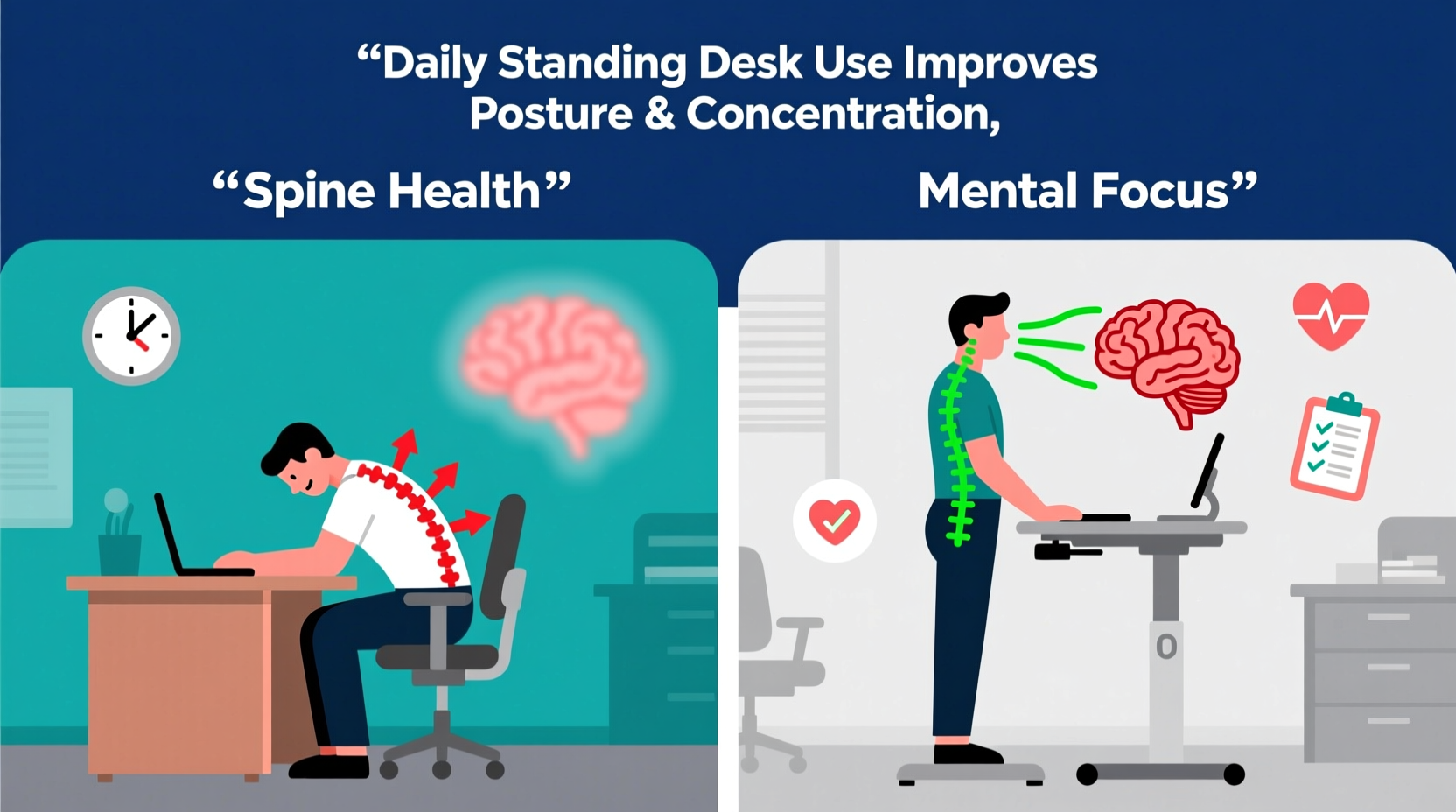
The spine is a complex structure designed to absorb shock, support movement, and protect the spinal cord. When seated for long durations, especially in poorly supported chairs, the natural curvature of the lower back (lumbar spine) flattens. This increases pressure on intervertebral discs and tightens hip flexors, contributing to chronic lower back pain—a leading cause of work-related disability.
Standing, when done correctly, encourages a more neutral spine alignment. It engages core stabilizers and reduces disc compression compared to prolonged sitting. However, standing too long without proper ergonomics can shift strain from the lower back to the knees, feet, and upper back, especially if posture deteriorates.
“The spine thrives on variation, not rigidity. Alternating between sitting and standing throughout the day supports disc hydration and muscular balance.” — Dr. Lena Torres, Physical Medicine & Rehabilitation Specialist
Cognitive Performance: Does Standing Boost Focus?
Mental focus is closely tied to physical state. Blood flow, oxygen delivery, and neurotransmitter activity are all influenced by posture and movement. Research suggests that light physical activity—such as standing or gentle shifting—can enhance alertness and executive function.
A 2016 study published in *Human Factors* found that participants who used standing desks showed improved sustained attention and faster response times during cognitive tasks compared to those who remained seated. The increase in energy expenditure—even minimal—appeared to stimulate cerebral blood flow and reduce mental fatigue.
However, the effect is not linear. Standing for extended periods can lead to discomfort, which diverts cognitive resources toward managing pain rather than concentrating on work. This creates a U-shaped curve: moderate standing enhances focus, but excessive standing diminishes it due to physical distraction.
The Role of Movement in Mental Clarity
It’s not the act of standing itself that boosts cognition, but the increased micro-movements that naturally occur while upright. Shifting weight, adjusting stance, and small muscle activations keep the nervous system engaged. In contrast, seated work often restricts even these minor motions, especially when deep in concentration.
Standing desks, therefore, serve as facilitators of dynamic posture rather than replacements for sitting. The real benefit emerges when users incorporate subtle motion—rocking slightly, using anti-fatigue mats, or pairing the desk with periodic walking breaks.
Ergonomic Best Practices for Standing Desk Use
To maximize spinal health and focus, proper setup is essential. A poorly adjusted standing desk can do more harm than good. Here are evidence-based guidelines for optimal use:
- Desk height: Adjust so your elbows rest at 90 degrees when typing, with wrists neutral and shoulders relaxed.
- Monitor position: Top of screen should be at or slightly below eye level, about an arm’s length away.
- Footwear: Avoid high heels or flat-soled shoes. Supportive footwear or anti-fatigue mats help reduce lower limb strain.
- Posture cues: Engage core lightly, keep chin slightly tucked, and avoid locking knees.
| Component | Optimal Setting | Common Mistake |
|---|---|---|
| Desk Height | Elbows at 90°, forearms parallel to floor | Too high causes shoulder shrugging |
| Monitor | Top line at eye level | Looking down causes neck strain |
| Feet | Shoulder-width apart, weight balanced | Shifting to one leg causes pelvic tilt |
| Duration | Stand 30–45 min per hour | Standing >2 hours continuously leads to fatigue |
Real-World Example: A Tech Worker’s Transformation
James, a 34-year-old software developer, began experiencing persistent lower back pain and afternoon brain fog after transitioning to remote work. He worked 9–10 hours daily, mostly seated, and noticed declining productivity by mid-afternoon.
After consulting a physiotherapist, he invested in a sit-stand desk and implemented a structured routine: 45 minutes sitting, 15 minutes standing, with a 5-minute walk every two hours. He also added simple stretches for hip flexors and thoracic extension.
Within three weeks, James reported reduced back discomfort and sharper focus during late-day coding sessions. His sleep improved, likely due to increased daytime movement. Crucially, he avoided the temptation to stand all day, recognizing that balance—not extremes—was key.
This case illustrates that success with a standing desk isn’t automatic. It requires intentionality, ergonomic awareness, and integration into a broader movement strategy.
Step-by-Step Guide to Implementing a Balanced Routine
Transitioning to a standing desk should be gradual to prevent overuse injuries and ensure long-term adherence. Follow this timeline for optimal results:
- Week 1: Assess and adjust – Set up your desk ergonomically. Begin with 15 minutes of standing per hour. Focus on posture and comfort.
- Week 2: Build duration – Increase standing time to 25–30 minutes per hour. Introduce an anti-fatigue mat and supportive footwear.
- Week 3: Add movement – Incorporate light stretches or walking in place while standing. Take short walks after standing sessions.
- Week 4: Optimize rhythm – Aim for a 30/30/30 split: 30 minutes sitting, 30 standing, 30 moving or sitting with active posture.
- Ongoing: Monitor and adapt – Track energy levels and discomfort. Adjust ratios based on workload and physical feedback.
Frequently Asked Questions
Can standing all day damage my spine?
Yes. Prolonged standing without breaks can lead to lower back strain, pelvic misalignment, and increased pressure on spinal joints. It may also contribute to varicose veins and foot problems. The goal is not to replace sitting with standing, but to alternate mindfully.
Will a standing desk help me concentrate better?
For many, yes—but only when used appropriately. Short-to-moderate standing sessions can improve alertness and reduce mental fatigue. However, standing while experiencing discomfort will impair concentration. Individual results vary based on health, job type, and habits.
How do I know if my standing desk is set up correctly?
You should be able to type with elbows close to your sides at 90 degrees, eyes level with the top of your monitor, and feet flat and balanced. There should be no need to hunch, reach, or crane your neck. If you feel strain within 10–15 minutes, re-evaluate the setup.
Actionable Checklist for Daily Use
Use this checklist to ensure you’re getting the most out of your standing desk while protecting your spine and focus:
- ✅ Adjust desk height before each standing session
- ✅ Position monitor at eye level
- ✅ Wear supportive shoes or use an anti-fatigue mat
- ✅ Limit continuous standing to 30–45 minutes
- ✅ Take a short walk or stretch every hour
- ✅ Maintain neutral spine: ears over shoulders, hips over ankles
- ✅ Hydrate well—this encourages natural movement via bathroom breaks
- ✅ Listen to your body: pain is a signal to change position
“Movement is medicine for the spine. The best desk is one that moves with you—not a fixed station for any single posture.” — Dr. Rajiv Mehta, Spine Biomechanics Researcher
Conclusion: Balance Over Rigidity
Using a standing desk every day isn’t inherently better for your spine or focus—it depends on how you use it. The true benefit lies in reducing sedentary time and introducing variability into your workday. Standing intermittently improves spinal loading patterns, enhances circulation, and supports cognitive engagement, but only when integrated into a holistic approach to movement and ergonomics.
The goal isn’t to stand all day, nor to abandon sitting altogether. It’s to break free from static postures and embrace dynamic work habits. By alternating positions, listening to your body, and designing your workspace for flexibility, you create conditions where both your spine and mind can thrive.




 浙公网安备
33010002000092号
浙公网安备
33010002000092号 浙B2-20120091-4
Comments
No comments yet. Why don't you start the discussion?