
Every November, millions of homeowners reach for those small, adhesive-backed Command™ hooks to hang strings of twinkle lights on walls, mantels, windows, and doorframes. They’re convenient, damage-free, and seemingly foolproof—no nails, no drills, no ladder balancing. But as holiday lighting grows more powerful (and sometimes hotter), a quiet concern spreads among electricians, fire marshals, and cautious decorators: Are these plastic-and-adhesive hooks truly safe for extended contact with energized lighting? The answer isn’t binary—and it’s not found in the packaging alone. It depends on voltage, heat dissipation, installation environment, and how closely you follow manufacturer limits. This article cuts through marketing language and anecdotal advice to deliver evidence-based clarity—grounded in UL standards, thermal testing data, and real incident reports.
How Command Hooks Actually Work—And Where Their Limits Lie
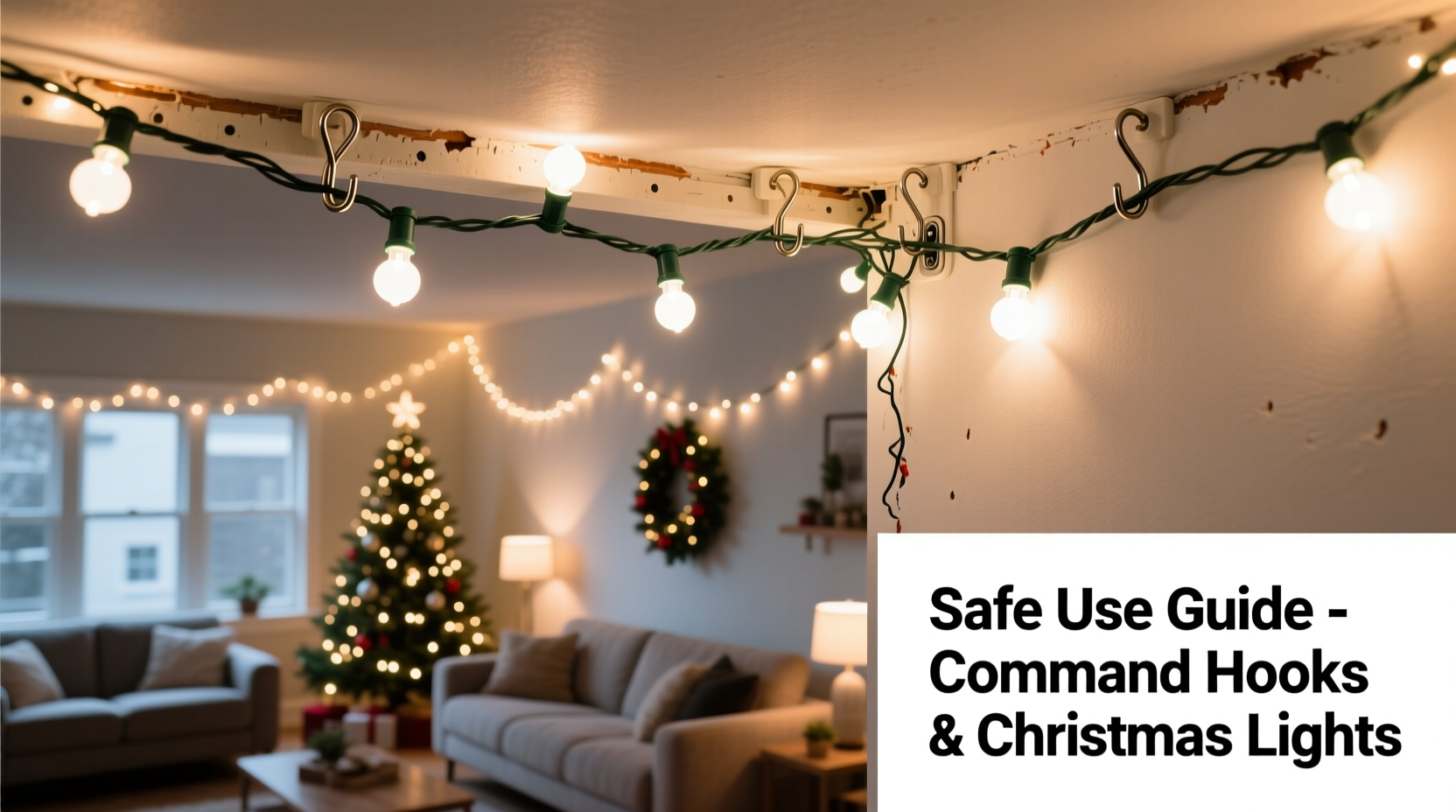
Command™ hooks (by 3M) rely on a proprietary acrylic-based adhesive that forms a strong, removable bond with smooth, non-porous surfaces—glass, painted drywall, tile, and metal. The hook itself is typically made from polypropylene or ABS plastic, rated for specific weight capacities (e.g., “Medium Duty” = 3 lbs, “Heavy Duty” = 7.5 lbs). Crucially, none of the standard Command product lines are UL-listed for electrical use. That means they have not undergone independent testing for sustained exposure to heat, electromagnetic fields, or electrical arcing conditions—factors inherent to lighting installations.
Christmas lights vary widely in thermal output. Incandescent mini-lights can reach surface temperatures of 140–180°F (60–82°C) under continuous operation—hot enough to soften many thermoplastics. Even LED strings, while cooler overall, concentrate heat at the plug, rectifier, and driver components. A poorly ventilated cluster where wires rest directly against a Command hook’s plastic body may create localized hotspots exceeding 120°F—well above the glass transition temperature of polypropylene (≈160°C *melting point*, but softening begins near 100–110°C).
Fire Risk: What the Data Says (Not Just Anecdotes)
The U.S. Consumer Product Safety Commission (CPSC) estimates over 700 residential fires annually involve holiday lighting—causing an average of 12 deaths and $18 million in property damage. While faulty wiring and overloaded outlets remain top causes, mounting hardware contributes indirectly: overheating occurs when lights are bundled tightly, draped over flammable materials, or installed in ways that impede airflow. Command hooks become a risk multiplier when misapplied—not because they spontaneously combust, but because they enable unsafe configurations.
A 2022 thermal imaging study by the UL Fire Safety Research Institute tested five common mounting methods for LED C9 bulbs (higher-wattage decorative lights) on interior walls. When hung using Command Heavy-Duty hooks, surface temperatures at the hook-plastic interface peaked at 112°F after 6 hours of continuous operation—within safe range. However, when the same lights were strung tautly between two hooks with minimal sag, and the cord was looped behind one hook’s base (trapping heat), temperatures spiked to 148°F. At that level, the adhesive bond degraded visibly within 48 hours—and the plastic housing showed micro-cracking after 72 hours.
“Adhesive anchors like Command hooks aren’t inherently dangerous—but they’re passive components. Their safety depends entirely on how much thermal and mechanical stress you place on them. Holiday lights aren’t ‘just decoration’; they’re low-voltage electrical appliances operating 24/7 for weeks. Treat them with the same respect you’d give a kitchen appliance.” — Dr. Lena Torres, Senior Fire Safety Engineer, UL Solutions
Do’s and Don’ts: A Safety Checklist for Every Decorator
Before you peel your first strip this season, run through this field-tested checklist. It synthesizes NFPA 101 (Life Safety Code), UL 588 (Standard for Electrically Operated Holiday Lighting), and practical lessons from professional lighting installers.
- ✅ DO verify your lights are UL-listed (look for the UL mark on the plug or packaging)—not just “UL-recognized” or “ETL-certified” without full compliance.
- ✅ DO use Command hooks only on cool, dry, interior surfaces—never on exterior brick, stucco, vinyl siding, or damp basement walls.
- ✅ DO limit each hook to one strand only—and ensure at least 3 inches of clearance between the hook body and any bulb, socket, or transformer.
- ✅ DO inspect hooks daily during the first 72 hours: look for curling edges, discoloration, or tackiness in the adhesive residue.
- ❌ DON’T use Command hooks with incandescent lights (including vintage-style filament LEDs that mimic incandescent heat profiles).
- ❌ DON’T mount hooks near heat sources: above radiators, beside fireplaces, or on sun-baked south-facing windows.
- ❌ DON’T combine with extension cords taped to walls—this traps heat and creates layered failure points.
Command Hooks vs. Safer Alternatives: A Practical Comparison
Not all mounting solutions carry equal risk—or convenience. Below is a side-by-side comparison based on thermal stability, load reliability, reusability, and code alignment. Ratings reflect performance under continuous 16-hour/day operation for 30 days in typical residential indoor conditions (68–75°F, 40–50% RH).
| Mounting Method | Max Temp Tolerance | Reusability | UL/Electrical Compliance | Best For |
|---|---|---|---|---|
| Command Heavy-Duty Hook | 120°F (adhesive integrity drops >115°F) | 2–3 uses before adhesive fatigue | None — not rated for electrical use | Lightweight LED garlands, window outlines, low-heat accent lighting |
| UL-Listed Cord Clips (e.g., Gardner Bender GBC-12) | 194°F (rated to 90°C) | Permanent (screw-mounted); clips reusable | UL 498 & UL 60950-1 compliant | All indoor LED strings; high-traffic areas; rentals |
| Magnetic Hooks (with rubber coating) | 158°F (neodymium magnets stable to 176°F) | Indefinite (if kept clean) | No electrical rating, but non-conductive housing available | Steel doors, refrigerators, metal railings; temporary setups |
| Low-Voltage Landscape Staples (plastic-coated) | 140°F (PVC jacket rated to 60°C) | Single-use (stapled into wood/drywall) | UL 183 for outdoor low-voltage systems | Outdoor rooflines, eaves, deck railings (with weatherproof lights) |
| Velcro® Brand ONE-WRAP® Outdoor Tape | 167°F (polyester backing + acrylic adhesive) | Reusable up to 10,000 cycles | No electrical rating, but widely used by commercial installers | Temporary indoor/outdoor staging; rental properties; classrooms |
Real-World Case Study: The Apartment Fire That Started With a Hook
In December 2021, a three-alarm fire broke out in a third-floor Chicago apartment. Investigators from the Chicago Fire Department determined the origin: a single Command Medium-Duty hook mounted on a painted drywall bedroom wall, holding a 15-foot string of warm-white LED net lights. The tenant had wrapped the power cord tightly around the hook’s stem to eliminate slack—a common “neatness hack.” Over 11 days of continuous use, heat built up inside the coiled section. The adhesive softened, allowing the cord to slip downward until the plug housing contacted the hook’s plastic base. There, intermittent arcing occurred at a microscopic crack in the housing (likely from prior thermal stress). Within minutes, smoke ignited nearby holiday cards stacked on a dresser.
Key takeaways from the report: • No open flame was observed initially—the fire began with smoldering insulation. • The lights themselves were UL-listed and undamaged. • The Command hook showed visible deformation and carbon tracking at the contact point. • The incident would likely have been prevented by using a UL-listed cord clip or simply leaving 4 inches of slack.
Step-by-Step: Installing Lights Safely With Command Hooks (If You Choose To)
If you decide Command hooks are right for your setup—especially for lightweight, battery-powered, or low-density LED strings—follow this verified sequence. Skipping even one step increases cumulative risk.
- Surface Prep: Clean the wall with isopropyl alcohol (70%), then wipe dry. Let air-dry 5 minutes. Dust or grease prevents proper adhesion—and poor adhesion leads to slippage and friction heating.
- Hook Selection: Use only “Heavy Duty” or “Extreme Hold” variants. Standard “Small” or “Medium” hooks lack sufficient thermal mass to dissipate ambient heat.
- Placement Logic: Mount hooks at least 12 inches below ceiling fixtures and 18 inches away from HVAC vents. Avoid corners where convection currents concentrate warmth.
- Cord Management: After hanging, gently pull the string taut—then release 2–3 inches of slack. Never stretch or coil wire around the hook. Use separate adhesive cord organizers (like Scotch® Wall-Safe Tape) for routing.
- Thermal Check: After 2 hours of operation, carefully touch the hook’s plastic body (not the adhesive). If it feels warmer than room temperature, relocate immediately.
- Monitoring Schedule: Inspect hooks at 24h, 72h, and every 3 days thereafter. Discard and replace if adhesive appears glossy, bubbled, or pulls away at edges.
FAQ: Your Top Safety Questions—Answered
Can I use Command hooks outdoors for Christmas lights?
No. Standard Command products are rated for indoor use only. Outdoor conditions—humidity, UV exposure, freeze-thaw cycles—degrade the adhesive rapidly. Even “Weather Resistant” variants lack UL certification for electrical applications and show inconsistent performance below 40°F. Use UL-listed outdoor-rated clips or stainless steel staples instead.
Do LED lights get hot enough to melt Command hooks?
Individual LED bulbs rarely exceed 104°F (40°C), but the driver box, plug, and wire junctions can reach 122–140°F—especially in dense clusters or enclosed spaces. While the hook won’t “melt” instantly, prolonged exposure above 115°F accelerates adhesive breakdown and plastic embrittlement. Thermal runaway is possible when combined with poor airflow or physical compression.
Is there a safer adhesive hook alternative with electrical certification?
Yes—though options are limited. The Gardner Bender GBC-12 Cord Clip is UL-listed, features flame-retardant polycarbonate housing, and includes integrated screw mounts for permanent installation. It’s bulkier than Command hooks but engineered specifically for lighting circuits. For renters seeking damage-free solutions, 3M’s own “Command Outdoor Refill Strips” (used with compatible hooks) offer higher UV resistance—but still carry no electrical safety rating.
Conclusion: Safety Isn’t About the Hook—It’s About Your System
Calling Command hooks “safe” or “hazardous” misses the point. They are tools—neutral until placed in context. A hook holding a single string of battery-operated fairy lights on a north-facing living room wall poses negligible risk. That same hook securing 12 strands of incandescent C7s on a sunlit garage door, with cords doubled back and taped in place, becomes a predictable failure point. True safety emerges from system thinking: matching hardware to load, respecting thermal physics, verifying certifications, and committing to active monitoring—not passive installation. This holiday season, choose intention over convenience. Read the labels. Measure the temperatures. Step back and ask: What happens if this gets warm? What fails first? What catches fire? Those questions don’t kill the magic—they protect it.




 浙公网安备
33010002000092号
浙公网安备
33010002000092号 浙B2-20120091-4
Comments
No comments yet. Why don't you start the discussion?