
In the world of high-performance gaming and immersive PC setups, every millisecond counts. Gamers obsess over input lag, frame timing, and synchronization between audio, visuals, and peripherals — especially when it comes to RGB lighting systems that pulse in time with music or game events. One fringe method has quietly circulated across forums and Reddit threads: placing a gaming headset’s microphone directly in front of an RGB-lit device and using audio feedback to \"test\" how quickly the lights respond. But is this actually a reliable technique, or just a clever myth born from DIY troubleshooting?
The short answer: yes, people do it — but not because it's accurate. It's more of a makeshift sanity check than a scientific measurement. Let’s unpack why this method exists, how it works (or doesn’t), and what better alternatives are available for those serious about latency testing.
The Origins of the Mic Feedback Hack
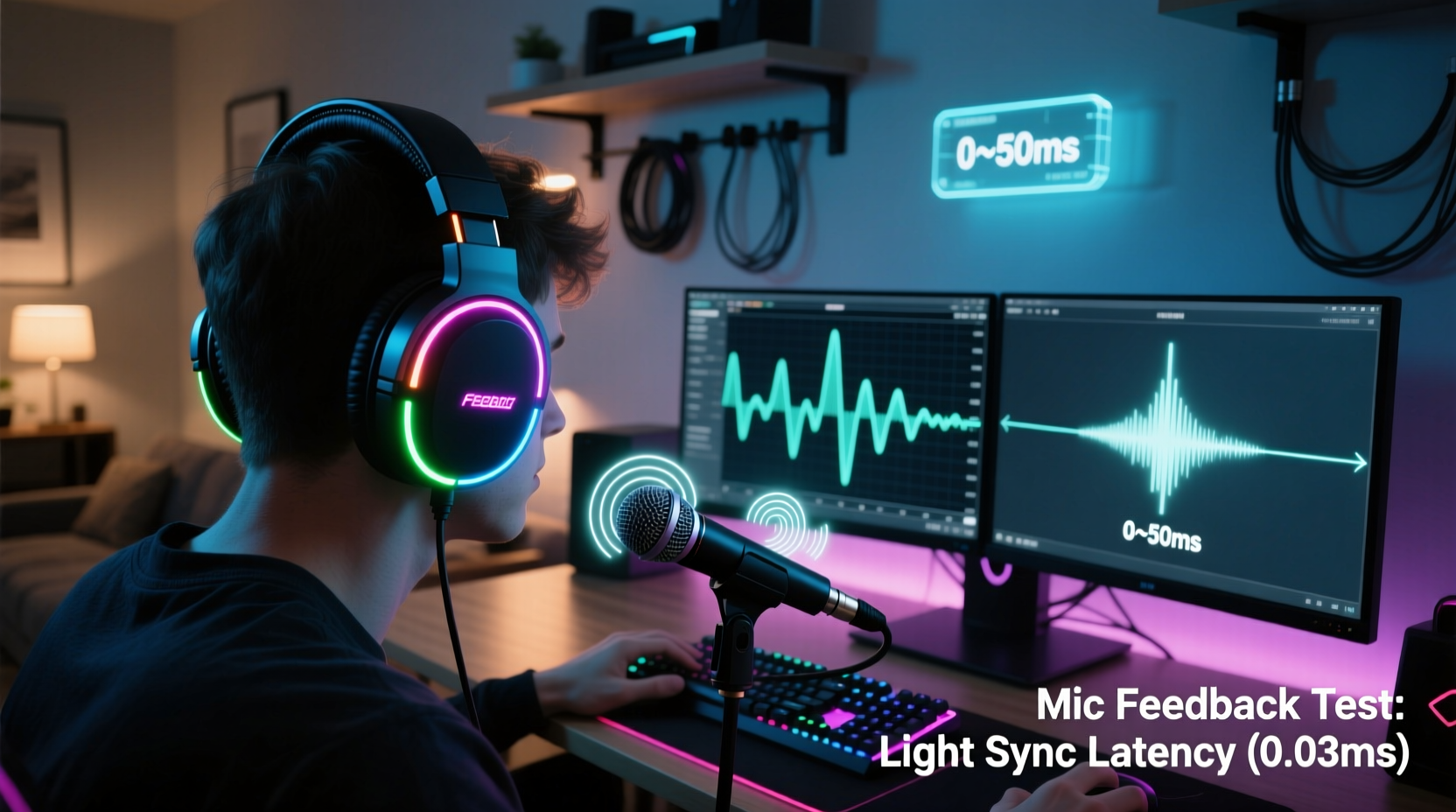
The idea stems from a basic principle: if a light turns on at the same time a sound plays, and both are captured simultaneously by a microphone, you should hear them together. If there's a delay between the audio cue and the visual flash, that lag might be detectable in the recording as an echo or secondary spike. By positioning a sensitive mic — like the boom on a gaming headset — close to an LED strip or keyboard backlight, users attempt to record the moment the light activates in response to a trigger, such as a beat in music or a system alert.
This method gained traction among budget-conscious tinkerers who lacked access to oscilloscopes, high-speed cameras, or specialized software. With nothing more than Audacity and a $30 headset, they claimed they could “see” latency in waveform peaks. While resourceful, the approach raises questions about precision, environmental noise, and hardware limitations.
How People Claim It Works: A Step-by-Step Breakdown
Despite its informal nature, the mic feedback test follows a rough procedure used by enthusiasts trying to compare different RGB control software (like Aura Sync, iCUE, or SignalRGB) or evaluate driver performance.
- A user plays a sharp, distinct audio tone (e.g., a 1 kHz beep) through their system.
- Simultaneously, they trigger an LED to illuminate — ideally via software tied to audio amplitude or a manual command.
- The gaming headset mic is placed within an inch of the LED source.
- The audio output (including the original tone and the mic capture) is recorded in stereo using software like Audacity.
- In the resulting waveform, the left channel shows the original audio signal; the right channel shows what the mic picked up — including any delayed light activation, inferred from when the mic detects reflected light (though technically, it captures no light — only sound).
Here’s the catch: microphones don’t detect light. What some interpret as “light detection” is actually indirect inference. The assumption is that when the LED turns on, it creates a tiny physical change — perhaps a faint buzz from the circuit, thermal expansion, or even ambient interference — that the mic picks up. More commonly, users rely on external triggers like solenoids or relays clicking when power hits the LEDs, which *are* audible.
In reality, unless the LED emits a sound upon activation (which most don’t), the mic isn’t measuring light latency at all — it’s either detecting electrical artifacts or misinterpreting timing due to software buffering.
Why This Method Is Flawed (and Potentially Misleading)
While creative, the headset mic technique suffers from several critical flaws that undermine its reliability:
- No direct light-to-sound conversion: Microphones respond to air pressure changes, not photons. There’s no mechanism for a standard LED to generate a detectable acoustic signature upon illumination.
- Audio loopback delays: Onboard audio routing introduces variable latency depending on drivers, sample rates, and OS-level processing. What appears as a 50ms LED delay might actually be a 45ms audio buffer.
- Environmental noise contamination: Desk vibrations, fan hum, or keyboard clicks can create false positives in recordings.
- Lack of calibration: Without a known reference point (e.g., a calibrated strobe synced to audio), there’s no way to verify accuracy.
- Subjective interpretation: Determining “when” a light turns on based on a fuzzy audio bump is inherently unreliable.
“Using consumer audio gear to measure sub-frame latency is like using a kitchen scale to weigh gold dust — it may register something, but you can't trust the number.” — Dr. Lena Petrov, Embedded Systems Engineer at SynchroTech Labs
Even if a correlation appears between audio playback and a waveform anomaly, causation remains unproven. In controlled lab environments, engineers use photodiodes connected to oscilloscopes to measure light response times down to microseconds. Consumer headsets lack both the sensitivity and sampling fidelity for such tasks.
Better Alternatives for Measuring Light Sync Latency
For those genuinely interested in evaluating RGB responsiveness — whether for competitive audio-reactive builds or low-latency ambient lighting — here are proven, accessible methods far superior to the mic feedback hack.
1. High-Speed Camera Method
Record your LED reaction using a smartphone or camera capable of 240fps or higher. Play a synchronized audio cue while triggering the light. Analyze the footage frame by frame to determine the delay. At 240fps, each frame represents ~4.17ms, giving reasonable resolution.
2. Photodiode + Oscilloscope (DIY-Friendly)
A simple photodiode circuit connected to an affordable USB oscilloscope (like the BitScope or Digilent Analog Discovery) can detect light changes in real time. Pair it with a known audio pulse, and you’ll get precise nanosecond-level data.
3. Software-Based Profiling Tools
Tools like LatencyMon, ClickTimmer, or custom Python scripts using pygame or sounddevice libraries can log event timestamps from both audio output and simulated light signals (via GPIO pins or serial commands). These provide digital logs rather than analog approximations.
4. Use Dedicated Testing Firmware
Open-source firmware like QMK (for keyboards) allows developers to insert timestamped debug signals. You can program a keypress to simultaneously play a tone and toggle an LED, then measure the difference externally with proper tools.
| Method | Precision | Cost | Accessibility |
|---|---|---|---|
| Gaming Headset Mic Feedback | Low (~±50ms) | $0–$50 | High |
| High-Speed Camera | Moderate (~±4ms) | $100+ | Medium |
| Photodiode + Oscilloscope | Very High (~±0.01ms) | $150+ | Low |
| Software Event Logging | High (~±1ms) | $0–$50 | Medium |
Mini Case Study: The Reddit Experiment That Went Viral
In early 2022, a Reddit user under the handle u/LatencyHacker64 posted a video claiming their Corsair K95 RGB keyboard had a 72ms light response delay based on mic feedback testing. The clip showed two waveforms in Audacity: one flat line from the audio source, and a second peak arriving 72 samples later on the mic track. The post gained over 3,000 upvotes and sparked heated debate in r/MechanicalKeyboards.
Several users attempted replication. One engineer reran the test using a phototransistor aimed at the same key’s backlight. Their results? The actual optical response time was 8.3ms — well under a single frame at 60Hz. The 72ms “delay” correlated instead with Windows audio stack buffering and ASIO driver overhead.
The takeaway: perceived latency in DIY audio tests often reflects software bottlenecks, not hardware performance. Without isolating variables, such experiments risk drawing incorrect conclusions that spread misinformation.
Checklist: How to Properly Test RGB Latency (Without Fooling Yourself)
- ✅ Define your trigger source (audio beat, keypress, etc.)
- ✅ Use a clean environment free of ambient light fluctuations
- ✅ Employ a high-speed recording method (camera or sensor)
- ✅ Synchronize audio and visual triggers via the same software event
- ✅ Calibrate your measurement tool with a known reference
- ✅ Repeat tests multiple times for consistency
- ✅ Document conditions (sample rate, refresh rate, software versions)
Frequently Asked Questions
Can a microphone really detect when an LED turns on?
No — not directly. LEDs do not produce sound when activated. Any signal picked up by a mic is likely due to electrical noise, mechanical components (like relays), or reflections of external audio off nearby surfaces. It cannot reliably indicate light-on time.
Is there any scenario where mic feedback testing makes sense?
Only as a rough qualitative check — for example, comparing two software profiles to see if one visibly shifts the waveform earlier than another. But even then, it shouldn’t be used to quote exact numbers. Think of it as a “smoke test,” not a benchmark.
What’s the typical latency for modern RGB lighting systems?
Well-optimized setups using native SDKs (like Razer Chroma or Corsair iCUE) typically respond within 5–15ms after a software trigger. End-to-end latency — from audio input to visible light change — can range from 30ms to over 100ms depending on drivers, polling rates, and software layers involved.
Conclusion: A Clever Hack, But Not Science
Yes, people use gaming headset mics to test RGB light sync latency — but calling it a “test” stretches the definition. It’s more accurately described as a heuristic, prone to error and misinterpretation. While it may reveal gross discrepancies (e.g., one setup being dramatically slower than another), it fails as a diagnostic tool for fine-tuning or objective comparison.
The persistence of this method speaks less to its validity and more to the accessibility gap in consumer-grade performance analysis. Gamers want control over their experience, and when official tools don’t provide transparency, they improvise.
Instead of relying on shaky audio parlor tricks, consider investing time in learning proper measurement techniques. Even modest tools like high-frame-rate phones or open-source firmware offer deeper insight. Accuracy benefits everyone — from modders optimizing reactive effects to manufacturers improving real-time lighting engines.




 浙公网安备
33010002000092号
浙公网安备
33010002000092号 浙B2-20120091-4
Comments
No comments yet. Why don't you start the discussion?