
In an era where online shopping dominates consumer behavior, the fashion and beauty industries are racing to close a persistent gap: the inability to physically try before buying. Virtual try-on (VTO) technology—powered by augmented reality (AR), artificial intelligence (AI), and 3D modeling—promises to bridge that divide. From seeing how a pair of sunglasses frames your face to visualizing how a dress drapes on your body, these tools aim to replicate the in-store experience from the comfort of home. But how accurate are they really? Can they truly replace the tactile, sensory confidence of walking into a store, holding an item, and trying it on?
The answer isn't a simple yes or no. While virtual try-ons have made remarkable strides in realism and usability, they still face technical, psychological, and practical limitations. For some products and consumers, VTO is already transformative. For others, nothing beats the mirror and the fitting room.
The Evolution of Virtual Try-On Technology
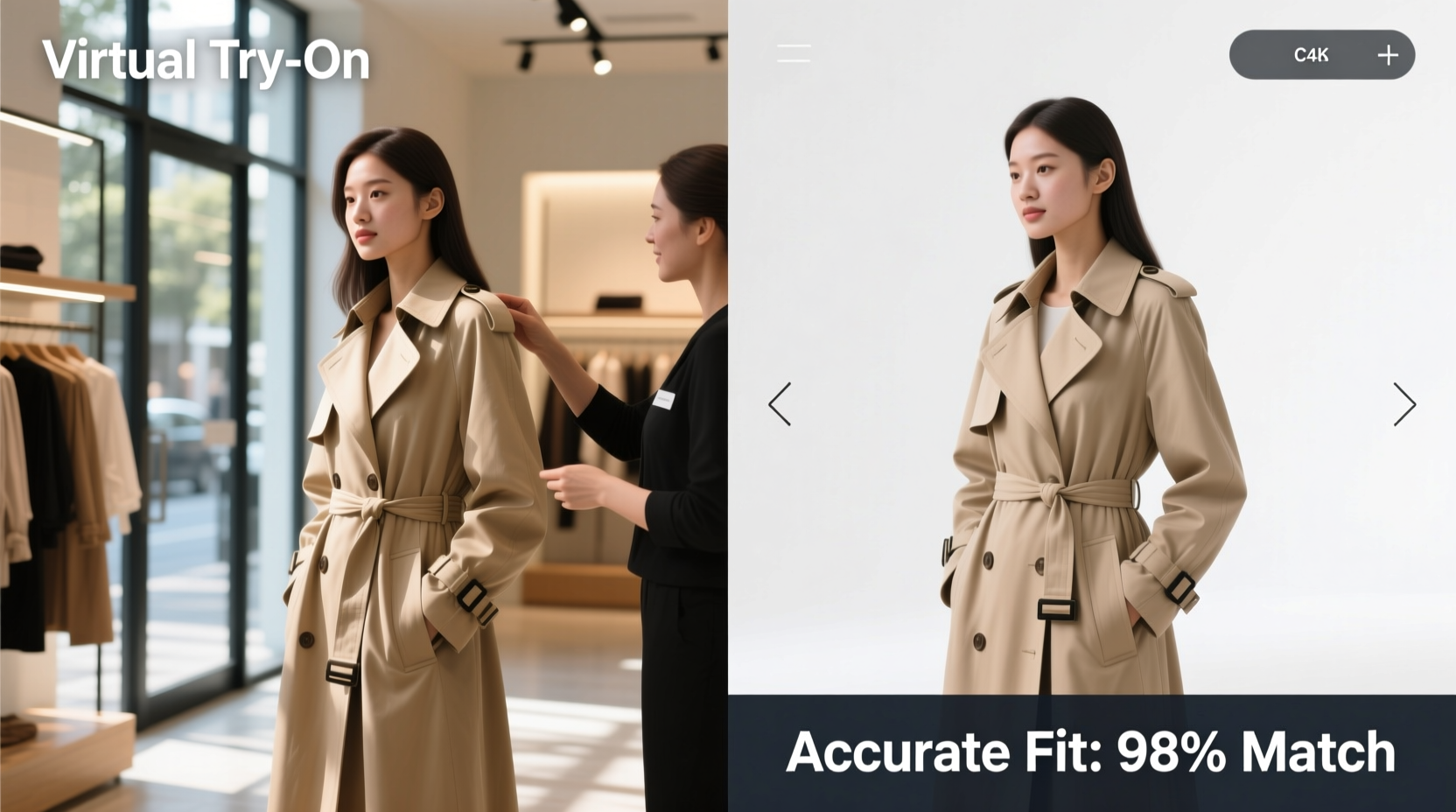
Virtual try-on began as a novelty—a gimmick used in early mobile apps that superimposed poorly aligned images over selfies. Today’s systems, however, leverage advanced computer vision and machine learning models trained on millions of human body shapes, facial structures, and fabric behaviors. Platforms like Snapchat, Amazon, Warby Parker, Sephora, and Gucci now offer highly refined AR experiences that adjust for lighting, movement, and perspective in real time.
For eyewear, makeup, and accessories, virtual try-ons are particularly effective. These items occupy predictable regions of the face or body, making spatial tracking more reliable. Algorithms can map facial landmarks with over 90% accuracy, adjusting shadows and reflections to simulate realistic wear. When you \"try on\" red lipstick via a brand’s app, the color blends with your skin tone and moves naturally as you smile or turn your head.
For apparel, the challenge is greater. Clothing involves complex variables: fabric drape, stretch, fit across different body types, and how garments interact with posture and motion. Some brands use 3D avatars based on user-inputted measurements, while others employ AI-driven body scanning via smartphone cameras. Companies like Zeekit (acquired by Walmart) and Vue.ai enable users to see garments on models that match their size and proportions—but not necessarily their exact body shape.
Accuracy vs. Realism: Understanding the Difference
One of the most common misconceptions about virtual try-ons is that visual realism equals functional accuracy. A shirt may look perfectly draped on your screen, but that doesn’t guarantee it will fit well in person. Realism refers to how lifelike the simulation appears—shadows, textures, folds. Accuracy, on the other hand, concerns whether the virtual representation matches physical reality in terms of size, proportion, and comfort.
A 2023 study by the Journal of Fashion Marketing and Management found that while 78% of users rated virtual try-ons as “visually convincing,” only 54% said the fit matched expectations upon delivery. This gap highlights a critical limitation: even the most photorealistic rendering cannot convey how a garment feels against the skin, how it stretches during movement, or how it holds up after a few hours of wear.
Footwear presents another challenge. Shoes require understanding of foot width, arch height, and gait dynamics—data most smartphones can’t capture. Nike’s AR shoe scanner lets users measure foot size via camera, but it still relies on standard sizing charts, which vary widely between brands.
“Virtual try-ons are excellent for top-line visualization, but they don’t yet solve the fundamental problem of fit uncertainty.” — Dr. Lena Patel, Consumer Behavior Researcher at MIT Media Lab
Where Virtual Try-Ons Excel—and Fall Short
Not all products benefit equally from virtual try-on technology. The success of the tool depends heavily on the category, the quality of the underlying data, and the user’s expectations.
| Product Category | Accuracy Level | Key Strengths | Limited By |
|---|---|---|---|
| Makeup (lipstick, eyeshadow) | High | Precise color mapping, real-time blending, texture simulation | Lighting variations, skin undertones not always captured |
| Eyewear | High | Facial landmark tracking, frame-to-face ratio accuracy | Slight misalignment in depth perception |
| Watches & Jewelry | Moderate to High | Size visualization, sparkle/light reflection simulation | Weight, comfort, and material feel missing |
| Apparel (tops, dresses) | Moderate | Fabric drape simulation, size-based model matching | Lack of stretch feedback, movement dynamics, personal body nuances |
| Footwear | Low to Moderate | Foot size estimation via AR | No arch support or gait analysis, inconsistent sizing standards |
| Hairstyles & Wigs | Moderate | Hair color and length preview, face framing | Texture mismatch, density variation not simulated |
The table shows a clear trend: the less dynamic and tactile a product is, the better virtual try-ons perform. Static items like sunglasses or lipstick are easier to model than flowing dresses or structured shoes.
Real-World Example: Emma’s Online Wardrobe Refresh
Emma, a 34-year-old marketing manager from Denver, decided to revamp her work wardrobe entirely through online shopping. She used a major retailer’s virtual try-on feature that allowed her to create a 3D avatar based on her height, weight, and measurements. She browsed blazers, tailored pants, and silk blouses, using the tool to visualize how each piece would look on a body similar to hers.
The experience was engaging. She could rotate the model, change colors, and layer outfits. Confident in her choices, she placed an order for five key pieces. When the package arrived, three items fit reasonably well—close enough to keep. One blazer was too tight across the shoulders, despite appearing loose in the simulation. The trousers, though correct in waist size, had a shorter rise than expected, altering the silhouette.
Emma returned two items and donated them to a friend. “It got me 80% there,” she said. “But I still needed to touch the fabric and move around in the clothes to know if they were right.” Her experience reflects a broader consumer sentiment: virtual try-ons reduce uncertainty but don’t eliminate it.
Improving Accuracy: What’s on the Horizon
Several technological advancements are poised to narrow the accuracy gap. First, improved body scanning via smartphone LiDAR sensors (available in newer iPhones and high-end Android devices) enables more precise 3D mapping of body contours. Second, AI-powered fit prediction engines—like those from Fit Analytics and TrueFit—analyze customer return data to recommend sizes with increasing precision.
Some retailers are experimenting with hybrid models. ASOS introduced a “See My Fit” feature that overlays garments onto real customer videos of various body types. Instead of relying solely on avatars, shoppers see how a dress fits on someone with a similar build. This crowdsourced approach adds authenticity and reduces reliance on idealized digital models.
Another promising development is haptic feedback integration. While still in early stages, startups are exploring wearable gloves or vibrations in smart mirrors that simulate fabric texture during virtual sessions. Combined with AR, this could deliver a multisensory try-on experience.
“We’re moving from ‘see it’ to ‘feel it.’ The next generation of virtual try-ons won’t just show you how something looks—they’ll help you understand how it behaves.” — Rajiv Mehta, CTO of StyleGenius Labs
Checklist: How to Use Virtual Try-Ons Effectively
To get the most out of virtual try-on tools and minimize disappointment, follow this practical checklist:
- Enter accurate measurements: Don’t guess your size. Use a tape measure and refer to the brand’s size guide.
- Use good lighting: Natural light helps AR tools detect facial and body features more accurately.
- Compare across models: If available, view the product on multiple body types to understand fit variance.
- Read fit reviews: Check customer feedback specifically mentioning “runs large” or “tight in hips.”
- Start with low-risk items: Test the tech with accessories or non-essential pieces before buying wardrobe staples.
- Understand return policies: Ensure hassle-free returns in case the fit doesn’t match expectations.
FAQ: Common Questions About Virtual Try-On Accuracy
Can virtual try-ons replace visiting a store completely?
For many routine purchases—especially makeup, glasses, or basic accessories—virtual try-ons can reduce or eliminate the need for in-store visits. However, for foundational wardrobe pieces, formal wear, or items requiring precise fit (like suits or wedding dresses), in-person try-ons remain more reliable.
Why do clothes sometimes look different in person than in the virtual preview?
Differences arise due to lighting interpretation, fabric behavior not fully modeled, and variations in body proportions that aren’t captured by standard avatars. Additionally, screen resolution and device type can affect color and texture perception.
Are virtual try-ons safe for my privacy?
Most reputable platforms process facial or body data locally on your device and do not store images. However, always review the app’s privacy policy. Avoid granting unnecessary permissions, and use trusted retail sites rather than third-party apps with unclear data practices.
Conclusion: A Powerful Tool, Not a Full Replacement
Virtual try-on technology has evolved from a futuristic concept to a practical shopping aid used by millions. It enhances convenience, reduces decision fatigue, and helps consumers visualize products in context. For certain categories—especially beauty and accessories—it comes remarkably close to replicating the in-store experience.
Yet, it remains a supplement, not a substitute. The sensory richness of touching fabric, assessing weight, and observing movement in a full-length mirror is irreplaceable. Human bodies are diverse and dynamic; no algorithm can yet account for every nuance of fit and comfort.
The future likely lies in hybrid retail—where virtual try-ons streamline discovery and pre-screening, while physical stores focus on high-touch, high-stakes purchases. As AI, 3D modeling, and sensor technology improve, the gap will narrow. But for now, the fitting room still holds a place in the shopper’s journey.




 浙公网安备
33010002000092号
浙公网安备
33010002000092号 浙B2-20120091-4
Comments
No comments yet. Why don't you start the discussion?