
Language acquisition has evolved beyond textbooks and flashcards. One of the most accessible and engaging tools available today is television — especially when consumed in a target language. Watching TV in another language isn't just entertainment; it's a powerful form of passive and active immersion that can accelerate vocabulary acquisition, improve listening comprehension, and deepen cultural understanding. The key lies not in passive viewing, but in intentional, strategic engagement with the content.
For decades, linguists and educators have emphasized the importance of immersion in language learning. True immersion means surrounding yourself with the language in natural contexts — exactly what foreign-language television provides. Whether it’s a Spanish telenovela, a Japanese drama, or a French documentary, these programs expose learners to authentic pronunciation, idiomatic expressions, and real-life conversational rhythms. But simply turning on a show isn’t enough. To turn screen time into meaningful progress, viewers must adopt specific techniques that transform passive watching into active learning.
The Science Behind Language Immersion Through Television
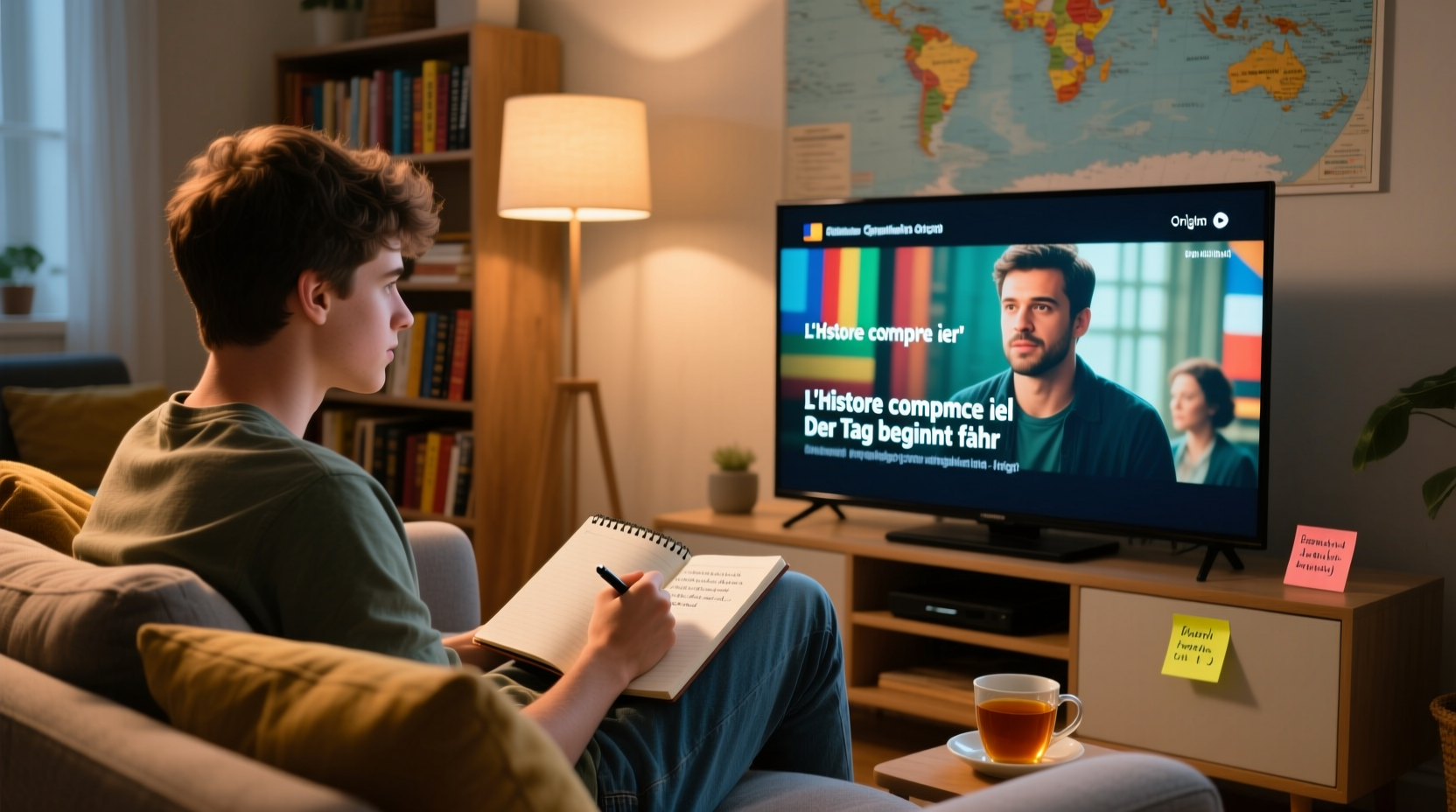
Research consistently supports the effectiveness of audiovisual input in second-language acquisition. A 2020 study published in Language Learning & Technology found that learners who engaged with subtitled TV shows demonstrated significantly better vocabulary retention and listening comprehension than those relying solely on classroom instruction. This is due in part to the brain’s ability to process visual and auditory cues simultaneously — a phenomenon known as dual coding theory.
When you watch a scene where someone says “Je suis fatigué” while yawning and rubbing their eyes, your brain links the phrase with both the sound and the visual context. That connection makes the phrase easier to recall later. Over time, repeated exposure builds automaticity — the ability to understand and use language without conscious effort.
Moreover, TV offers exposure to a wide range of accents, speech speeds, and registers (formal vs. informal), which textbooks often fail to capture. You’ll hear slang, contractions, interruptions, and emotional inflections — all essential components of real-world communication.
“Learners who engage with authentic media develop a more intuitive grasp of rhythm, intonation, and pragmatic usage than those limited to artificial dialogues.” — Dr. Lena Torres, Applied Linguist at McGill University
How to Maximize Learning: Effective Viewing Strategies
To benefit from foreign-language TV, you need structure. Unfocused binge-watching may be enjoyable, but it won’t lead to measurable progress. Instead, treat each episode like a mini language lesson. Here’s how:
1. Choose the Right Content for Your Level
Selecting appropriate material is crucial. Beginners should avoid fast-paced dramas or films with heavy jargon. Instead, opt for children’s programming, sitcoms with clear dialogue, or educational series designed for language learners. As proficiency grows, transition to news broadcasts, documentaries, and eventually complex narratives.
2. Use Subtitles Strategically
Subtitles are not a crutch — they’re a scaffold. For beginners, start with subtitles in your native language to follow along. After one viewing, rewatch with subtitles in the target language. This reinforces spelling, word recognition, and sentence structure. Advanced learners should aim to watch without subtitles entirely, using them only during review.
3. Pause, Repeat, and Shadow
Pause after short segments to summarize what was said in your own words. Rewind difficult lines and listen multiple times. Even better: practice shadowing — speaking aloud along with the actors, mimicking their pronunciation, rhythm, and intonation. This strengthens phonetic memory and improves speaking fluency.
4. Keep a Vocabulary Journal
Note down new words and phrases. Include context: who said it, when, and why. Later, create example sentences or record yourself using the expressions. Review entries weekly to reinforce retention.
Practical Tips for Building a Sustainable Routine
Consistency matters more than intensity. Watching 20 minutes daily is far more effective than two hours once a week. Integrate language TV into your existing habits — during breakfast, after work, or as a weekend ritual.
- Set a fixed schedule: Watch every Tuesday and Thursday evening after dinner.
- Limit distractions: Turn off notifications and commit to focused viewing.
- Track progress: Mark episodes completed and note new vocabulary mastered.
- Vary genres: Rotate between comedy, drama, news, and reality TV to encounter diverse language patterns.
| Level | Recommended Show Type | Subtitle Strategy | Viewing Duration |
|---|---|---|---|
| Beginner | Children’s shows, sitcoms | Native language → Target language | 15–20 min/session |
| Intermediate | Dramas, talk shows | Target language only | 25–30 min/session |
| Advanced | Films, documentaries, live debates | No subtitles (optional review with) | 40+ min/session |
Mini Case Study: Maria’s Journey from Beginner to Conversational Fluency
Maria, a university student in Germany, began learning French with no prior experience. Her classes provided grammar foundations, but she struggled to understand spoken French. On her tutor’s advice, she started watching Extra, a beginner-friendly French sitcom originally produced for language learners.
At first, she used English subtitles and rewound nearly every line. She wrote down five new words per episode. After three weeks, she switched to French subtitles. By week six, she could follow entire scenes without pausing. Within four months, she was watching regular French series like Call My Agent! with minimal subtitle use.
After nine months of consistent viewing — about 30 minutes, five days a week — Maria passed the DELF B1 exam and confidently held conversations during a trip to Paris. “The characters felt familiar,” she said. “Their voices, their jokes — I’d heard them so many times, it was like meeting old friends.”
Common Pitfalls and How to Avoid Them
Even with the best intentions, learners often fall into traps that limit progress. Awareness is the first step toward correction.
Over-reliance on subtitles: Constantly reading can distract from listening. Challenge yourself to watch segments blind, then replay with subtitles for verification.
Choosing overly difficult content: Trying to understand a legal thriller in your target language as a beginner leads to frustration. Match content to your level.
Passive consumption: Simply having the TV on in the background doesn’t count as immersion. Active attention is required for neural encoding.
Neglecting output: Watching builds input skills, but speaking and writing must be practiced separately. Use what you learn by role-playing scenes or narrating your day in the target language.
Step-by-Step Guide to Starting Your Language-TV Routine
- Assess your current level using a CEFR guideline (A1–C2). Be honest about your listening comprehension.
- Select one show appropriate for your level. Use platforms like Netflix, YouTube, or DW Learn German, which label content by difficulty.
- Gather tools: Notebook, pen, and a device for pausing playback.
- Watch the first episode with native-language subtitles. Focus on grasping the overall story.
- Rewatch the same episode with target-language subtitles. Pause to write down 5–7 new words.
- Listen again without subtitles and try to catch phrases you previously noted.
- Shadow 2–3 short dialogues — repeat them aloud, matching tone and speed.
- Review your notes at the end of the week and use new vocabulary in sentences.
- Repeat weekly with new episodes, gradually reducing subtitle dependence.
- After 4 weeks, assess progress by attempting an unsubtitled episode of a slightly harder show.
FAQ
Can I learn a language just by watching TV?
While TV is a powerful tool, it shouldn’t be your only method. It excels at building listening skills and vocabulary, but speaking, writing, and grammar accuracy require active practice. Combine TV with conversation exchanges, writing exercises, and structured lessons for balanced development.
Is it better to watch dubbed or original content?
Original productions in the target language are ideal because they reflect natural speech patterns, regional accents, and cultural nuances. Dubbed content often uses simplified or unnatural phrasing and may lack authenticity in delivery.
What if I don’t understand anything at first?
This is completely normal. Focus on picking out cognates (words similar to your native language), recurring phrases, and visual context. Progress is gradual. Celebrate small wins — recognizing a single word correctly is a step forward.
Conclusion: Turn Screen Time Into Growth Time
Watching TV in another language is not only good for learning — it’s one of the most enjoyable and sustainable forms of immersion available. When approached with intention, it transforms leisure into a powerful educational experience. The secret lies in consistency, active engagement, and progressive challenge.
You don’t need expensive courses or perfect conditions. All you need is access to content, a willingness to pause and reflect, and the patience to grow incrementally. Every episode watched is a step closer to fluency. So pick a show, press play, and let the journey begin.




 浙公网安备
33010002000092号
浙公网安备
33010002000092号 浙B2-20120091-4
Comments
No comments yet. Why don't you start the discussion?