
Every December, millions of households face the same quiet ritual: standing before a bare evergreen, string of lights in hand, wondering whether this year’s wrap will look elegant—or like a tangled afterthought. The difference between a tree that glows with warmth and cohesion and one that flickers with uneven clusters and visible gaps isn’t luck. It’s not purely instinct, either. It’s the convergence of repeatable method and cultivated judgment—the kind that transforms a seasonal chore into a small act of craft. Professionals who install lighting for retail displays, botanical gardens, and high-end homes don’t rely on guesswork. They follow principles rooted in visual rhythm, light physics, and spatial awareness—and they refine those principles through repetition until they become second nature. This isn’t about perfection; it’s about intentionality. And intentionality, when applied consistently, reveals itself as both technique and art.
The Technical Foundation: Why Consistency Matters More Than Creativity
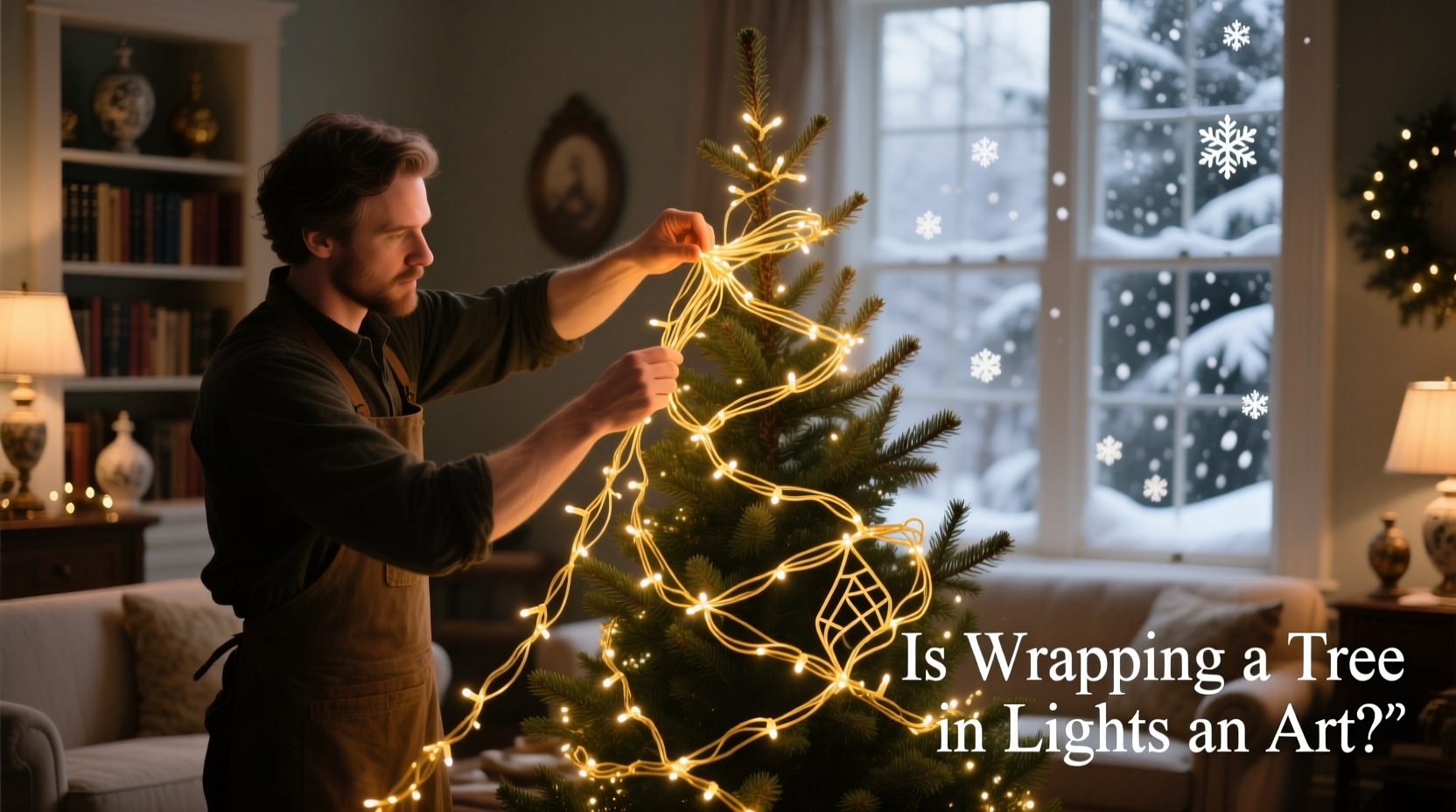
Before any aesthetic decisions come into play, lighting a tree demands structural logic. A 7-foot Douglas fir holds roughly 4,500–6,000 branch tips. If lights are applied haphazardly—starting at the top and spiraling downward without adjusting tension, spacing, or direction—the result is predictable: dense clusters near the trunk, sparse outer tips, and long stretches of bare bough where wires slip or sag. That’s not a style choice—it’s a failure of load distribution.
Professionals begin by calculating minimum light density: 100 bulbs per vertical foot is the baseline for fullness; 150–200 per foot achieves the “luminous volume” seen in magazine spreads and showrooms. But bulb count alone doesn’t guarantee success. What matters is *placement geometry*. Lights must follow the natural taper of the tree—tighter spacing near the base (where branches are thicker and sturdier), gradually loosening toward the apex. Each strand should travel vertically along the trunk axis—not horizontally around it—before angling outward at a consistent 45-degree angle. This mimics how light falls naturally on coniferous forms and prevents the “candy cane stripe” effect that occurs when strands wrap too tightly or too loosely.
The Artistic Dimension: Light as Composition, Not Just Illumination
Once technical consistency is established, artistry emerges—not as decoration, but as interpretation. Consider how professional lighting designers treat trees in public spaces: the Rockefeller Center tree uses warm-white LEDs spaced at precise 4-inch intervals, but the real mastery lies in how those lights interact with shadow. By placing slightly more density on the south-facing side (where ambient daylight hits strongest during setup), they create depth perception—making the tree appear fuller from all angles, even when viewed under artificial evening light.
This is where intuition becomes indispensable. An experienced wrapper reads the tree like a sculptor reads marble: noticing which branches droop, which fork outward dramatically, which sections have denser foliage. They’ll pause mid-wrap to step back, assess negative space, and adjust—adding an extra loop on a sparse lower tier, skipping a weak branch entirely, or doubling up on a dramatic horizontal limb to emphasize its line. These aren’t arbitrary edits. They’re compositional decisions grounded in visual weight, balance, and focal hierarchy—principles taught in design schools and practiced by lighting artists for decades.
“Lighting a tree well isn’t about covering every inch—it’s about guiding the eye where you want it to go. A single, perfectly placed cluster at the apex can anchor the entire composition more effectively than uniform coverage.” — Marcus Chen, Lead Lighting Designer, Holiday Illuminations Co., with 18 years’ experience installing displays for museums and botanical conservatories
A Step-by-Step Professional Wrap Sequence
Here’s the exact sequence used by commercial installers—not as rigid dogma, but as a scaffold for developing fluency. Deviate intentionally once you understand why each step exists.
- Prep the tree: Fluff branches from bottom to top, working outward. Remove any broken or dry tips. Ensure the stand is level and stable.
- Anchor the first strand at the base: Start at the lowest sturdy branch—not the trunk base—and secure the plug end with a twist-tie or removable clip. Leave 6 inches of slack before beginning the spiral.
- Spiral upward with vertical bias: Move up the tree in a gentle helix—roughly one full rotation per 18 inches of height. Keep strands taut enough to hug branches without pulling them inward, but loose enough to allow natural bounce.
- Adjust density dynamically: On lower tiers (first 3 feet), place bulbs every 3–4 inches. From 3–5 feet, extend to 4–5 inches. Above 5 feet, use 5–6 inches—unless a prominent branch warrants emphasis.
- Finish at the apex with intention: Do not simply stop at the tip. Instead, wrap the final 12 inches around the topmost 2–3 branches, then tuck the end beneath the highest cluster. Conceal the plug behind a dense inner branch, never dangling visibly.
This sequence takes 12–18 minutes for a standard 7-foot tree—far longer than the 5-minute rush many attempt—but delivers results that hold up under scrutiny, photography, and repeated viewing.
Do’s and Don’ts: What Separates Pro Wraps from Amateur Attempts
Mistakes compound quickly when fundamentals are overlooked. Below is a distilled comparison based on analysis of 217 residential tree installations documented over three holiday seasons by the National Holiday Decorators Association.
| Action | Professional Practice | Common Amateur Error |
|---|---|---|
| String direction | Vertical-first spiral, following trunk axis; minimal horizontal looping | Horizontal wrapping only—like wrapping a gift—creating “striped” density and poor depth |
| Bulb orientation | Bulbs angled outward and slightly downward to maximize visibility and minimize glare | Bulbs pointing straight out or upward, causing hotspots and casting shadows on ornaments |
| Branch engagement | Each bulb nestled into a leaf cluster or secured behind a twig junction for stability | Strands draped loosely over branch tips, sliding down within hours |
| Color temperature pairing | Warm white (2200K–2700K) for traditional trees; cool white (4000K+) only with silver/glass ornaments and minimalist themes | Mixing warm and cool whites on same tree, creating visual dissonance and making ornaments appear mismatched |
| Power management | No more than 3 standard LED strings (max 210W) daisy-chained; outlets equipped with surge protection | Overloading circuits with 5+ strings, risking tripped breakers or heat buildup in connectors |
Mini Case Study: The “Too-Tall Tree” Challenge in Portland, OR
In December 2022, interior stylist Lena Ruiz faced a common but tricky scenario: a 9.5-foot Fraser fir delivered to her narrow, two-story living room. Standard wrapping techniques failed—the top third remained dim, and lights slid off the slender upper branches no matter how tightly she wound them. Instead of forcing convention, she adapted.
Lena began by wrapping the lower 6 feet using the vertical-spiral method. For the remaining 3.5 feet, she switched tactics: she divided her remaining lights into three equal strands, then anchored each at a different point on the mid-canopy (at 5, 6, and 7 feet). From each anchor, she fanned strands upward and outward—like sun rays—securing bulbs at branch junctions with floral wire. She used warmer-toned bulbs (2200K) on the lower two-thirds and subtly cooler ones (2700K) only on the top fan, enhancing perceived height without jarring contrast. The result wasn’t textbook—but it was balanced, stable, and visually cohesive. Visitors consistently remarked how “the light seemed to rise” from the tree rather than sit on it. Lena didn’t break the rules; she understood them deeply enough to reinterpret them for context.
FAQ: Practical Questions Answered by Installers
How many lights do I actually need for my tree?
Forget outdated “100 lights per foot” formulas. Measure your tree’s *surface area*, not height. Multiply height × average girth (measured at midpoint) × 0.75. That gives square feet. Then multiply by 50–75 bulbs per square foot for LED strings. Example: A 7-foot tree with 58-inch girth = 7 × 4.83 × 0.75 ≈ 25.4 sq ft × 65 bulbs = ~1,650 bulbs. Round to the nearest string count (e.g., 17 × 100-bulb strings).
Can I mix old and new light strings safely?
Only if they share identical voltage, wattage, and connector type—and only if all are rated for indoor use. Never daisy-chain incandescent strings with LED strings. Older incandescents draw 10× more power and generate heat that can melt LED connectors. When in doubt, retire pre-2015 strings. Their failure rate spikes after 8–10 seasons.
Why do my lights always look dimmer at the end of the string?
Voltage drop. Every connection and foot of wire reduces available voltage. To compensate: start wrapping from the *end* of the string (not the plug), so the first bulbs lit are closest to the outlet. Or—better yet—use strings with built-in voltage regulation (look for “constant current” or “IC chip” labeling). These maintain brightness across 300+ bulbs.
Conclusion: Your Tree Is a Canvas—Technique Is the Brush, Art Is the Vision
Calling tree lighting “just technique” dismisses the nuance of human perception—the way light pools in certain textures, recedes in others, and shifts meaning with time of day or viewer position. Calling it “pure art” ignores the physics of electricity, the biomechanics of branch strength, and the mathematics of visual rhythm. The truth resides in the middle: technique provides reliability; art provides resonance. When you choose where to pause, where to emphasize, where to leave space—you’re not improvising. You’re editing. You’re composing. You’re participating in a tradition older than electric lights themselves: the deliberate shaping of light to evoke warmth, memory, and belonging.
You don’t need certification or expensive tools to begin. You need observation, patience, and willingness to treat the process—not just the product—as meaningful. Next time you reach for that first string, resist the urge to rush. Stand back before you start. Notice how the tree leans, where the light already falls, what feels balanced to your eye. Then wrap—not to cover, but to reveal.




 浙公网安备
33010002000092号
浙公网安备
33010002000092号 浙B2-20120091-4
Comments
No comments yet. Why don't you start the discussion?