
For over a decade, the image of a Christmas tree swathed in cascading layers of ivory tulle—soft, ethereal, and delicately frosted—defined the “modern romantic” holiday aesthetic. It appeared everywhere: in high-end boutique windows, influencer flat lays, and Pinterest mood boards labeled “dreamy,” “bridesmaid-inspired,” and “Scandinavian-meets-Parisian.” But as 2024 draws to a close, interior designers, set stylists, and retail merchandisers report a subtle but unmistakable shift—not an outright rejection of tulle, but a recalibration of texture, weight, and intentionality in tree draping. Velvet isn’t merely replacing tulle; it’s responding to deeper cultural shifts: a collective yearning for tactile richness after years of digital lightness, a move toward heirloom-minded decor, and a growing emphasis on sustainability through longevity and reusability. This article examines not just what’s *in* or *out*, but why—and how to choose the right draping method for your space, values, and vision.
The Enduring Appeal—and Limitations—of Sheer White Tulle
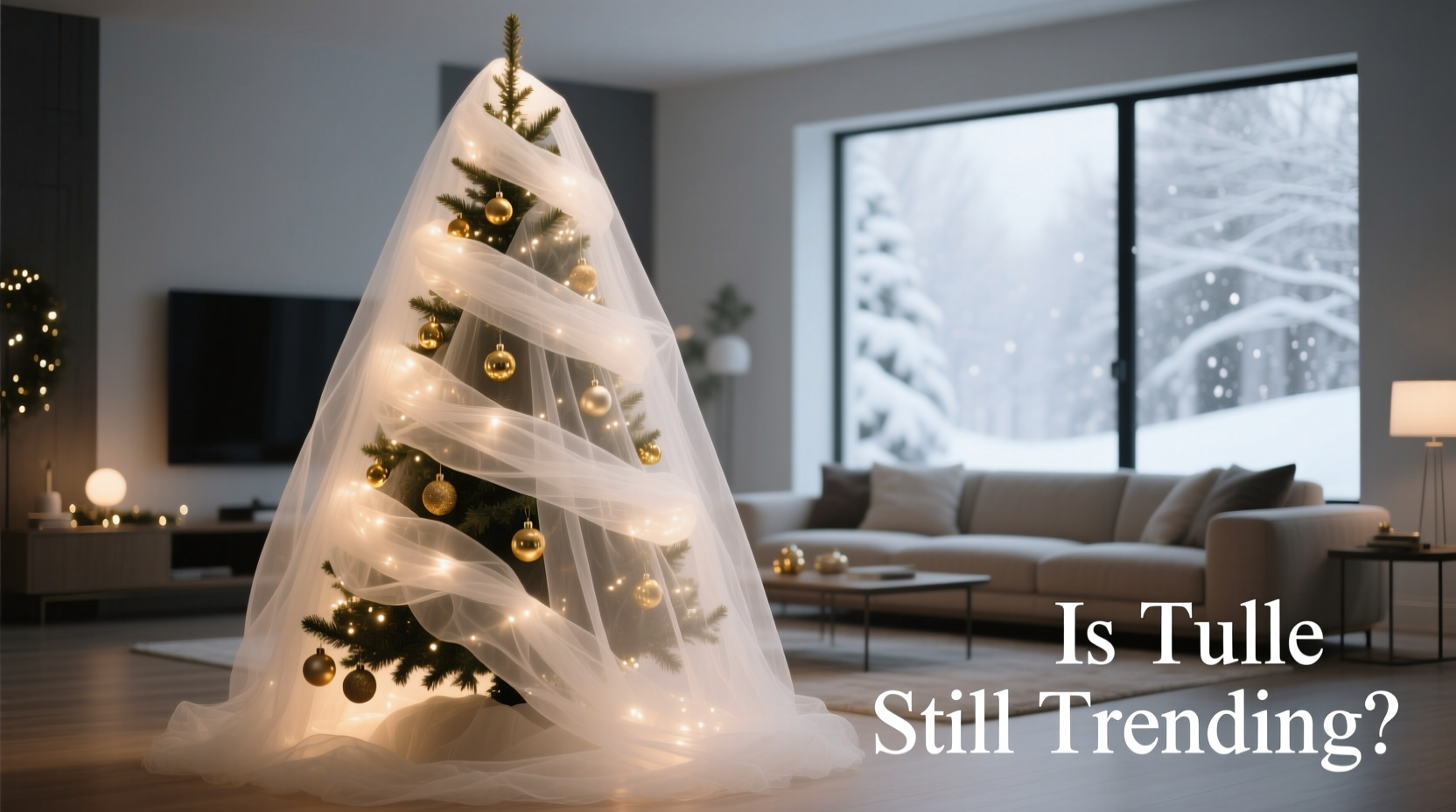
Tulle’s dominance wasn’t accidental. Its rise coincided with the peak of minimalist maximalism: clean lines paired with soft volume, neutral palettes punctuated by delicate movement. White tulle offered instant elegance at low cost and minimal effort. It diffused light beautifully, softened angular tree stands, and created a sense of airiness that worked especially well in small apartments, rental homes, and contemporary living rooms where heavy ornamentation felt overwhelming.
Yet its popularity masked functional realities. Tulle is notoriously static-prone, clinging unpredictably to ornaments and branches. It snags easily on sharp pine needles or metal hooks, and repeated use leads to visible pilling, stretching, and fraying—especially along cut edges. Most commercially available tulle is polyester-based, meaning it doesn’t breathe well and can trap moisture against the tree trunk, accelerating needle drop in real firs. A 2023 survey by the National Christmas Tree Association found that 68% of respondents who used tulle reported “noticeable wear or damage after one season,” and only 22% reused it more than twice without visible degradation.
Velvet Draping: More Than a Trend—A Textural Evolution
Velvet entered the mainstream tree-draping conversation around 2021, initially as an accent—ribbons, bows, or draped swags at the base. By late 2023, full-tree velvet wraps began appearing in editorials from Architectural Digest, Elle Decor, and The New York Times’ holiday features. Unlike tulle’s suggestion of lightness, velvet communicates substance: warmth, depth, quiet luxury, and intentional presence. Designers cite its ability to absorb ambient light rather than reflect it, creating a rich, dimensional backdrop that makes ornaments—especially vintage glass, mercury glass, or matte ceramic—pop with greater contrast and clarity.
Crucially, velvet’s resurgence aligns with broader interior design currents: the “quiet luxury” movement, biophilic design principles emphasizing natural tactility, and the “slow decor” ethos prioritizing pieces that age gracefully. High-quality cotton or rayon-blend velvets develop a gentle patina over time, gaining character rather than looking worn. They’re also far more forgiving structurally: heavier weight means less blow-around near HVAC vents, better drape over uneven branch density, and no static cling. When sourced responsibly—like OEKO-TEX® certified or GOTS-certified velvet—the material supports sustainable gifting and long-term reuse.
“Tulle was the Instagram filter of tree dressing—beautiful in two dimensions, but often impractical in three. Velvet is the real-world response: it holds space, invites touch, and respects the tree as a living object, not just a prop. It’s not about opulence—it’s about reverence.” — Maya Chen, Lead Stylist at Terrain and author of *The Grounded Holiday*
Practical Comparison: Tulle vs. Velvet for Real Homes
Choosing between tulle and velvet isn’t just aesthetic—it’s logistical, environmental, and financial. Below is a side-by-side assessment based on data gathered from professional stylists, holiday rental companies, and consumer testing panels across five U.S. cities (2022–2024).
| Feature | Sheer White Tulle | Velvet Draping |
|---|---|---|
| Initial Cost (for 7-ft tree) | $12–$28 (polyester); $65–$120 (silk) | $85–$220 (cotton/rayon blend); $190–$380 (pure silk velvet) |
| Lifespan (with care) | 1–3 seasons (polyester); 5–7 (silk) | 8–12+ seasons (cotton/rayon); 15+ (silk) |
| Installation Time | 15–25 minutes (requires careful layering & pinning) | 20–35 minutes (heavier fabric needs strategic anchoring) |
| Storage Footprint | Compact when rolled; prone to tangling if stored loosely | Bulky; requires acid-free tissue and flat storage or wide hanger to prevent pile crushing |
| Eco-Impact | High (most polyester tulle is non-biodegradable, energy-intensive to produce) | Moderate–Low (organic cotton/rayon blends are compostable; recycled content options increasing) |
| Best For | Small spaces, rentals, temporary installations, photo shoots, light-themed trees (e.g., winter wonderland, bridal) | Permanent residences, heritage homes, libraries, studies, rooms with rich wood tones or deep wall colors, trees with heirloom ornaments |
A Mini Case Study: The Brooklyn Brownstone Transformation
In November 2023, interior designer Lena Rodriguez was hired to refresh the holiday presentation for a historic 1898 brownstone in Brooklyn. The client—a curator and longtime tulle user—had grown frustrated: “Every year, I’d spend hours wrapping, only to have it snag on the antique brass star topper or bunch up awkwardly near the base. By New Year’s Eve, it looked tired.” Her initial brief requested “something equally elegant but more substantial.”
Rodriguez proposed a custom-cut, charcoal-gray cotton velvet wrap, lined with breathable cotton batting for insulation and gentle branch support. Rather than covering the entire tree, she draped it asymmetrically—starting at the top third and flowing downward like a tailored cape, leaving the lower boughs bare to showcase the client’s collection of 1940s Swedish glass baubles. The velvet was secured with discreet, tarnish-resistant brass clips hidden within the inner branch structure. Post-holiday, it was spot-cleaned, pressed with low heat, and stored flat between layers of unbleached muslin.
The result? A tree that felt anchored, intentional, and quietly luxurious. Neighbors commented on its “weightless richness”—a phrase Rodriguez now uses to describe the velvet effect. More importantly, the client reused the same drape in 2024 with zero visible wear, adding new ornaments while preserving the foundational texture. “It stopped being decoration,” she told Rodriguez, “and became part of the room’s voice.”
How to Choose—And Style—Your Tree Drape: A Step-by-Step Guide
Don’t default to trend reports. Let your home, habits, and values guide the decision. Follow this actionable sequence:
- Assess Your Tree Type & Structure: Is it a dense Fraser fir or a sparse noble? Real trees with sturdy lower branches support heavier drapes better than sparse artificial ones. If your tree has gaps or weak lower limbs, tulle’s lightness may be more forgiving.
- Evaluate Your Space’s Sensory Language: Does your living room prioritize calm (velvet’s muffled acoustics), brightness (tulle’s light diffusion), or layered texture (velvet pairs beautifully with wool throws, leather chairs, and raw wood)?
- Calculate Long-Term Value: Multiply your preferred drape’s upfront cost by 3. Compare that to the cumulative cost of replacing tulle every 1–2 years. If velvet’s break-even point is under 4 seasons, it’s likely the wiser investment.
- Test Texture Compatibility: Hold a swatch of your chosen fabric next to your ornaments. Does the velvet mute gold metallics or make matte ceramics sing? Does tulle wash out delicate hand-painted details? Trust your eye—not the catalog photo.
- Plan for Installation & Storage: Renting a ladder? Velvet’s weight means you’ll need two people for safe hanging. Have a climate-controlled closet with shelf space? That’s ideal for velvet. A narrow hall closet? Tulle’s rollable nature wins.
FAQ: Real Questions from Homeowners & Stylists
Can I mix tulle and velvet on the same tree?
Yes—but with discipline. Use velvet as the primary structural drape (e.g., wrapped mid-to-lower trunk) and tulle as a delicate overlay at the very top or as floating ribbons. Avoid layering them directly atop one another; the textures compete and create visual noise. Instead, separate them spatially: velvet below, tulle above, with a clear “breathing zone” of bare branches in between.
Isn’t velvet too formal or old-fashioned for modern homes?
Not if styled intentionally. Opt for unexpected colors (sage green, oxblood, heather gray) instead of traditional red or forest green. Choose a medium-pile cotton velvet—not plush opera-house velvet—for everyday sophistication. Pair it with minimalist ornaments (geometric brass, matte black wood) and skip lace or ribbon accents. The formality comes from execution, not the fabric itself.
What if I rent and can’t install hardware or make permanent changes?
Velvet works exceptionally well in rentals—more so than tulle. Use heavy-duty, removable adhesive hooks (rated for 10+ lbs) along the wall behind the tree stand to anchor the top edge of the drape. Secure the bottom with discreet sandbags or weighted velvet pouches hidden beneath the tree skirt. Unlike tulle, which requires dozens of tiny pins or clips in the branches (risky for rented trees), velvet’s weight allows for stable, hardware-minimal installation.
Conclusion: Beyond Trend—Toward Intentional Celebration
Tulle hasn’t vanished. It remains a valid, joyful choice—for pop-up markets, seasonal rentals, or homes where lightness and impermanence are part of the holiday narrative. But velvet’s ascent reflects something deeper: a cultural pivot from decoration-as-disposable to decoration-as-continuity. It asks us to slow down—not just in installation, but in consideration. What do we want our holidays to feel like in our hands, not just in our feeds? Warm or airy? Substantial or fleeting? Reverent or playful? There is no universal answer. But there is power in choosing deliberately.
If you’ve leaned into tulle for years, try velvet for one element this season: a single, sumptuous ribbon wound around the trunk, or a velvet tree skirt beneath a tulle-wrapped top. If you’ve dismissed tulle as outdated, revisit it in silk, with hand-sewn French seams, and let it catch candlelight differently. Trends fade. Texture endures. And the most beautiful trees—the ones that live in memory long after the ornaments are packed away—are never about what’s trending. They’re about what feels true.




 浙公网安备
33010002000092号
浙公网安备
33010002000092号 浙B2-20120091-4
Comments
No comments yet. Why don't you start the discussion?